Facts
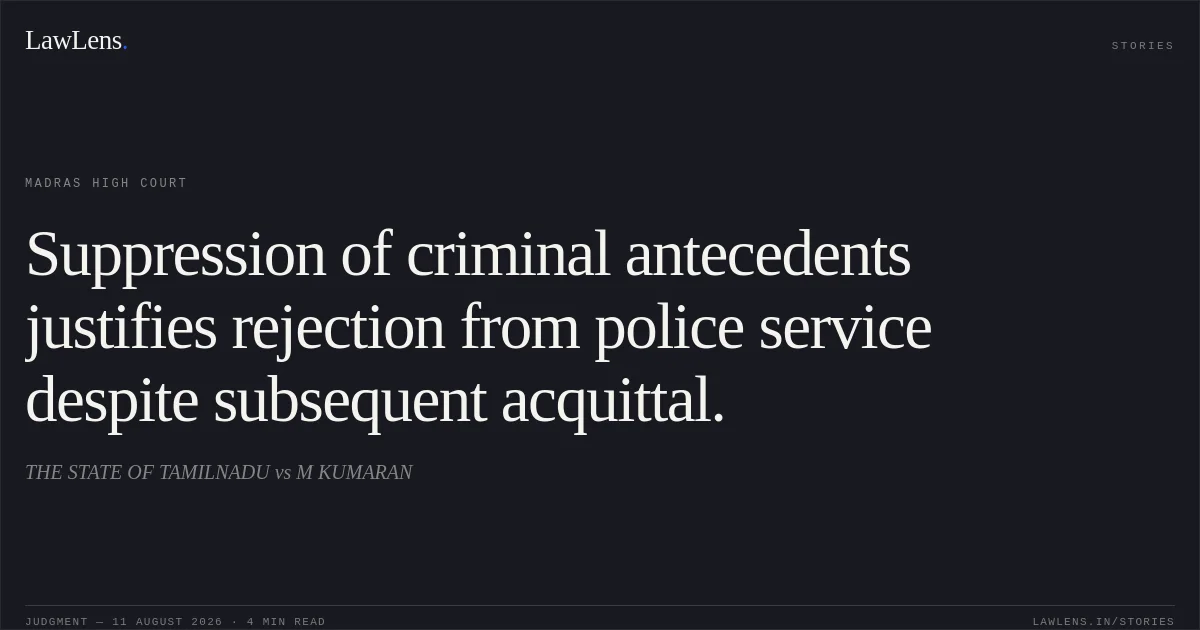
M. Kumaran applied pursuant to the 2019 recruitment notification for Grade-II Police Constable in the Tamil Nadu Police Service.
Source reference: p.2Although he cleared the written, physical eligibility and endurance tests, he answered “No” to the application-form question concerning involvement in any criminal case.
Source reference: p.2During certificate verification, the authorities discovered that he had been arrayed as Accused No.2 in Crime No.232 of 2015, subsequently referred to in the rejection proceedings as Crime No.293 of 2018, involving offences under Sections 294(b), 323, 324/326 and 506(ii) IPC.
Source reference: pp.2–4He had been acquitted by the trial court on 13 December 2018, before submitting his recruitment application.
Source reference: pp.2–4The Superintendent of Police rejected his candidature on 23 March 2020 on the grounds of suppression and unsatisfactory character and antecedents.
Source reference: pp.2–4In an earlier writ petition, the High Court directed reconsideration of his case in light of a prior decision and on its own merits.
Source reference: p.3, para.4Upon reconsideration, the Superintendent of Police again rejected the candidature on 30 August 2022, relying on Rule 14(2)(b)(iv) and Explanations (1) and (2) of the Special Rules for the Tamil Nadu Police Subordinate Services, the nature of the acquittal, and the candidate’s failure to disclose the criminal case.
Source reference: pp.3–4, pp.6–7The learned Single Judge thereafter allowed W.P.No.27526 of 2022 and directed appointment.
Source reference: p.4, paras.5–7The State and the Superintendent of Police challenged that order in the present writ appeal.
Source reference: p.4, paras.5–7Issues
Whether suppression of the candidate’s prior involvement in a criminal case, notwithstanding his subsequent acquittal, justified rejection of his candidature for appointment as a Grade-II Police Constable.
Source reference: pp.5–7, paras.9–11, 14–15Whether the High Court, in exercise of judicial review, could reassess the criminal case and substitute its view for that of the competent selection or appointing authority on the candidate’s suitability and character antecedents.
Source reference: pp.5, 8–10, paras.9, 12–15Whether the direction to appoint the candidate, issued by the learned Single Judge in respect of the 2019 recruitment, exceeded the permissible limits of judicial review.
Source reference: p.11, para.15Law Applied
The Court applied Rule 14(2)(b)(iv) and Explanations (1) and (2) of the Special Rules for the Tamil Nadu Police Subordinate Services, under which a direct recruit must satisfy the appointing authority that his character and antecedents qualify him for service and that he has not been involved in a criminal case before police verification.
Source reference: p.11, para.14The Court reiterated that suppression of material information in a recruitment application is independently sufficient to justify rejection, particularly for uniformed services; that assessment of suitability and eligibility lies primarily with the selection or appointing authority; and that judicial review is limited to illegality, mala fides, arbitrariness, unreasonableness or mindlessness.
Source reference: p.5, para.9Relying on Jainendra Singh v. State of Uttar Pradesh, 2012 (8) SCC 748, the Court held that suppression of criminal antecedents bears directly on character and that the heightened standards applicable to uniformed services permit serious consideration of deliberate omissions.
Source reference: pp.7–8, para.12(a)It further relied on Commissioner of Police v. Rajkumar, 2021 INSC 423, and Rajasthan High Court, Jodhpur v. Akashdeep Morya, 2021 INSC 485, for the principle that courts must not second-guess executive assessments of suitability in judicial review.
Source reference: p.8, para.12(b)–(c)State of Madhya Pradesh v. Rajkumar Yadav, 2026 INSC 225, was applied for the proposition that criminal antecedents, the nature of the alleged offence and the nature of the acquittal are relevant considerations, and that screening committees possess a wide, though non-arbitrary, discretion, especially in police recruitment.
Source reference: pp.9–10, para.12(d)Reasoning
The Court found it undisputed that Kumaran neither disclosed his involvement in the criminal case nor produced the acquittal judgment before the selection authorities.
Source reference: p.5, para.10The authorities had not rejected him solely because a criminal case had once been registered; they had considered the alleged offences, his status as A2, the circumstances in which the prosecution witnesses turned hostile, the acquittal on benefit of doubt, and the resulting assessment that his character and antecedents were unsatisfactory.
Source reference: pp.6–7, para.11Under Rule 14, the appointing authority was entitled to form a subjective satisfaction regarding suitability for police service.
Source reference: pp.10–11, paras.13–15The fact that the acquittal preceded the application did not eliminate the obligation to disclose the criminal involvement where the application specifically sought that information.
Source reference: pp.10–11, paras.13–15Since the selection authority’s decision was reasoned and was not shown to be mala fide, arbitrary or illegal, the learned Single Judge erred by examining the merits of the criminal case and effectively substituting the Court’s assessment for that of the competent authority.
Source reference: pp.10–11, paras.13–15The direction to appoint the candidate from the 2019 recruitment, issued several years after the recruitment process, was therefore beyond the proper scope of judicial review.
Source reference: p.11, para.15Holding
The Division Bench answered the issues in favour of the State.
It held that Kumaran’s non-disclosure of his prior criminal involvement, coupled with the authority’s assessment of his character and antecedents, validly rendered him unsuitable for appointment as a Grade-II Police Constable, notwithstanding his acquittal.
Source reference: pp.10–11, paras.14–16The writ appeal was allowed; the learned Single Judge’s order dated 31 July 2023 in W.P.No.27526 of 2022 was set aside; no costs were awarded; and the connected miscellaneous petition was closed.
Source reference: p.12, para.16Acts & Sections Cited
5 provisions across 1 statute referred to in this judgment. Each provision opens on LawLens.
Indian Penal Code, 18605
Original Court PDF
THE STATE OF TAMILNADUvsM KUMARAN
Click to open original judgment
Original judgment, available to read, download and summarize on LawLens.in