Facts
The State appealed against a judgment dated 22.08.2017 by the JMFC, Amarpatan, which acquitted the respondents of charges under Sections 294, 323, 324, 325, 506 Part-II, and 34 of the IPC.
Source reference: para. 1The prosecution alleged that on 01.08.2013, the respondents assaulted the complainant, Shridhar Yadav (PW-1), and his family with a trident and sticks over a land cultivation dispute.
Source reference: para. 2The trial court acquitted the accused, primarily finding that the prosecution failed to explain injuries sustained by the accused and suppressed the genesis of the incident, suggesting the accused may have acted in private defense of property.
Source reference: para. 6, 9Issues
1. Whether the trial court erred in granting the benefit of doubt to the accused despite the testimony of injured eye-witnesses.
Source reference: para. 62. Whether the non-explanation of injuries sustained by the accused and the suppression of a cross-case by the prosecution are fatal to the case.
Source reference: para. 103. Whether the appellate court should interfere with an order of acquittal when a plausible view has been taken by the trial court.
Source reference: para. 13, 14Law Applied
The court primarily applied the principle from Laxmi Singh v. State of Bihar (1976), holding that non-explanation of serious injuries on the accused suggests the prosecution has suppressed the genesis of the occurrence, rendering the case doubtful.
Source reference: para. 10Regarding the scope of appellate review of acquittals under Section 378 of the CrPC, the court relied on H.D. Sundara v. State of Karnataka (2023), Babu Sahebagouda Rudragoudar v. State of Karnataka (2024), and Mallappa v. State of Karnataka (2024), which establish that an appellate court should not overturn an acquittal if the trial court’s view is a "legally plausible view," even if a contrary view is possible.
Source reference: para. 14, 15, 18Reasoning
The Court observed that while PW-1, PW-2, and PW-3 supported the prosecution, they were related witnesses whose testimonies contained material contradictions and omissions.
Source reference: para. 8, 12Crucially, PW-1 admitted the accused had been cultivating the disputed land for 14 years and that the conflict arose when the complainant party attempted to stop them.
Source reference: para. 9, 11The prosecution failed to examine independent neighbors as witnesses or produce documentation proving possession.
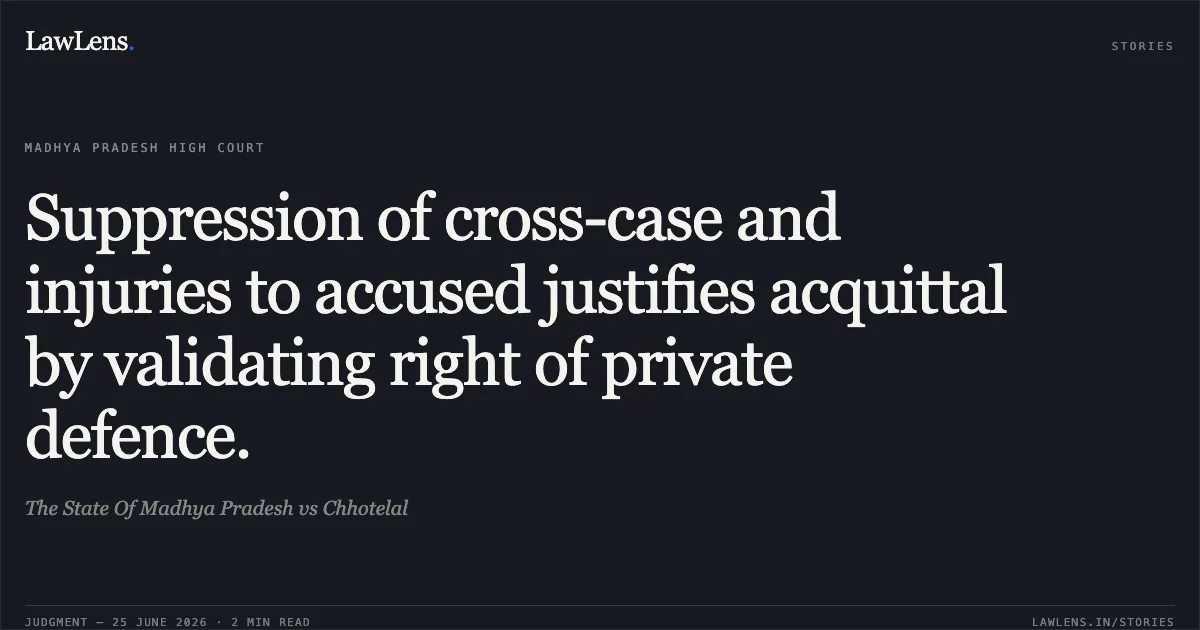
Source reference: para. 8, 9Furthermore, the prosecution suppressed evidence of a pending cross-case and injuries sustained by the accused (Ramavatar), which PW-1 implausibly claimed were self-inflicted.
Source reference: para. 9, 11Applying Laxmi Singh, the court reasoned that this suppression indicated the prosecution did not present a true version of the incident.
Source reference: para. 10Since the injuries to the victims could also have resulted from falling, the trial court's decision to favor the accused's right of private defense was deemed a possible and reasonable view.
Source reference: para. 12, 13Holding
The Court concluded that the prosecution failed to prove the guilt of the accused beyond a reasonable doubt and that the appellate court cannot substitute its own view for a plausible view taken by the trial court in an acquittal matter.
The High Court dismissed the appeal and affirmed the acquittal.
Source reference: para. 20It held that the trial court's findings were not perverse, illegal, or unreasonable.
Source reference: para. 13Acts & Sections Cited
8 provisions across 2 statutes referred to in this judgment. Each provision opens on LawLens.
Code of Criminal Procedure, 19732
Indian Penal Code, 18606
Original Court PDF
The State Of Madhya PradeshvsChhotelal
Click to open original judgment
Original judgment, available to read, download and summarize on LawLens.in