01Facts
The petitioner instituted Title Suit No. 189 of 2007 seeking declaration of title and permanent injunction against Sashi Bhusan Panda, whose counterclaim was dismissed and the suit was decreed in the petitioner’s favour on 24 June 2011.
¶ 3–5Sashi Bhusan Panda’s appeal, later numbered Title Appeal No. 4 of 2012, was dismissed for non-prosecution on 5 January 2013.
¶ 6–7His application under Order XLI Rule 19 of the Code of Civil Procedure, registered as J. Misc. Case No. 1 of 2013, was also dismissed for default on 27 January 2015.
¶ 8After Sashi Bhusan Panda’s death, his legal heirs filed an application under Order IX Rule 9 read with Section 151 CPC, along with an application under Section 5 of the Limitation Act, seeking restoration of J. Misc. Case No. 1 of 2013.
¶ 9, 17The application was filed on 13 October 2020, nearly five years after its dismissal.
¶ 9, 17By Order No. 91 dated 17 November 2025, the Court below condoned the delay and restored the proceeding, holding that sufficient and bona fide cause had been shown.
¶ 10The petitioner challenged that order under Article 227 of the Constitution of India.
02Issues
i.Whether the opposite parties had explained and proved sufficient cause for the delay in filing the application for restoration under Order IX Rule 9 CPC.
¶ 18, Issue 1ii.Whether the opposite parties had suppressed material facts regarding their knowledge of the proceedings and the dismissal of J. Misc. Case No. 1 of 2013 so as to obtain condonation of delay.
¶ 18, Issue 203Law Applied
The Court applied Section 5 of the Limitation Act, 1963, under which delay may be condoned only upon the applicant establishing “sufficient cause”; Order IX Rule 9 and Section 151 CPC concerning restoration of proceedings dismissed for default; and Article 227 of the Constitution governing the High Court’s supervisory jurisdiction.
Relying on H. Guruswamy v. A. Krishnaiah, Civil Appeal No. 317 of 2025, 2025 INSC 53, the Court held that a liberal or justice-oriented approach cannot override the limitation law and that the applicant’s bona fides must first be assessed.
¶ 22Applying Basawaraj v. Special Land Acquisition Officer, (2013) 14 SCC 81, the Court reiterated that “sufficient cause” cannot reward negligence, inaction or lack of bona fides, and that condonation of inordinate delay must be supported by cogent reasons.
¶ 23The Court also considered Ghanshyam Das Gupta v. Makhan Lal, (2012) 8 SCC 745, cited by the opposite party, but found it inapplicable to the issue of unexplained delay and suppression of material facts.
¶ 15Provisions in the judgment · 3 · Linked ones open on LawLens
Code of Civil Procedure, 1908 Section 151
Limitation Act, 1963 Section 5
Code of Criminal Procedure, 1973 Section 144
04Reasoning
The Court found that the restoration application did not disclose the precise period of delay or provide a satisfactory explanation for the nearly five-year lapse.
¶ 17, 19Although the opposite parties claimed that they first learnt of the dismissal on 11 October 2020, the record showed that they had participated in proceedings under Section 144 CrPC initiated in 2015 and had also been parties in proceedings before the High Court in W.P. No. 30941 (W) of 2017, where the underlying litigation and related proceedings were disclosed.
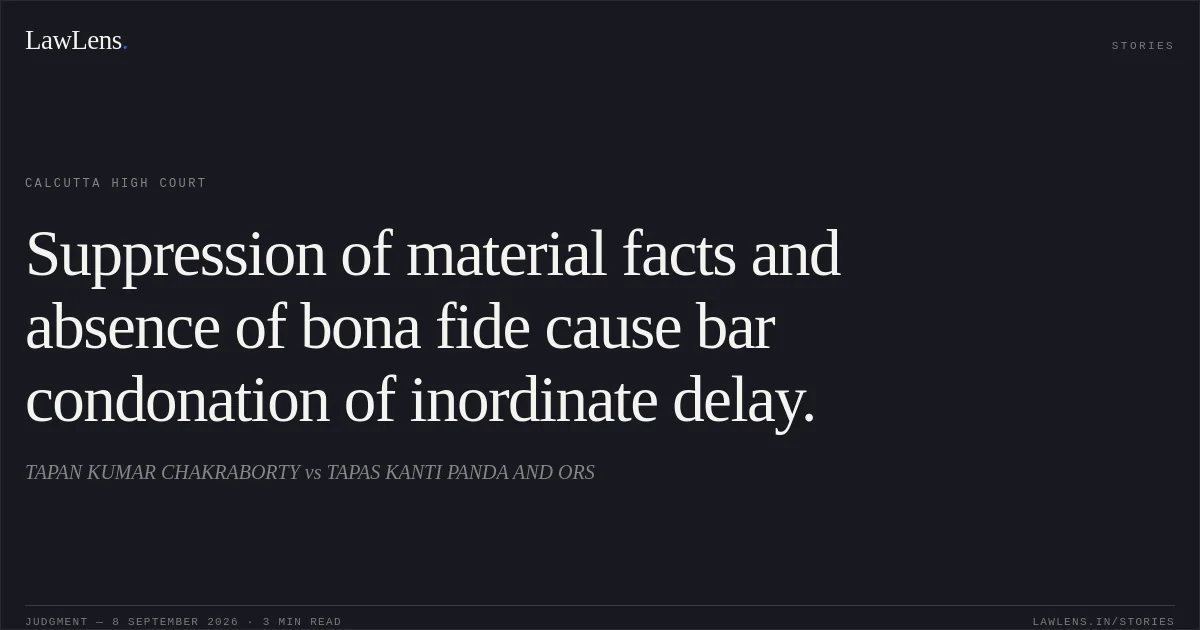
¶ 19–20The Court therefore concluded that the opposite parties had knowledge of the dismissal substantially earlier than asserted and had suppressed material facts.
The Court below failed to examine these circumstances, failed to give adequate reasons for condoning the inordinate delay, and mechanically relied on the preference for adjudication on merits.
¶ 22–25In the absence of a bona fide and sufficiently explained cause, the discretionary relief under Section 5 of the Limitation Act was not available.
05Holding
The Court answered both issues against the opposite parties.
¶ 24–26It held that no sufficient cause had been established for condoning the delay and that the opposite parties had suppressed material facts concerning their prior knowledge of the dismissal.
¶ 24–26Accordingly, C.O. No. 167 of 2026 was allowed without costs; the order dated 17 November 2025 condoning the delay and restoring J. Misc. Case No. 1 of 2013 was set aside, and the connected applications were disposed of.
¶ 26–29Original Court PDF
TAPAN KUMAR CHAKRABORTYvsTAPAS KANTI PANDA AND ORS
Click to open original judgment
Original judgment, available to read, download and summarize on LawLens.in