Facts
The six applicants were appointed as casual workers (Beldar, Driver, and Wiremen) between 1988 and 1989
Source reference: para. 2.1They were granted temporary status in 1994, which the respondents withdrew in January 1995 upon realizing the grant was erroneous and violated government policy
Source reference: para. 2.1Over the following decade, the applicants filed multiple original applications (OA 401/2001 and OA 267/2004) and a writ petition (WP(C) 20155/2004) seeking regularization
Source reference: para. 2.2, 2.3Consequently, they were regularized in Group 'D' posts effective from 2006/2011
Source reference: para. 2.3, 5.4In 2016, the applicants filed the present OA seeking parity with alleged juniors who were granted temporary status retrospectively from 1993 via a 2014 order, which would entitle the applicants to the Old Pension Scheme
Source reference: para. 2.4, 4.1The respondents contested the OA on grounds of inordinate delay, suppression of material facts, and lack of eligibility
Source reference: para. 5.1Issues
1. Whether the OA is barred by the doctrine of limitation and laches due to the delayed challenge of orders from 1995 and 2011?
Source reference: para. 5.4, 5.52. Whether the applicants are disqualified from relief for failing to approach the Tribunal with "clean hands" by concealing previous litigation and material facts?
Source reference: para. 7.1, 7.23. Whether the applicants are entitled to the grant of temporary status effective from 1993 and subsequent benefits under the Old Pension Scheme at par with their juniors?
Source reference: para. 4.1, 8.1Law Applied
The Tribunal applied the statutory limitation period prescribed under the Administrative Tribunals Act, 1985.
Source reference: no citationIt relied on the landmark judgment in Secretary, State of Karnataka v. Uma Devi (2006) 4 SCC 1 regarding the regularization of casual workers
Source reference: para. 2.3For the doctrine of "clean hands," the Tribunal cited S.P. Chengalvaraya Naidu v. Jagannath (1994) 1 SCC 1 and Dalip Singh v. State of U.P. (2010) 2 SCC 114, which establish that litigants who suppress material facts or misrepresent the truth are not entitled to legal or equitable relief
Source reference: para. 7.4, 7.5Furthermore, it applied Union of India v. Mohan Pal (2002) 4 SCC 573, which clarified that the grant of temporary status was a one-time scheme and not an ongoing entitlement
Source reference: para. 6.2Reasoning
The Tribunal found that the applicants failed to challenge the 1995 order withdrawing their temporary status or the 2011 regularization orders at the appropriate time; therefore, seeking these benefits in 2016 without a condonation of delay application rendered the OA "hopelessly time-barred"
Source reference: para. 5.5, 8.1Regarding the conduct of the applicants, the Tribunal noted "significant concealment of facts," including the 1995 withdrawal order, previous OAs, and specific undertakings given by the applicants to accept Group ‘D’ regularization
Source reference: para. 5.8, 7.1Applying the "clean hands" doctrine, the Tribunal held that such deliberate suppression of material facts polluted the stream of justice, disqualifying the applicants from relief
Source reference: para. 7.3, 7.6On the merits, the Tribunal observed that the applicants failed to provide documentary evidence (such as seniority lists or recruitment records) to prove they were similarly situated to the beneficiaries of the 2014 order they sought to emulate
Source reference: para. 7.7Holding
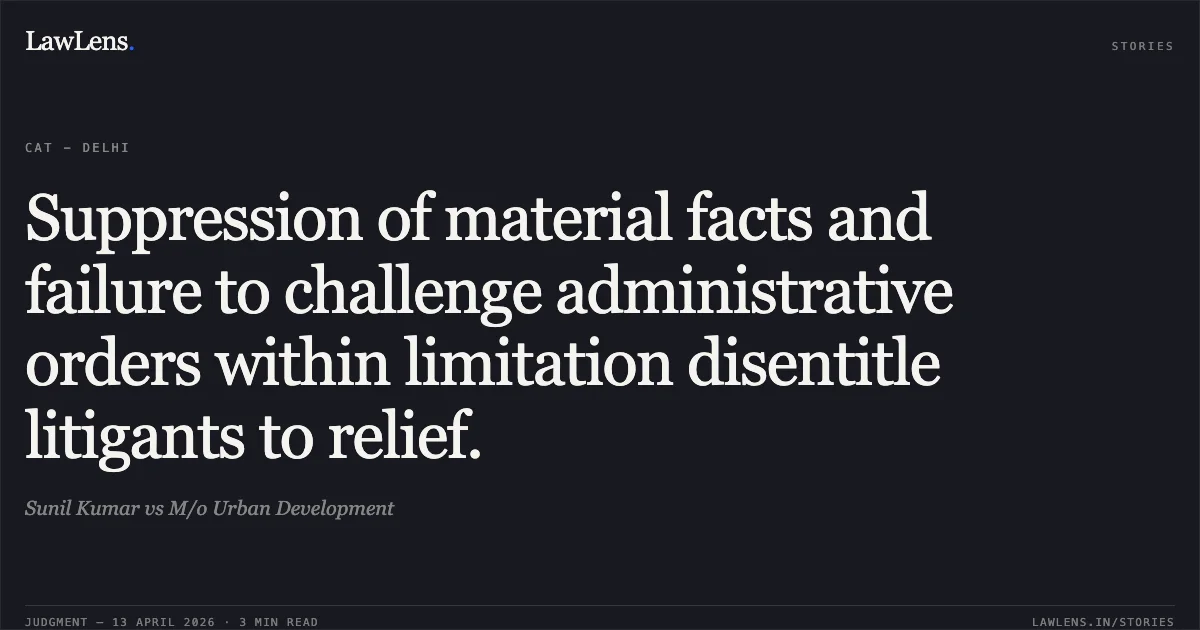
The Tribunal dismissed the OA, holding that the claims were both devoid of merit and barred by limitation
The Tribunal specifically ruled that the applicants’ failure to approach the court with clean hands and their failure to challenge the relevant orders of 1995 and 2011 in a timely manner precluded them from seeking retrospective temporary status or parity with juniors
Source reference: para. 8.1No order as to costs was made
Source reference: para. 9Acts & Sections Cited
1 provisions across 1 statute referred to in this judgment. Each provision opens on LawLens.
Administrative Tribunals Act, 19851
Original Court PDF
Sunil KumarvsM/o Urban Development
Click to open original judgment
Original judgment, available to read, download and summarize on LawLens.in