Facts
The petitioner claimed settled and continuous possession over land bearing Khasra No. 259/2, Village Malikpur Kohi @ Rangpuri, New Delhi. He challenged a preliminary notice dated 14 May 2026 issued by the National Highway Authority of India alleging unauthorised occupation and sought disclosure of the acquisition notifications, award, possession and demarcation records, along with protection against dispossession or demolition.
Source reference: paras. 1–5; pp. 1–3The respondents contended that the land had been acquired under the National Highways Act, 1956, pursuant to a Section 3A notification dated 12 January 2018 and Award No. 02/2018/NHAI dated 18 December 2018. They further stated that physical possession had been taken on 1 October 2020 and that the 2026 notice was issued after unauthorised occupation was detected on acquired highway land.
Source reference: paras. 6–8; p. 3The respondents also relied on an earlier writ petition, W.P.(C) 7003/2026, filed by the petitioner concerning other khasra numbers from the same village. In that proceeding, the petitioner had himself placed the 12 January 2018 acquisition notification and the 18 December 2018 award on record. The schedule to that notification also included Khasra No. 259/2, the subject property in the present petition.
Source reference: paras. 9–11; pp. 3–6The petitioner had not disclosed the earlier proceedings or his knowledge of the acquisition in the present writ petition.
Source reference: paras. 12–14; pp. 6–7Issues
Whether the petitioner was entitled to relief under Article 226 of the Constitution against the notice dated 14 May 2026 and the alleged threat of dispossession, without disclosing the earlier writ proceedings and the acquisition documents already within his knowledge?
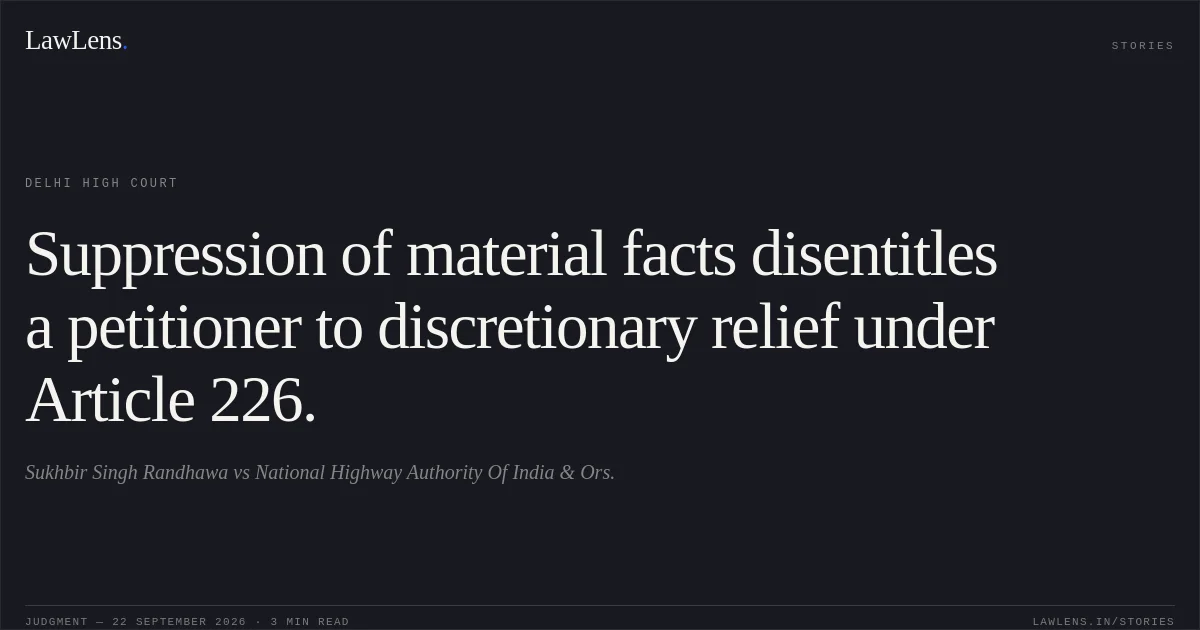
Source reference: paras. 9–14; pp. 3–7Whether suppression of material facts concerning the acquisition proceedings disentitled the petitioner from invoking the discretionary and extraordinary jurisdiction of the High Court?
Source reference: paras. 12–14; pp. 6–7Law Applied
The Court applied the principle that jurisdiction under Article 226 of the Constitution is discretionary and extraordinary, and that a litigant seeking such relief must approach the Court with complete candour and clean hands.
Source reference: para. 13; p. 6Suppression or concealment of material facts having a direct bearing on the dispute may justify dismissal of the writ petition without examination of its merits. The Court relied on Prestige Lights Ltd. v. State Bank of India, (2007) 8 SCC 449, which recognises that a party suppressing material facts or presenting twisted facts may be denied relief in writ jurisdiction.
Source reference: para. 13; p. 6The Court also noted the statutory acquisition framework under the National Highways Act, 1956, particularly the acquisition notification under Section 3A and the consequential award and taking of possession relied upon by the respondents.
Source reference: paras. 6–8; p. 3Reasoning
The Court found that the petitioner’s assertion that he lacked particulars or knowledge of the acquisition was inconsistent with the record of W.P.(C) 7003/2026. In that earlier proceeding, he had relied on the same acquisition notification dated 12 January 2018 and award dated 18 December 2018; moreover, the notification’s schedule expressly included Khasra No. 259/2.
Source reference: paras. 9–11; pp. 3–6Therefore, the petitioner was aware, or was necessarily expected to be aware, of the acquisition affecting the subject property. His failure to disclose the earlier writ petition and the relevant acquisition documents constituted concealment of material facts directly relevant to the relief sought in the present case.
Source reference: para. 12; p. 6Applying the clean-hands doctrine and the rule in Prestige Lights, the Court held that the petitioner could not invoke the discretionary jurisdiction of Article 226. The Court consequently declined to examine the substantive challenges to the notice, acquisition, possession or alleged procedural deficiencies.
Source reference: paras. 13–14; pp. 6–7Holding
The Court held that the petitioner had concealed material facts concerning the prior writ proceedings and the acquisition of the subject land and, therefore, was not entitled to relief under Article 226.
The writ petition was dismissed, and all pending applications were also disposed of.
Source reference: paras. 15–16; p. 7Acts & Sections Cited
1 provisions across 1 statute referred to in this judgment. Each provision opens on LawLens.
Right to Fair Compensation and Transparency in Land Acquisition, Rehabilitation and Resettlement Act, 20131
Original Court PDF
Sukhbir Singh RandhawavsNational Highway Authority Of India & Ors.
Click to open original judgment
Original judgment, available to read, download and summarize on LawLens.in