Facts
The Supreme Court took suo motu cognizance of observations made by the Allahabad High Court in its judgment dated 17.03.2025 in Criminal Revision No. 1449/2024, following a communication from “We the Women of India” dated 20.03.2025.
Source reference: para. 1In earlier proceedings, the Supreme Court found the High Court’s decision to be inconsistent with settled criminal-law principles, set it aside, and remitted the matter to the Special Judge (POCSO), Kasganj.
Source reference: para. 2The Court also identified a broader need for greater sensitivity, compassion, empathy, and a victim-centric approach in judicial proceedings involving sexual offences and vulnerable persons.
Source reference: paras. 3–4It constituted an expert committee chaired by Justice Aniruddha Bose to prepare guidelines on sensitivity and compassion in judicial decisions and processes.
Source reference: paras. 5–6The Committee submitted a publication addressing gender-sensitive and non-stereotypical language, victim-blaming, secondary trauma, respectful terminology concerning transgender and SOGIESC persons, and compassionate court procedures.
Source reference: paras. 12–15Issues
Whether the expert Committee’s publication on sensitivity, compassion, inclusive language, and judicial processes in sexual-offence and other vulnerable-person cases should be accepted and approved as a guiding resource for the judiciary.
Source reference: paras. 5, 12–18Whether directions should be issued for the dissemination, publication, training, and institutional implementation of the publication by courts, tribunals, police authorities, prosecution agencies, judicial academies, and governmental bodies.
Source reference: paras. 20–24Whether the observations made by the Patna High Court in Criminal Appeal (SJ) No. 775/2013 warranted registration of a fresh suo motu proceeding.
Source reference: para. 25Law Applied
The Court applied the constitutional and institutional principles that judicial administration must protect the dignity, equality, and rights of victims and vulnerable persons, particularly in cases involving sexual offences.
Source reference: paras. 3–4It held that judicial decisions and court procedures should be informed by sensitivity, compassion, empathy, and a victim-centric approach, while preserving fairness, impartiality, and adjudicatory integrity.
Source reference: paras. 4, 15The Court further endorsed the principle that judicial language should be clear, accessible, inclusive, non-stereotypical, and responsive to India’s linguistic and cultural diversity rather than unnecessarily technical or foreign in orientation.
Source reference: paras. 7–11The approved publication was treated as a mandatory guiding resource for relevant judicial, governmental, police, prosecution, and quasi-judicial authorities.
Source reference: paras. 17, 23–24Reasoning
The Court considered the Committee’s publication to be a practical institutional response to the systemic concern identified during the proceedings: that insensitive language, stereotyping, victim-blaming, and procedurally insensitive treatment can cause secondary trauma and undermine access to justice.
Source reference: paras. 3–4, 13Because the publication addressed both substantive judicial discourse and the conduct of proceedings, and was framed in accessible language suited to India’s diverse legal and linguistic contexts, the Court found it suitable for adoption across all levels of the justice system.
Source reference: paras. 7–15The Court therefore approved it as a guiding resource and directed broad dissemination, publication, training, and implementation.
Source reference: paras. 17, 20–24Regarding the Patna High Court judgment, the Court did not itself register a fresh proceeding; instead, it directed the Registry to seek administrative guidance from the Chief Justice of India.
Source reference: para. 25Holding
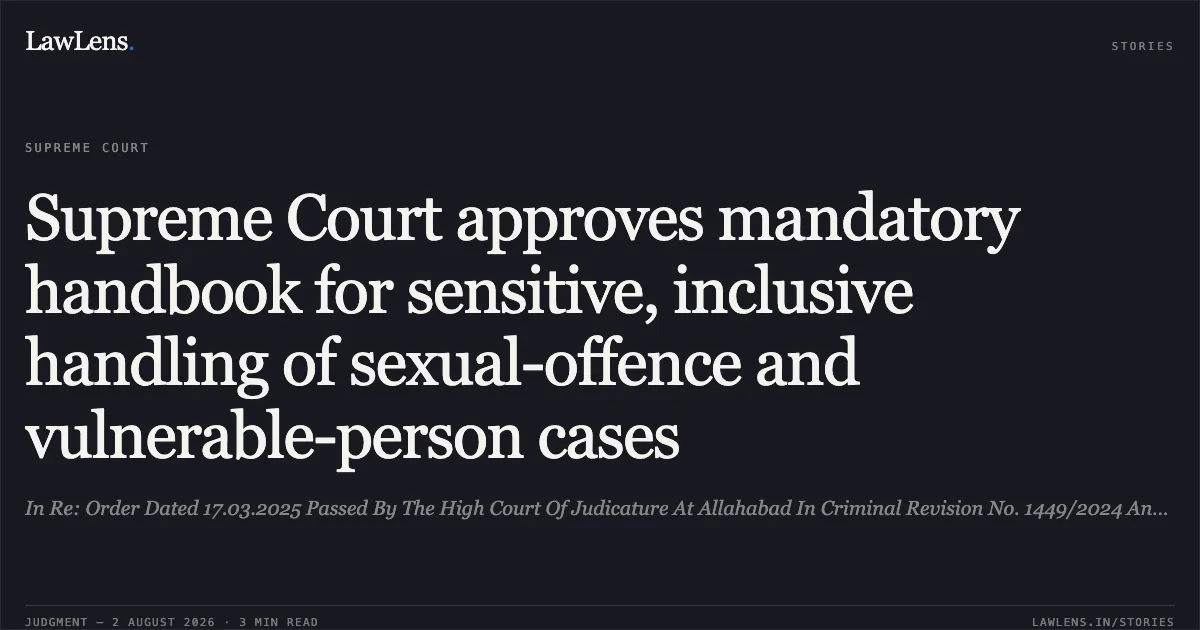
The Supreme Court accepted and approved the Committee’s publication as a mandatory guiding resource for judicial officers dealing with sexual offences and other cases involving vulnerable persons.
It directed the Registry to upload and circulate the publication to the High Courts, District Judiciary, tribunals, quasi-judicial bodies, judicial academies, legal-services authorities, government departments, and other relevant institutions.
Source reference: paras. 20–21Directors General of Police and Directors of Prosecution were directed to implement it and instruct police stations to follow its contents while registering FIRs and filing chargesheets.
Source reference: para. 22Authorities were further encouraged to conduct orientation programmes, training sessions, workshops, and other capacity-building initiatives.
Source reference: para. 24The Court directed administrative consideration of whether a fresh suo motu proceeding was required concerning the Patna High Court judgment and disposed of the matter and pending applications.
Source reference: paras. 25–27Original Court PDF
In Re: Order Dated 17.03.2025 Passed By The High Court Of Judicature At Allahabad In Criminal Revision No. 1449/2024 And Ancillary Issues vs
Click to open original judgment
Original judgment, available to read, download and summarize on LawLens.in