Facts
Following a detailed order on May 26, 2026, the Supreme Court monitored compliance regarding illegal sand mining in the National Chambal Gharial Sanctuary across Rajasthan, Madhya Pradesh, and Uttar Pradesh.
Source reference: para. 1The Court had previously identified ecological degradation, habitat destruction, and threats to the Morena-Dholpur bridge (NH-44) caused by organized mining networks.
Source reference: paras. 1-2The Central Empowered Committee (CEC) submitted its Third Report on July 20, 2026, highlighting that vast areas of the Sanctuary remain classified as revenue land rather than notified forest land, hindering enforcement under the Indian Forest Act.
Source reference: paras. 3, 13While Madhya Pradesh and Rajasthan showed progress in surveillance (CCTV, drones), Uttar Pradesh lagged in infrastructure and personnel recruitment.
Source reference: paras. 6-10Issues
1. Whether the failure to notify revenue lands within the Sanctuary as "Forests" creates a jurisdictional gap that facilitates illegal mining.
Source reference: para. 132. Whether the States have effectively implemented the Court’s prior directions regarding surveillance, enforcement, and protection of frontline staff.
Source reference: para. 113. Whether the maintenance of the Sanctuary's riverine ecosystem constitutes a matter of "public order" justifying special legal protections for enforcement officers under the BNSS.
Source reference: paras. 11-12Law Applied
The Court applied Section 218(3) of the Bharatiya Nagarik Suraksha Sanhita (BNSS), 2023, regarding the issuance of notifications for acts done in the maintenance of public order.
Source reference: paras. 11-12It invoked Section 52 of the Indian Forest Act, 1927, regarding seizure powers and the "Polluter Pays Principle" for environmental restoration.
Source reference: paras. 13, 19(O)It further referenced the Wildlife (Protection) Act, 1972, and the Mines and Minerals (Development and Regulation) Act, 1957, alongside the Prevention of Damage to Public Property Act, 1984, to establish a multi-statutory enforcement framework against criminal syndicates.
Source reference: para. 19(G)Reasoning
The Court reasoned that the ecological preservation of the Sanctuary is intrinsically linked to public order and the integrity of national infrastructure.
Source reference: para. 19(B)It observed that the administrative mismatch—where the Sanctuary consists largely of revenue lands—handicaps Forest Officers from exercising statutory seizure powers under the Indian Forest Act.
Source reference: para. 13By analyzing the CEC report, the Court found that the States’ slow response in invoking preventive detention laws against "kingpins" and the lack of immunity for bona fide actions by frontline staff emboldened illegal mining networks.
Source reference: paras. 9, 11To bridge this, the Court determined that specific administrative accountability must be fixed on District Magistrates and Superintendents of Police, rather than just lower-level staff, to dismantle organized syndicates.
Source reference: para. 19(F-G)Holding
The Court directed the States of M.P., Rajasthan, and U.P. to issue notifications under Section 218(3) of the BNSS to protect frontline staff.
The Court ordered the NHAI to provide a definitive timeline for surveillance infrastructure at the Morena-Dholpur bridge.
Source reference: para. 19(C)Key directions included designating District Magistrates as Nodal Officers; incorporating mining prevention performance into APARs; establishing an Integrated Public Reporting mechanism; and involving the Enforcement Directorate (ED) and Income Tax Department.
Source reference: para. 19(F), 19(I), 19(P), 19(M)The matter is listed for further consideration on August 11, 2026.
Source reference: para. 22Acts & Sections Cited
5 provisions across 4 statutes referred to in this judgment. Each provision opens on LawLens.
Bharatiya Nagarik Suraksha Sanhita, 20231
Code of Criminal Procedure, 19732
Indian Forest Act, 19271
Bharatiya Nyaya Sanhita, 20231
Original Court PDF
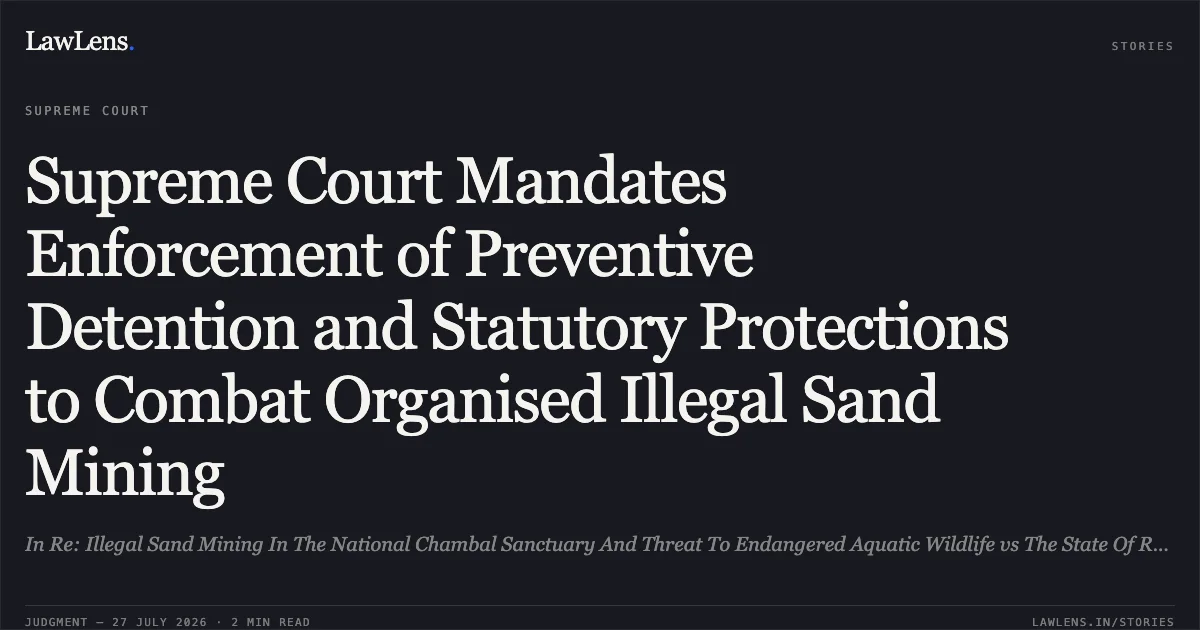
In Re: Illegal Sand Mining In The National Chambal Sanctuary And Threat To Endangered Aquatic WildlifevsThe State Of Rajasthan
Click to open original judgment
Original judgment, available to read, download and summarize on LawLens.in