Facts
The appellant entered the Tourism Department, Government of Tamil Nadu, on compassionate grounds in 1983 after completing SSLC and the first year of higher secondary education.
Source reference: para. 6–7With the Director of Tourism’s permission, he completed the second-year foundation course through Madurai Kamaraj Open University and subsequently obtained a B.Com. degree and other qualifications through distance education.
Source reference: para. 6–7, 17–18He was appointed as Receptionist Grade II in 1990 and temporarily promoted as Tourist Officer in 2011; his service in that post was regularised with effect from 05.08.2011 by Government Order No. 224 dated 16.10.2017.
Source reference: para. 8, 19, 39, 41After serving as Tourist Officer for several years, he sought promotion to Assistant Director of Tourism.
Source reference: para. 9–10.3, 20The State rejected his request on the ground that his open-university degree was not obtained in the prescribed 10+2+3 pattern and that he was therefore not qualified even to hold the feeder post of Tourist Officer.
Source reference: para. 9–10.3, 20The learned Single Judge allowed his writ petition and directed consideration of his name for promotion if his juniors had been promoted.
Source reference: para. 11–11.3The Division Bench reversed that decision, holding that he did not possess the requisite qualification for the post of Tourist Officer, though it did not disturb his existing service in that post.
Source reference: para. 12–12.3The Review Bench subsequently held that the foundation course could be treated as equivalent to +2 but concluded that the appellant’s distance-education degree was insufficient for promotion.
Source reference: para. 13–13.1Issues
1. Whether the appellant was eligible to be considered for promotion to the post of Assistant Director of Tourism under the applicable Special Rules and Government Orders?
Source reference: para. 23, 25–29, 52–52.12. Whether the High Court erred in examining the appellant’s eligibility to hold the post of Tourist Officer, instead of determining his eligibility for promotion to Assistant Director of Tourism?
Source reference: para. 23, 29, 513. Whether the appellant’s qualifications obtained through the open-university or distance-education mode could be rejected on the ground that they did not conform to the 10+2+3 pattern or were not obtained through a regular physical course?
Source reference: para. 30.1–30.4, 33–38, 42, 49–504. Whether Government Order No. 144 dated 20.11.2017 could retrospectively invalidate qualifications obtained under the earlier prevailing regime?
Source reference: para. 42, 46–50Law Applied
The Court applied the Special Rules governing the post of Assistant Director of Tourism under Government Order No. 290 dated 18.06.1986, as modified by Government Order No. 45 dated 27.02.1997, under which promotion required a degree, a pass in the Accounts Test for Executive Officers, and one year’s service as Tourist Officer outside Tamil Nadu.
Source reference: para. 25–26, 52Government Order No. 528 dated 18.05.1985 recognised the pre-foundation and two-year foundation courses of Madurai Kamaraj Open University as equivalent to SSLC and higher secondary education respectively for public employment.
Source reference: para. 33Government Orders Nos. 180 dated 11.09.2000 and 217 dated 08.09.2007 recognised qualifying degrees obtained through open-university or distance-education courses at par with regular degrees.
Source reference: para. 35–36Although Government Order No. 107 dated 18.08.2009 and the 2016 Act prescribed the 10+2+3 pattern, Section 54 of the Tamil Nadu Government Servants (Conditions of Service) Act, 2016 protected existing service members from adverse retrospective changes.
Source reference: para. 30–30.3, 37The Court relied on P. Mahendran v. State of Karnataka for the principle that amended service rules are ordinarily prospective and cannot retrospectively impair existing rights.
Source reference: para. 43–43.1The Court relied on Annamalai University v. Secretary to Government for the supremacy of UGC standards where applicable to open universities.
Source reference: para. 44–44.2The Court relied on Chandrakala Trivedi v. State of Rajasthan for giving a reasonable meaning to “equivalent” qualifications.
Source reference: para. 45–45.1The Court endorsed P. Thavam v. State of Tamil Nadu, holding that the adverse effect of Government Order No. 144 could operate only prospectively from 20.11.2017.
Source reference: para. 46–49Reasoning
The Court held that the High Court had misdirected itself by reopening the appellant’s eligibility for the post of Tourist Officer, despite his promotion having remained unchallenged and his having served in that post for more than fifteen years.
Source reference: para. 23, 51In any event, the appellant’s qualifications were valid under Government Order No. 528, which remained the applicable regime when he was promoted as Tourist Officer in 2011.
Source reference: para. 30.2–30.3, 50–51The later Government Orders and the 2016 Act could not be applied retrospectively to invalidate qualifications or adversely affect his existing service status, particularly in view of Section 54 of the 2016 Act and the principle in P. Mahendran.
Source reference: para. 30.2–30.3, 43.1, 50–51The Court further rejected the Review Bench’s assumption that the degree had to be obtained through a regular physical course.
Source reference: para. 30.1–30.4Neither Explanation 1(b) to Section 25 of the 2016 Act nor the applicable promotion rules required a degree obtained exclusively through regular education; the relevant requirement was possession of a degree from a recognised university.
Source reference: para. 30.1–30.4Since the appellant possessed a recognised degree, had passed the prescribed Accounts Test, and had the requisite service as Tourist Officer outside Tamil Nadu, he satisfied the conditions for consideration for promotion to Assistant Director of Tourism.
Source reference: para. 52–52.1The High Court’s contrary approach improperly converted a validly acquired qualification into a ground for denying promotional consideration.
Source reference: para. 48–50Holding
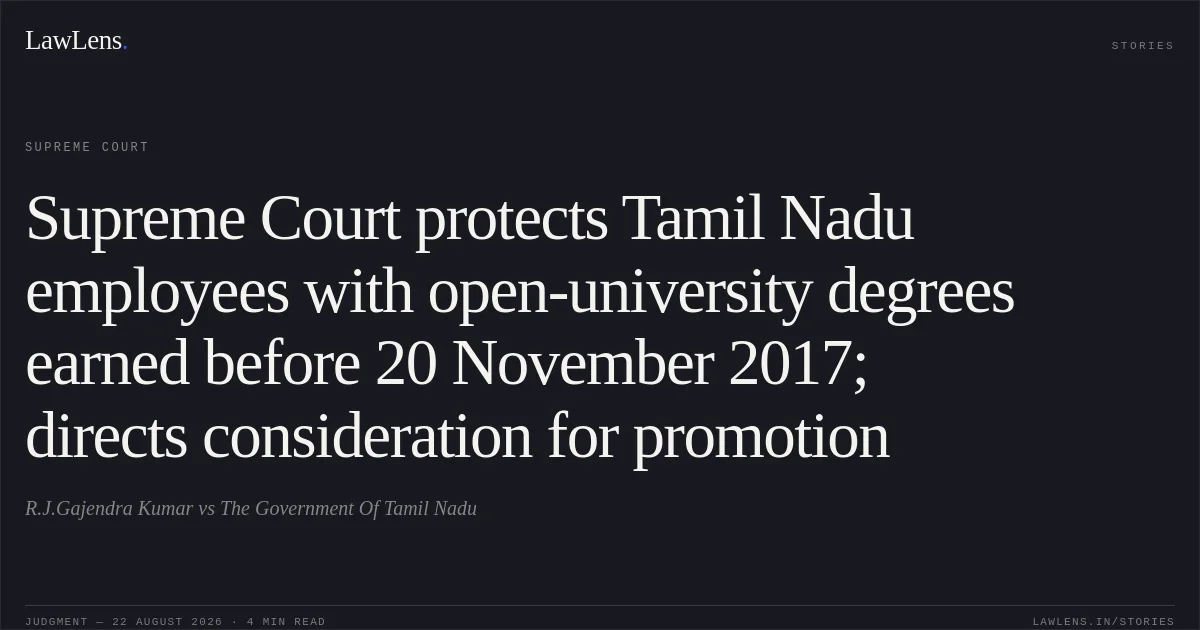
The Supreme Court held that the appellant was eligible to be considered for promotion to the post of Assistant Director of Tourism.
The Division Bench judgment dated 06.06.2023 and the Review Bench order dated 18.11.2024 were set aside, and the learned Single Judge’s order dated 16.08.2021 was restored.
Source reference: para. 53The respondents were directed to consider the appellant’s case for promotion in accordance with law.
Source reference: para. 54The appeals were allowed without any order as to costs.
Source reference: para. 55Acts & Sections Cited
4 provisions across 1 statute referred to in this judgment. Linked provisions open on LawLens.
Tamil Nadu Government Servants (Conditions of Service) Act, 20164
Original Court PDF
R.J.Gajendra KumarvsThe Government Of Tamil Nadu
Click to open original judgment
Original judgment, available to read, download and summarize on LawLens.in