Facts
On the intervening night of 4–5 January 2025, police intercepted an Ashok Leyland truck bearing registration no. RJ-14-GQ-22692 at Lunawada, Gujarat, while it was travelling from Modasa towards Vadodara.
Source reference: para. 3–4; pp. 2–3The truck, operated by driver Qasid Mohammad Khan, was found carrying 8,064 bottles of prohibited Indian-Made Foreign Liquor (approximately 22,532.253 litres, valued at ₹17,02,656), concealed among edible transport goods valued at approximately ₹98,66,552; the driver could not produce a valid pass or permit.
Source reference: para. 3–4; pp. 2–3An FIR was registered under Sections 65(a), 65(e), 98(2), 81, 116(b) and 83 of the Gujarat Prohibition Act, 1949, and a chargesheet was filed against four accused persons, including the driver, on 1 March 2025.
Source reference: para. 5; p. 3The appellant-owner sought interim custody of the truck under Section 497 of the Bharatiya Nagarik Suraksha Sanhita, 2023, but the application was rejected by the Chief Judicial Magistrate, the Sessions Court and the Gujarat High Court, principally on the basis of Section 98(2) of the Gujarat Prohibition Act.
Source reference: paras. 6–9; pp. 3–4The appellant thereafter approached the Supreme Court, contending that the truck was deteriorating while parked and that its evidentiary value could be preserved through documentation.
Source reference: para. 8; p. 4Issues
1. Whether Section 98(2) of the Gujarat Prohibition Act, 1949 creates an absolute bar against the interim release of a vehicle seized for transporting liquor exceeding the prescribed quantity.
Source reference: paras. 9–11; pp. 4–72. Whether, notwithstanding the potential confiscation of the vehicle, the criminal court may exercise its powers under Section 451 of the Code of Criminal Procedure, 1973, and the corresponding provisions governing interim custody, to release the vehicle pending inquiry or trial.
Source reference: paras. 10–14; pp. 4–93. Whether the appellant was entitled to interim custody of the truck subject to appropriate safeguards, including security, production of the vehicle and preservation of evidence.
Source reference: paras. 14–17; pp. 9–10Law Applied
The Court applied Section 98(2) of the Gujarat Prohibition Act, 1949, which makes conveyances used to transport confiscable liquor liable to confiscation, while holding that its latter portion does not constitute an absolute prohibition on interim release when the vehicle has been produced before the criminal court for custody during inquiry or trial.
Source reference: para. 11; pp. 4–7Section 451 CrPC empowers the criminal court to make appropriate orders for the custody or disposal of property produced before it; the Court treated this power as operating in a distinct field from confiscation proceedings under Section 98.
Source reference: para. 11; pp. 6–7The Court relied on Khengarbhai Lakhabhai Dambhala v. State of Gujarat, 2024 INSC 285, which harmonised Section 98(2) with Section 451 CrPC and rejected an absolute embargo on release.
Source reference: para. 11; pp. 5–7It further relied on Sunderbhai Ambalal Desai v. State of Gujarat, 2002 INSC 418; Basavva Kom Dyamangouda Patil v. State of Mysore, (1977) 4 SCC 358; and General Insurance Council v. State of Andhra Pradesh, 2010 INSC 225, establishing that seized vehicles should not remain unused and deteriorating in police custody, and that their evidentiary value may ordinarily be preserved through panchnamas, photographs and videography.
Source reference: paras. 10, 12–13; pp. 4–9The possibility of subsequent confiscation does not, by itself, preclude interim custody where the applicable confiscation regime provides notice and an opportunity of hearing.
Source reference: para. 15; pp. 9–10Reasoning
The Court held that the courts below had adopted an unduly narrow interpretation of Section 98(2) by treating it as an absolute statutory bar.
Source reference: paras. 11–12; pp. 4–8Section 98 concerns eventual confiscation, whereas the power to order interim custody under Section 451 CrPC concerns the proper preservation and management of property during investigation or trial; the two provisions therefore operate in different fields.
Source reference: para. 11; pp. 6–7The truck had already been seized, the liquor counted and the chargesheet filed, reducing the need for continued physical retention of the vehicle.
Source reference: paras. 13–14; pp. 8–9Keeping a commercial truck idle at the police station would cause continuing economic loss and deterioration, while its evidentiary value could be secured through a detailed panchnama, photographs and videography.
Source reference: paras. 13–14; pp. 8–9The Court also distinguished authorities involving statutory confiscation schemes that expressly excluded the jurisdiction of criminal courts, finding that the Gujarat Prohibition Act did not create such an exclusion.
Source reference: para. 15; pp. 9–10Accordingly, the balance between the owner’s interest, the State’s interest and the integrity of the trial favoured conditional interim release.
Source reference: paras. 14–17; pp. 9–10Holding
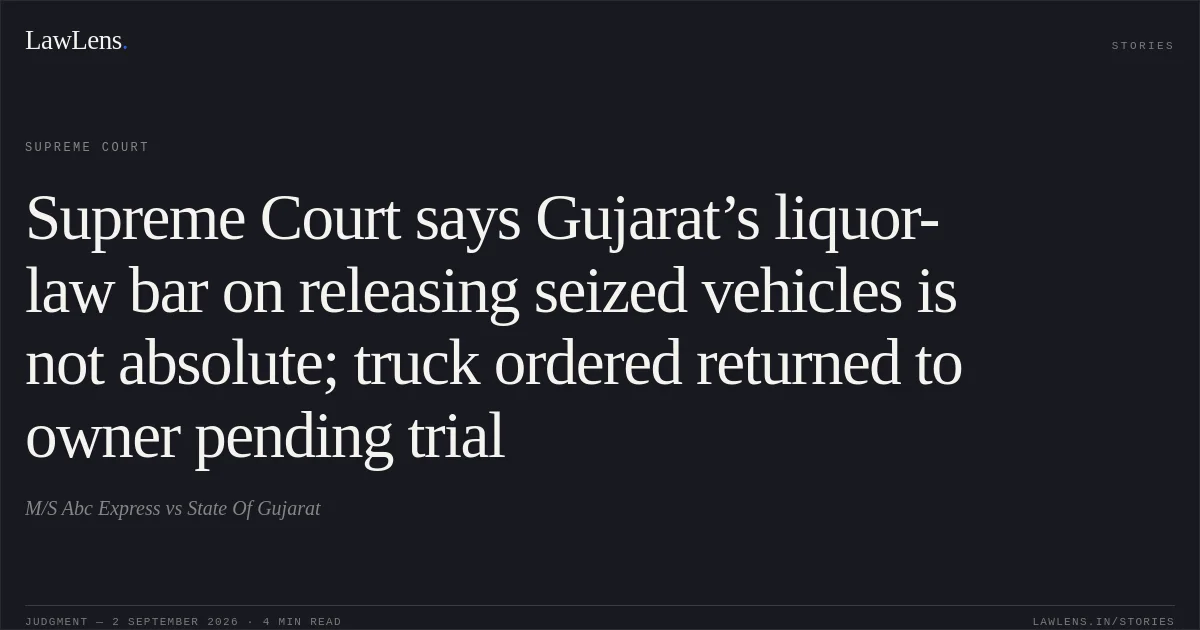
The Supreme Court allowed the appeal, set aside the orders of the High Court, Sessions Court and Chief Judicial Magistrate, and directed that interim custody of the truck be handed over to the appellant.
The release was made subject to: (i) a personal bond and appropriate security of ₹15,00,000; (ii) production of the truck before the Investigating Officer or Trial Court whenever directed; (iii) no alienation or creation of third-party interest during trial; (iv) preparation of a detailed panchnama, photographs and videography before release; (v) liberty to proceed against the security or order further action, including auction, if the vehicle is ultimately confiscated; and (vi) compliance with any additional conditions imposed by the Trial Court.
Source reference: para. 17; pp. 10–11The Court clarified that its observations were confined to interim custody and would not affect the merits of the pending criminal trial.
Source reference: para. 18; p. 11Acts & Sections Cited
12 provisions across 3 statutes referred to in this judgment. Each provision opens on LawLens.
Gujarat Prohibition Act, 1949.6
Bharatiya Nagarik Suraksha Sanhita, 20232
Code of Criminal Procedure, 19734
Original Court PDF
M/S Abc ExpressvsState Of Gujarat
Click to open original judgment
Original judgment, available to read, download and summarize on LawLens.in