Facts
Following a 1991 hooch tragedy in Mumbai in which approximately 93 persons died after consuming methanol-adulterated liquor, the Maharashtra Government amended the Maharashtra Poisons Rules, 1972 through the 2011 Notification.
Source reference: paras. 5–10Methanol was included as a poison, and Rules 18A and 18B were introduced.
Source reference: paras. 5–10Rule 18A(1) required sellers to verify that purchasers possessed a Form A licence and ascertain the intended use of methanol; Rule 18A(2) required methanol sold to non-drug manufacturers to be mixed with specified quantities of methylene carmine and denatonium saccharide; and Rule 18B mandated confiscation of methanol possessed without a Form A licence.
Source reference: paras. 5–10The petitioners, manufacturers and industrial users of methanol-based products, contended that the additives contaminated or altered their final products and impaired their commercial usability.
Source reference: paras. 11–17They challenged the 2011 Notification as ultra vires the Poisons Act, 1919 and Articles 14 and 19(1)(g) of the Constitution.
Source reference: paras. 11–17The Bombay High Court upheld the rules, leading to the connected proceedings before the Supreme Court.
Source reference: paras. 6, 11–14Issues
Whether Rules 18A(1) and 18A(2) of the Maharashtra Poisons Rules, 1972 were arbitrary, disproportionate and violative of Article 19(1)(g) and/or Article 14 of the Constitution.
Source reference: para. 17(a); paras. 27–51Whether Rule 18B, providing for confiscation of methanol found in possession without a Form A licence, was constitutionally valid.
Source reference: para. 17(a); paras. 52–60Whether the impugned rules were within the authority conferred by Sections 2 and 8 of the Poisons Act, 1919 and constituted reasonable restrictions in the public interest.
Source reference: paras. 19, 31–37Law Applied
The Court applied Sections 2 and 8 of the Poisons Act, 1919, which empower the State Government to regulate the possession and sale of poisons and to make rules furthering the Act’s purposes.
Source reference: para. 19It held that subordinate legislation may be challenged for lack of legislative competence, violation of fundamental rights, excess of delegated authority, inconsistency with the parent statute, manifest arbitrariness, unreasonableness or disproportionality.
Source reference: paras. 23–24Under Articles 14 and 19(1)(g), a restriction must have a reasonable and proximate nexus with its legitimate object, must not be excessive, and must satisfy proportionality by being suitable, necessary and adequately balanced against the affected right.
Source reference: paras. 25, 33–37, 54–58The Court relied on State of Tamil Nadu v. P. Krishnamoorthy, Mahalakshmi Sugar Mills Co. Ltd. v. Union of India, Vasu Dev Singh v. Union of India and Mohd. Faruk v. State of M.P. for the principles governing judicial review of subordinate legislation and reasonable restrictions.
Source reference: paras. 23, 33It also applied the proportionality framework stated in K.S. Puttaswamy (Privacy-9J.) v. Union of India: legitimate aim, suitability, necessity and balancing.
Source reference: para. 54Reasoning
The Court accepted that preventing methanol from being used in illicit liquor was a legitimate public objective and that methanol could properly be regulated as a hazardous poison.
Source reference: paras. 31, 55However, Rule 18A(1) was disproportionate because Form A was intended for persons selling or possessing poison for sale, whereas industrial consumers and downstream manufacturers generally held Form B permits; requiring Form A therefore excluded legitimate users, rendered Form B substantially nugatory and did not reliably ascertain the actual use of methanol.
Source reference: paras. 28–30, 35–37Rule 18A(2) also lacked a proximate nexus with the stated objective.
Source reference: no citationThe evidence showed that the mandated colourant and bitterant adversely affected chemical, pharmaceutical and other industrial products, while the rule did not address diversion through illegal channels, pilferage, corruption, substitution or misuse outside lawful points of sale.
Source reference: paras. 40–48The State failed to demonstrate that denaturing would prevent the manufacture of spurious liquor or that less restrictive safeguards—such as stricter verification, stock reconciliation, return of surplus methanol, cancellation of licences and penalties for discrepancies—would be ineffective.
Source reference: paras. 36, 46, 57Rule 18B was similarly unworkable and disproportionate because it authorised confiscation where no Form A licence existed even though possession could be lawful under a Form B permit, thereby undermining the existing licensing framework.
Source reference: paras. 52–58The continuing and substantial burden imposed on legitimate industries outweighed the uncertain benefit of identification and therefore failed the proportionality test.
Source reference: paras. 58–60Holding
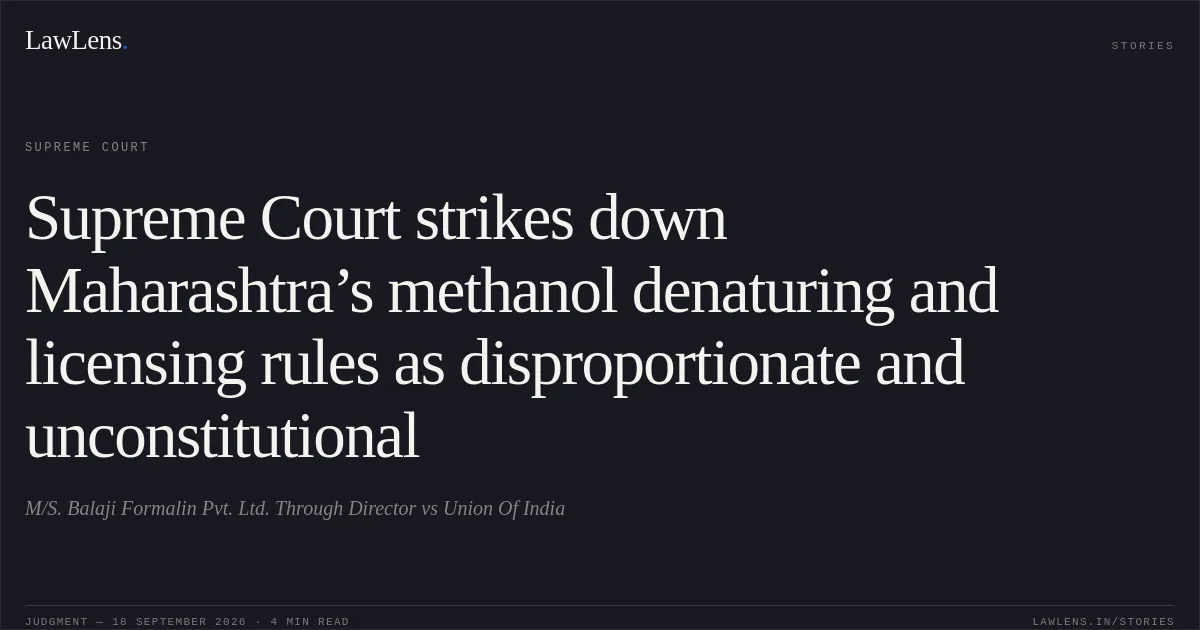
The Supreme Court held that the impugned Rules 18A and 18B were manifestly arbitrary, lacked a rational and proximate nexus with the objective of preventing methanol-related hooch tragedies, and imposed disproportionate restrictions on legitimate industrial activities.
They were therefore violative of Articles 14 and 19(1)(g) of the Constitution.
Source reference: paras. 51, 60, 68The writ petitions were allowed, the connected civil appeal was disposed of accordingly, and pending applications were also disposed of.
Source reference: paras. 69–70The Court additionally directed that copies of the judgment be forwarded to all High Courts and the Chief Secretaries of the States, and suggested coordinated regulatory measures addressing licensing, stock monitoring, transport, sealing, diversion, enforcement and public-health preparedness.
Source reference: paras. 65–71Acts & Sections Cited
7 provisions across 1 statute referred to in this judgment. Each provision opens on LawLens.
Original Court PDF
M/S. Balaji Formalin Pvt. Ltd. Through DirectorvsUnion Of India
Click to open original judgment
Original judgment, available to read, download and summarize on LawLens.in