Facts
Hari Om, a taxi driver, left Bhiwani on 10 August 1998 in his Ambassador taxi with the appellant Dinesh Kumar and co-accused Manoj and Mukesh Kumar, who were known to the deceased’s brother, PW-13.
Source reference: paras. 1–9Hari Om did not return. On 13 August 1998, his decomposed body was found in a sugarcane field, and it was identified by his brother and the vehicle owner through the deceased’s clothes and remaining physical features.
Source reference: paras. 1–9On 15 August 1998, the three accused were apprehended while allegedly attempting to dispose of the deceased’s taxi; the vehicle’s registration certificate and insurance papers were recovered.
Source reference: paras. 1–9The appellant and Mukesh also led to the recovery of the deceased’s driving licence and tiffin carrier.
Source reference: paras. 1–9The Trial Court convicted all three accused under Sections 302/34 and 392/34 IPC, and the High Court affirmed the convictions.
Source reference: paras. 1–9During the appeal, the appellant produced an order of the Juvenile Justice Board declaring that he was below eighteen years of age on the date of the offence and had already undergone detention exceeding the maximum permissible period under the Juvenile Justice (Care and Protection of Children) Act, 2000.
Source reference: paras. 3, 27–31Issues
Whether the concurrent conviction of the appellant under Sections 302 read with 34 and 392 read with 34 IPC, based on circumstantial evidence, required interference.
Source reference: para. 13Whether the appellant was a juvenile on the date of the offence, namely 10 August 1998.
Source reference: para. 13If the appellant was a juvenile, what legal consequences followed regarding the adult sentence, release, and disqualifications attached to the conviction.
Source reference: para. 13Law Applied
The Court applied the principles governing conviction on circumstantial evidence stated in Sharad Birdhichand Sarda v. State of Maharashtra, namely that each circumstance must be firmly established, the circumstances must form a complete chain, and the chain must be consistent only with the guilt of the accused.
Source reference: para. 14It considered the evidentiary value of the last-seen circumstance, recent unexplained possession of the deceased’s property, and discoveries under Section 27 of the Indian Evidence Act, 1872.
Source reference: paras. 15–18Section 106 of the Evidence Act places the burden of explaining facts especially within an accused’s knowledge, but it cannot relieve the prosecution of its primary burden.
Source reference: para. 17Motive is not indispensable where the circumstantial chain is complete.
Source reference: para. 21Under Sections 7A and 20 of the Juvenile Justice (Care and Protection of Children) Act, 2000, a claim of juvenility may be raised at any stage; a finding of guilt may be maintained, but an adult sentence cannot operate against a person who was a juvenile on the date of the offence.
Source reference: paras. 24–26Relying on Hari Ram v. State of Rajasthan, Dharambir v. State (NCT of Delhi) and Jitendra Singh @ Babboo Singh v. State of U.P., the Court held that the benefit of the 2000 Act extends to offences committed before 1 April 2001 and to pending appeals.
Source reference: para. 26Section 19 of the 2000 Act protects a juvenile dealt with under the Act from disqualifications attached to conviction under another law.
Source reference: para. 30Reasoning
The Court held that PW-13’s evidence established that the deceased had left with the appellant and the co-accused, who were known to him, and that the deceased thereafter disappeared.
Source reference: para. 15This last-seen circumstance was materially corroborated by the accused’s possession of the deceased’s taxi within five days, their alleged attempt to dispose of it, and their failure to provide any explanation under Section 313 CrPC.
Source reference: paras. 16–17The recovery of the deceased’s driving licence and tiffin carrier from a concealed location in a large sugarcane field, pursuant to information supplied by the appellant and Mukesh, constituted further corroboration under Section 27 of the Evidence Act.
Source reference: para. 18Although the body was decomposed, the identification through clothing and remaining features was reinforced by the recovery of the taxi and personal articles.
Source reference: para. 19The absence of a precise cause of death and the approximate post-mortem interval did not negate the prosecution case, particularly because the body had been exposed, scavenged and substantially decomposed.
Source reference: para. 20Collectively, the circumstances formed a complete chain excluding a reasonable hypothesis of innocence.
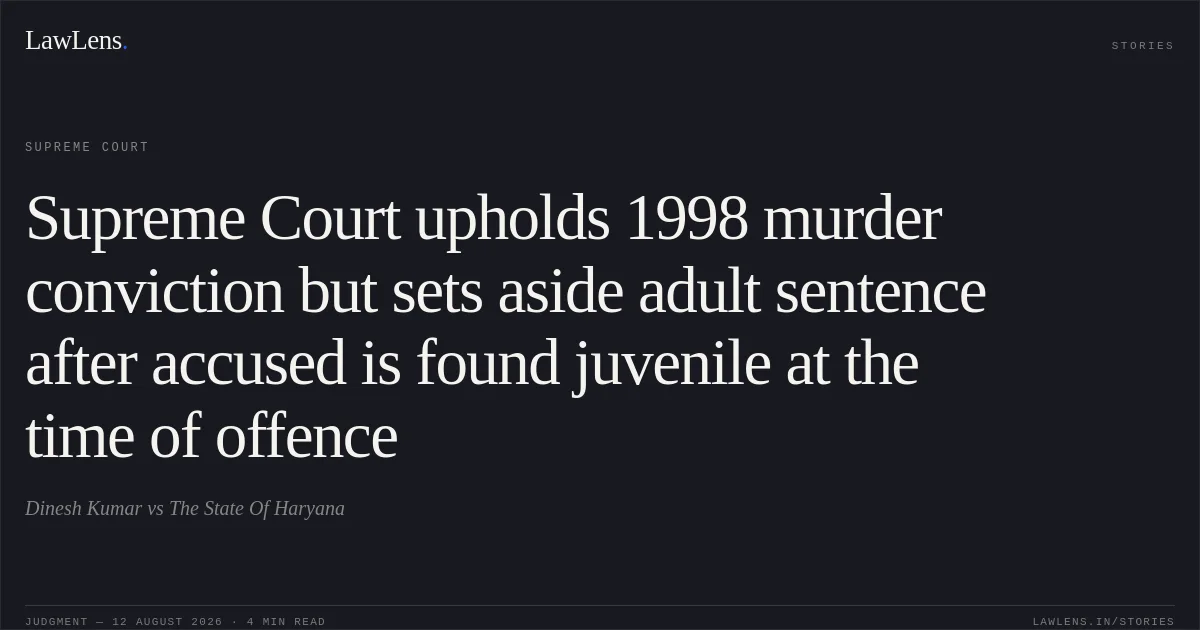
Source reference: para. 23Separately, the Juvenile Justice Board’s finding that the appellant was born on 3 February 1981 established that he was seventeen years old on 10 August 1998; consequently, the adult sentences imposed by the regular criminal courts could not legally operate against him.
Source reference: paras. 27–29Holding
The appeal was partly allowed.
The appellant’s convictions under Sections 302/34 and 392/34 IPC were affirmed on merits.
Source reference: para. 32However, upon accepting the Juvenile Justice Board’s declaration of juvenility, the life sentence, seven-year sentence, fines and default sentences were set aside and treated as having no effect under Sections 7A(2), 15 and 20 of the 2000 Act.
Source reference: paras. 29, 32Since the appellant had already undergone detention exceeding the maximum three-year period permissible under the 2000 Act, he was not required to surrender, and his bail bonds, if subsisting, were discharged.
Source reference: paras. 28–32He was also held not to suffer any disqualification attached to the conviction under Section 19 of the 2000 Act, with the Juvenile Justice Board directed to take consequential steps regarding the records.
Source reference: para. 33Acts & Sections Cited
5 provisions across 3 statutes referred to in this judgment. Each provision opens on LawLens.
Indian Penal Code, 18603
Code of Criminal Procedure, 19731
Juvenile Justice (Care and Protection of Children) Act, 2015.1
Original Court PDF
Dinesh KumarvsThe State Of Haryana
Click to open original judgment
Original judgment, available to read, download and summarize on LawLens.in