Facts
The petitioner, Accused No. 3, had been granted bail by the Sessions Court on 1 September 2026, subject to conditions including payment of a ₹10,000 penalty, execution of a personal bond for ₹1,00,000, and furnishing two sureties for the like amount
Source reference: p. 3, para. 3The petitioner offered his brother and mother as sureties against property jointly held by six persons. The trial court rejected the sureties because the other four co-owners had not filed affidavits consenting to the property being offered, and also noted that the penalty had not been deposited
Source reference: pp. 3–4, para. 4The petitioner challenged that order under Section 528 of the Bharatiya Nagarik Suraksha Sanhita, 2023
Source reference: p. 2, para. 2Issues
1. Whether the trial court erred in rejecting the petitioner’s sureties because the other co-owners of the property had not filed affidavits consenting to its use as security
Source reference: pp. 3–5, paras. 4–5; p. 8, para. 122. Whether the High Court should set aside the rejection order and direct the petitioner’s release on the strength of the sureties already offered
Source reference: p. 2, para. 2; p. 8, para. 12Law Applied
The petition invoked Section 528 of the BNSS, corresponding to Section 482 of the Code of Criminal Procedure, under which the petitioner sought the High Court’s intervention against the trial court’s order
Source reference: p. 2, para. 2The bail order had been made under Section 439 CrPC and required two sureties for the like amount, among other conditions
Source reference: p. 3, para. 3The Court considered Ramchandra Thangappan Aachari v. State of Maharashtra, concerning inability to furnish local surety, and Prathap Singh @ Prem Bahaddur Khatri v. State of Karnataka, concerning surety requirements in statutory bail cases under Section 167(2) CrPC; it held those decisions inapplicable to the circumstances before it
Source reference: pp. 5–6, paras. 6–9The judgment did not state a broader rule governing sureties over jointly owned property.
Source reference: no citationReasoning
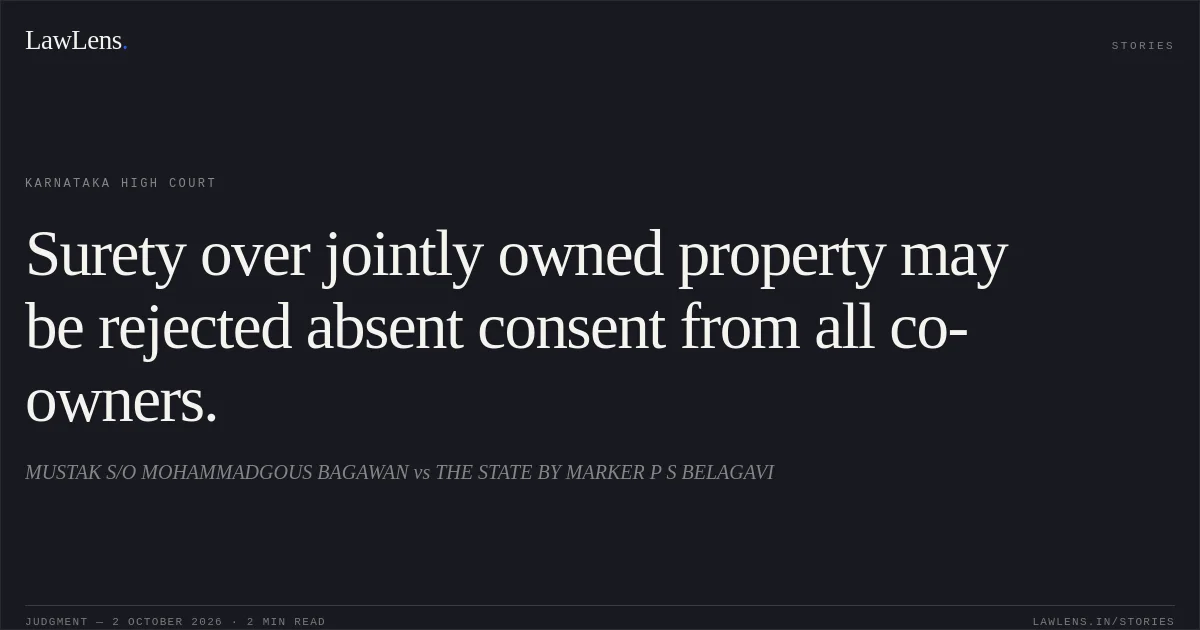
The Court found that the property offered as security was owned jointly by six persons, but only two had offered themselves as sureties; the remaining four had not filed affidavits consenting to the property being offered
Source reference: pp. 7–8, para. 12It distinguished Ramchandra Thangappan Aachari, which concerned inability to furnish local surety, and Prathap Singh, which concerned surety requirements in statutory-bail cases
Source reference: pp. 5–6, paras. 7–9On these facts, the Court found no error in the trial court’s refusal to accept the sureties
Source reference: p. 8, para. 12Holding
The High Court answered the challenge in the negative, finding no error in the trial court’s order rejecting the sureties where the other co-owners had not filed consent affidavits
It dismissed the criminal petition; the requested direction to accept the sureties and release the petitioner was not granted
Source reference: p. 8, “Order”Acts & Sections Cited
2 provisions across 2 statutes referred to in this judgment. Each provision opens on LawLens.
Bharatiya Nagarik Suraksha Sanhita, 20231
Code of Criminal Procedure, 19731
Original Court PDF
MUSTAK S/O MOHAMMADGOUS BAGAWANvsTHE STATE BY MARKER P S BELAGAVI
Click to open original judgment
Original judgment, available to read, download and summarize on LawLens.in