01Facts
The petitioners challenged two orders dated 10.09.2025 issued by the Collector, Gwalior, which suspended their firearm licenses until the completion of a pending criminal trial.
¶ 1The suspension was based on a 2021 criminal case involving charges of simple assault, abusive language, and criminal intimidation under the IPC.
¶ 1, 3The petitioners argued that the licensing authority failed to provide required findings that the suspension was necessary for public peace or safety.
¶ 202Issues
i.1. Whether the licensing authority is required to record a specific finding regarding threats to public peace or safety before suspending a firearm license under Section 17(3)(b) of the Arms Act.
¶ 2, 7ii.2. Whether the mere pendency of a criminal case, without evidence of weapon misuse or a specific threat to public order, is sufficient grounds for license suspension.
¶ 3, 1003Law Applied
The Court applied Section 17(3) of the Arms Act, 1959, which defines the specific contingencies under which a license may be suspended or revoked.
¶ 2It relied on the principle from Abdul Saleem v. State of M.P. that "public peace and safety" refers to public tranquility rather than individual law and order issues, and that licenses cannot be revoked arbitrarily just because a criminal case is pending.
¶ 7Further, it cited Gajendra Singh v. State of M.P., establishing that a licensing authority must provide a reasoned discussion on why a person's conduct is dangerous to the public to satisfy the test of reasonableness.
¶ 8Provisions in the judgment · 13 · Linked ones open on LawLens
Indian Penal Code, 1860 Section 294Section 323Section 506Section 34
Arms Act, 1959 Section 13Section 14Section 15Section 16Section 17Section 18
Code of Criminal Procedure, 1973 Section 107Section 110Section 116
04Reasoning
The Court observed that the Collector’s orders were based solely on the assumption that the petitioners' involvement in a criminal case made future misuse of firearms likely.
¶ 2However, the Court noted that the licensing authority failed to record any actual findings that the petitioners posed a present threat to public peace or safety as mandated by Section 17(3)(b).
¶ 10Relying on precedent, the Court distinguished between "law and order" (affecting individuals) and "public order" (affecting the community), noting that the 2021 assault case did not demonstrate a reach sufficient to disturb public tranquility.
¶ 7, 10Because the impugned orders lacked specific reasoning and failed to show how the possession of the arms was detrimental to the public, the Court found them to be cryptic and legally unsustainable.
¶ 1005Holding
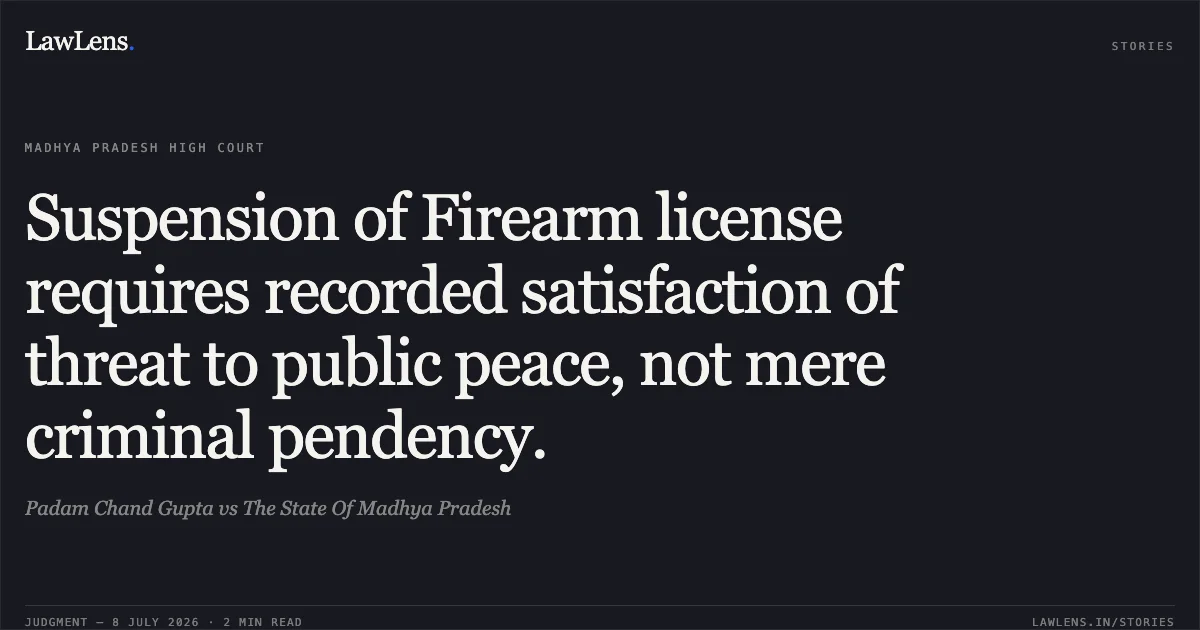
The Court answered that a specific finding of a threat to public safety is a mandatory prerequisite for suspension and that mere criminal pendency is insufficient.
¶ 9-11The Court allowed the writ petition, set aside the Collector's suspension orders, and remitted the matter back to the Collector, Gwalior.
¶ 12The authority was directed to conduct a fresh consideration on the merits, providing the petitioners an opportunity to be heard and issuing a reasoned order in accordance with the law.
¶ 12Original Court PDF
Padam Chand GuptavsThe State Of Madhya Pradesh
Click to open original judgment
Original judgment, available to read, download and summarize on LawLens.in