Facts
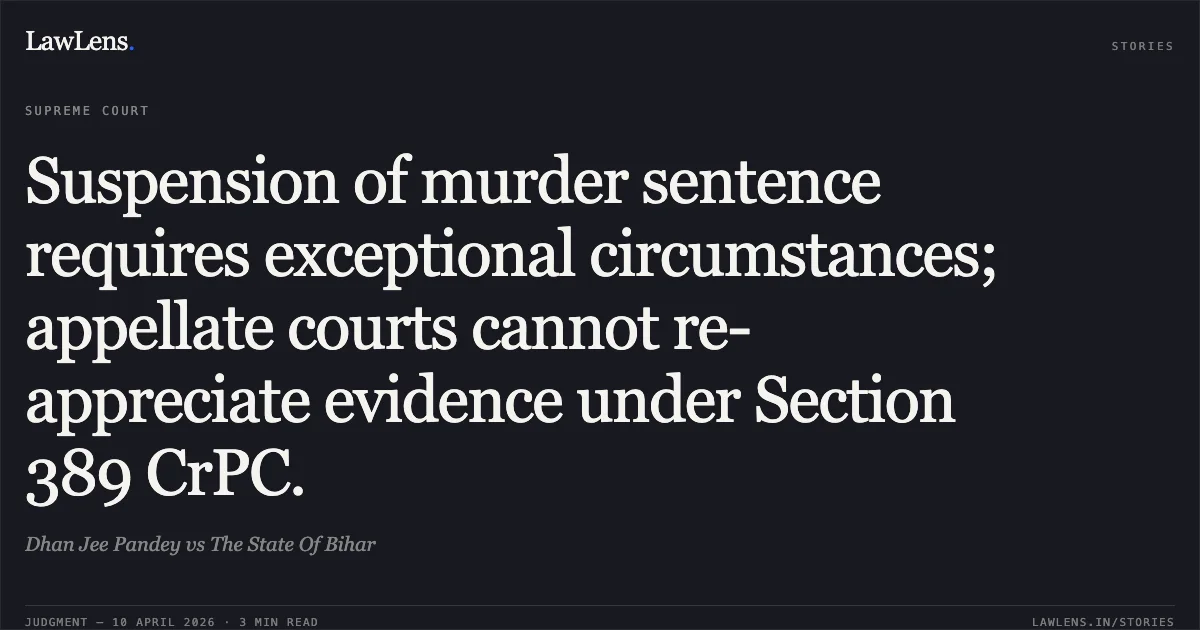
The appellant/informant challenged two orders of the Patna High Court which suspended the life sentences of Respondent No. 2 (Shekhar Pandey and Ghanshyam Pandey) during the pendency of their appeals
Source reference: para. 2, 27The respondents were convicted by the Trial Court on 18.08.2018 for offences under Sections 302, 307 read with 34 of the IPC and Section 27 of the Arms Act for the murder of the appellant’s brother
Source reference: para. 4The prosecution case established that while co-accused Shiv Jee Pandey fired the fatal shot, the respondents held the deceased to facilitate the crime
Source reference: para. 3The High Court granted suspension of sentence primarily on the grounds of the respondents' specific roles (constructive liability under Section 34 IPC), the period of incarceration (approx. 6 years and 9 months), and the pendency of the appeal
Source reference: para. 8(iv), 8(vi)The appellant contended that the respondents had significant criminal antecedents and had issued continuous threats to the informant’s family
Source reference: para. 6(viii), 6(ix)Issues
1. Whether the High Court was justified in exercising its discretion under Section 389 of the Cr.P.C. to suspend a life sentence for a serious offence under Section 302 IPC in the absence of exceptional circumstances
Source reference: para. 13, 142. Whether the appellate court can undertake a detailed reappreciation of evidence or distinguish roles of convicts (actual shooter vs. constructive liability) at the stage of considering suspension of sentence
Source reference: para. 16, 19, 20Law Applied
Section 389 of the Code of Criminal Procedure, 1973 (Cr.P.C.), which governs the suspension of sentence pending appeal
Source reference: para. 15State of Haryana v. Hasmat, establishing that suspension in serious offences must not be routine and requires recorded reasons
Source reference: para. 15Om Prakash Sahni v. Jai Shankar Chaudhary, which held that post-conviction, the presumption of innocence is erased, and suspension should only be granted if there is a "palpable infirmity" apparent on the record
Source reference: para. 16The doctrine of constructive liability under Section 34 IPC, where every participant is equally liable for acts done in furtherance of common intention
Source reference: para. 19Reasoning
The parameters for suspension of sentence post-conviction are qualitatively different from pre-trial bail, as the judicial determination of guilt erases the presumption of innocence
Source reference: para. 14The Court found that the High Court erred by embarking on a selective and premature reappreciation of evidence, which is impermissible under Section 389 Cr.P.C.
Source reference: para. 20The High Court’s reliance on the fact that the respondents were convicted via Section 34 IPC rather than as the principal shooter was deemed "wholly misconceived," as common intention renders all participants equally culpable at this stage
Source reference: para. 19The Court noted that the Trial Court had already found the ocular evidence of PW-1, PW-2, and PW-5 to be credible
Source reference: para. 18The High Court failed to adequately weigh the respondents' criminal antecedents and the alleged threats to the informant against the mere period of incarceration
Source reference: para. 21-23Holding
The Supreme Court allowed the appeals and set aside the High Court's orders granting suspension of sentence
The High Court was not justified in releasing the convicts, given the gravity of the offence and the absence of any palpable infirmity in the Trial Court’s judgment
Source reference: para. 24The bail bonds of the respondents were cancelled, and they were directed to surrender before the Trial Court within two weeks, failing which the Trial Court must take steps to secure their custody
Source reference: para. 25, 28Acts & Sections Cited
23 provisions across 3 statutes referred to in this judgment. Each provision opens on LawLens.
Indian Penal Code, 1860
Arms Act, 19591
Code of Criminal Procedure, 19734
Original Court PDF
Dhan Jee PandeyvsThe State Of Bihar
Click to open original judgment
Original judgment, available to read, download and summarize on LawLens.in


