Facts
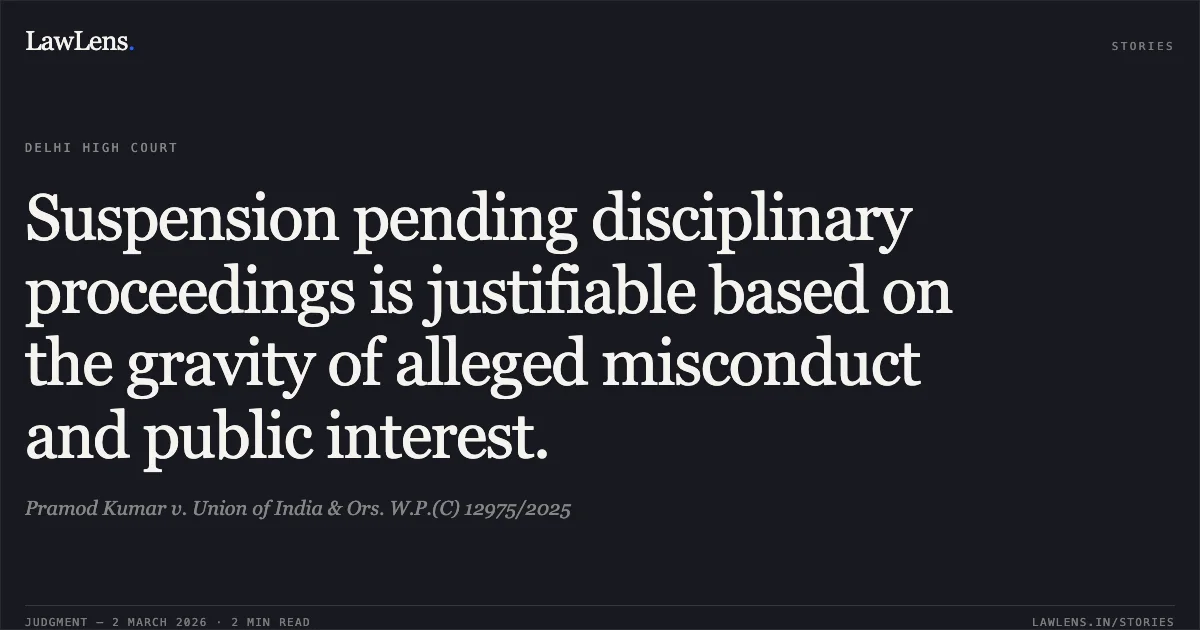
The Petitioner, an Executive Engineer (Civil) at HQ 32 BRTF (Project Beacon), challenged a suspension order dated 03.06.2025 issued under Rule 10(1)(a) of the CCS (CCA) Rules, 1965.
Source reference: para 1-2The suspension was initiated in contemplation of disciplinary proceedings regarding alleged misconduct during his previous tenure as Surveyor of Work at HQ 755 BRTF (Project Swastik), specifically concerning the payment of 16 invoices without proper scrutiny.
Source reference: para 2, 6The Petitioner contended the suspension was arbitrary as his current posting is 2300 km away from the site of the alleged incident, making it impossible for him to tamper with evidence or influence witnesses.
Source reference: para 3During the pendency of the matter, a charge sheet was issued to the Petitioner.
Source reference: para 6Issues
1. Whether the continued suspension of the Petitioner is legally unsustainable or arbitrary given his distant transfer from the place of the alleged misconduct.
Source reference: para 3, 62. Whether the failure to reinstate the Petitioner violates the principles laid down in Ajay Kumar Chaudhary v. Union of India regarding the duration of suspension and the issuance of a charge sheet.
Source reference: para 5, 7Law Applied
The Court primarily applied Rule 10(1)(a) of the CCS (CCA) Rules, 1965, governing the power to place government servants under suspension.
Source reference: para 2It relied on the precedent of Ajay Kumar Chaudhary v. Union of India (2015) as interpreted by the Delhi High Court in Vikash Kumar v. Union of India (2023) and State (NCT of Delhi) v. Rishi Anand (2017), which establishes that there is no automatic lapsing of suspension if a charge sheet is not issued within 90 days, provided the government records sufficient justification for the extension.
Source reference: para 7, 7.1The Court further applied the principle that judicial review of suspension is minimal and must be determined based on the gravity of the charges and public interest rather than a mechanical application of timelines.
Source reference: para 7.1, 12Reasoning
The Court rejected the Petitioner’s argument that his geographical distance from the records (2300 km) rendered the suspension unjustified.
Source reference: para 6The Court noted the respondents' stand that the Petitioner had authorized payments for 16 invoices without scrutiny, highlighting the gravity of the misdemeanor.
Source reference: para 6Applying the refined interpretation of Ajay Kumar Chaudhary, the Court observed that the power of the competent authority to continue suspension is not extinguished merely by the passage of time if valid reasons exist.
Source reference: para 7.1The Court found that since a charge sheet had already been issued and the allegations involved serious financial irregularities, revocation of suspension would not be in the public interest.
Source reference: para 6, 15The Court emphasized that suspension is not a punishment but a temporary measure to disable an employee from duties during an inquiry, and the decision to continue it depends on the specific facts and gravity of each case.
Source reference: para 12Holding
The Court held that the suspension was neither arbitrary nor unjustified and found no merit in the Petitioner’s claims.
It ruled that the issuance of the charge sheet and the serious nature of the allegations justified the continued suspension in the public interest.
Source reference: para 6, 14The Writ Petition was dismissed, and all pending applications were disposed of as infructuous.
Source reference: para 9Acts & Sections Cited
4 provisions across 1 statute referred to in this judgment. Each provision opens on LawLens.
Prevention of Corruption Act, 19884
Original Court PDF
Pramod Kumar v. Union of India & Ors. W.P.(C) 12975/2025
Click to open original judgment
Original judgment, available to read, download and summarize on LawLens.in