Facts
The applicant, Harish Deshwal, a TGT (Science) under Navodaya Vidyalaya Samiti, was placed under suspension effective January 2, 2009, following his arrest in a criminal case under Sections 304-B and 498-A IPC and Section 3/4 of the Dowry Prohibition Act
Source reference: p.2On August 4, 2011, the competent criminal court acquitted the applicant of all charges
Source reference: p.2After his acquittal, the applicant made several representations for the revocation of his suspension and reinstatement, which was eventually revoked on July 19, 2013, and he was posted to JNV Chamoli
Source reference: p.2A show cause notice was issued on March 14, 2014, proposing to treat the suspension period as not spent on duty and to deny full pay and allowances
Source reference: p.2The applicant's reply dated May 23, 2014, was rejected by the Deputy Commissioner, NVS, Lucknow Region, via an order dated September 12, 2014
Source reference: p.2, p.3An appeal against this order was disposed of on November 8, 2017
Source reference: p.2The applicant filed the present Original Application seeking to quash these orders and obtain full pay and allowances for the suspension period
Source reference: p.3Issues
1. Whether the order dated September 12, 2014, treating the applicant's suspension period as not spent on duty and denying full pay and allowances, is arbitrary, illegal, and contrary to settled principles of law, particularly given his acquittal on merits
Source reference: p.32. Whether the principle of "No Work No Pay" is applicable to the entire suspension period, especially where a significant portion of the delay in reinstatement occurred after the applicant's acquittal and was not attributable to him
Source reference: p.4, p.6, p.10Law Applied
The Tribunal primarily considered the provisions of Fundamental Rule 54-B concerning the treatment of a period of suspension, particularly in cases of acquittal
Source reference: p.6, p.7It also referenced the principle of "No Work No Pay," as elaborated in various judicial precedents.
Source reference: no citationSpecifically, the Tribunal considered the Hon'ble Supreme Court's decisions in *Union of India & Ors. v. Jaipal Singh* and *Raj Narain v. Union of India*, which generally support the applicability of "No Work No Pay" when an employee is away from duty due to their own involvement in criminal proceedings
Source reference: p.5Conversely, it also applied the ruling in *Shobha Ram Raturi v. Haryana Vidyut Prasaran Nigam Ltd. & others*, (2016) 16 SCC 663, and *U.P. State Road Transport Corporation & another v. Prayag Narain Dubey*, which hold that "No Work No Pay" does not apply when an employee is prevented from discharging duties through no fault of their own or due to reasons attributable to the employer
Source reference: p.6The Tribunal further considered the requirement for administrative or quasi-judicial orders to be reasoned and speaking, citing *Mahabir Prasad Santosh Kumar v. State of U.P.*, AIR 1970 SC 1302
Source reference: p.6Reasoning
The Tribunal found that the applicant was under deemed suspension from November 14, 2008, when he was arrested, until his acquittal on August 4, 2011
Source reference: p.9, p.11During this period, the suspension was directly attributable to the criminal proceedings.
Source reference: no citationHowever, the applicant was acquitted on merits and no departmental proceedings were initiated against him
Source reference: p.3, p.7Crucially, after his acquittal on August 4, 2011, and intimation of release on August 11, 2011, the respondents delayed revoking his suspension until July 19, 2013, despite his repeated representations
Source reference: p.9, p.10The Tribunal distinguished the respondents' reliance on *Shivakar Singh v. State of U.P. and 5 others* because, in that case, there was an imprisonment period, whereas the present applicant was acquitted and no departmental proceedings followed
Source reference: p.7, p.8The Tribunal determined that the respondents' mechanical application of "No Work No Pay" for the entire period, particularly for the period after acquittal when the applicant was prevented from working due to administrative inaction, was not in consonance with settled principles and Fundamental Rule 54-B
Source reference: p.10The impugned order of September 12, 2014, was also deemed unstainable for lacking cogent reasons and being a non-speaking order
Source reference: p.3, p.6, p.8Holding
The Tribunal partly allowed the Original Application, setting aside the impugned order dated September 12, 2014
The respondents were directed to consider the period of suspension from November 14, 2008 (date of arrest) to August 4, 2011 (date of acquittal), in accordance with law
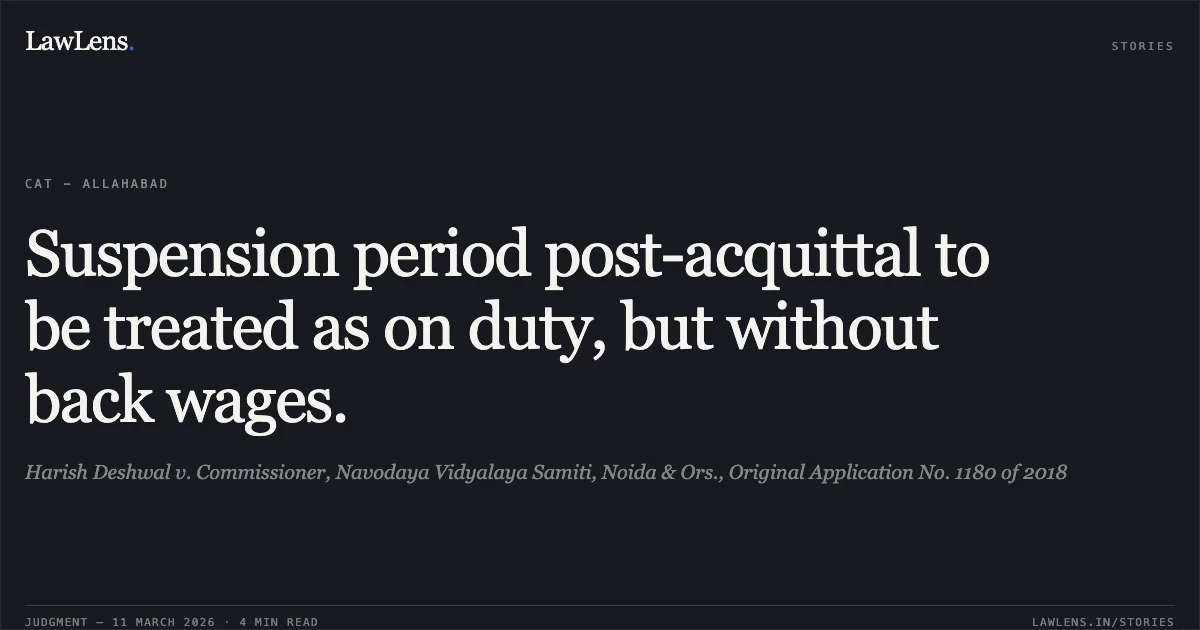
Source reference: p.11Further, the period from August 11, 2011 (date of intimation of release) to July 19, 2013 (date of suspension revocation), was directed to be treated as "on duty"
Source reference: p.11However, the applicant was not held entitled to any back wages for the said period
Source reference: p.11This exercise is to be completed within three months from the date of receipt of the order
Source reference: p.11Acts & Sections Cited
3 provisions across 2 statutes referred to in this judgment. Each provision opens on LawLens.
Administrative Tribunals Act, 19851
Original Court PDF
Harish Deshwal v. Commissioner, Navodaya Vidyalaya Samiti, Noida & Ors., Original Application No. 1180 of 2018
Click to open original judgment
Original judgment, available to read, download and summarize on LawLens.in


