Facts
The respondent-accused was the husband of Hemlataben, who died on 6 March 2010 from burn injuries sustained after she allegedly poured kerosene on herself and set herself ablaze on 28 February 2010.
Source reference: pp.1–4; para. 12The prosecution alleged that the accused had habitually suspected her character and subjected her to mental and physical cruelty, thereby abetting her suicide.
Source reference: pp.1–4; para. 12A dying declaration and a police statement were recorded after the incident.
Source reference: pp.1–4; para. 12However, the police initially recorded the matter as an accidental death/Janva Jog entry, and the complainant-father lodged the FIR only on 9 March 2010 under Sections 498A and 306 IPC.
Source reference: pp.1–4; para. 12The accused was tried in Sessions Case No. 61 of 2012 and acquitted by the trial court on 31 July 2012.
Source reference: pp.1–4; para. 12The State preferred the present appeal against acquittal under Section 378(1) and (3) CrPC.
Source reference: pp.1–4; para. 12Issues
1. Whether the trial court was justified in acquitting the respondent of offences under Sections 306 and 498A IPC
Source reference: p.7; para. 112. Whether the trial court properly appreciated the oral and documentary evidence led by the prosecution
Source reference: p.7; para. 113. Whether the impugned judgment of acquittal suffered from illegality, irregularity, or perversity warranting appellate interference
Source reference: p.7; para. 11Law Applied
The Court applied Sections 306 and 498A IPC, read with Section 107 IPC.
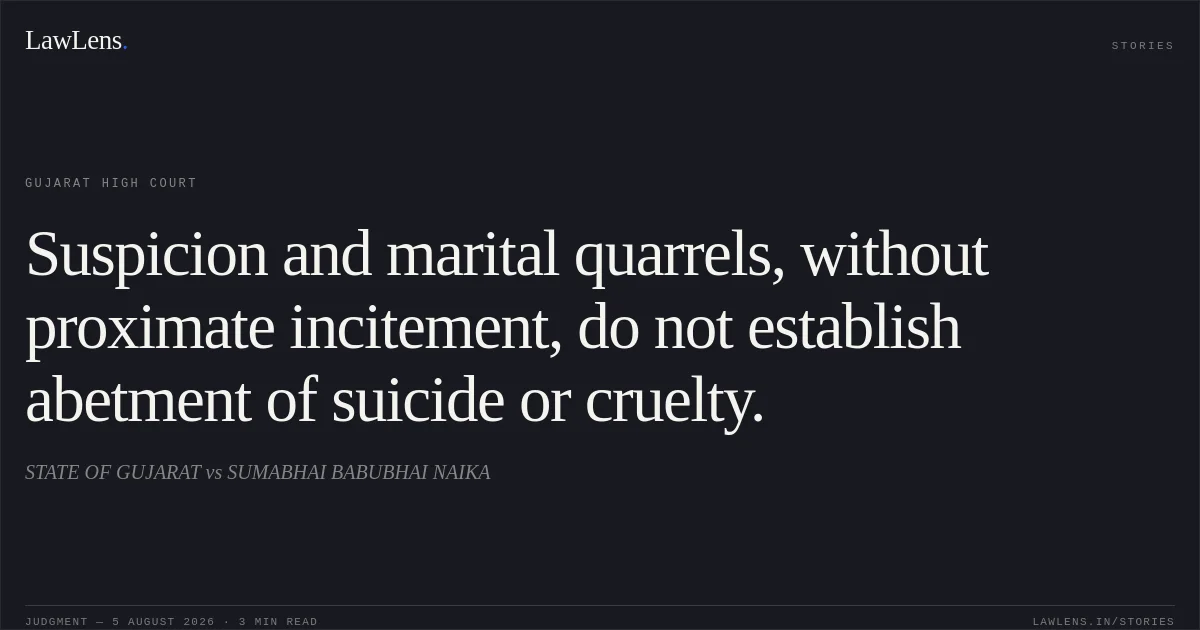
Source reference: pp.9–10; para. 13Conviction under Section 306 requires proof of abetment, including a proximate act of instigation, conspiracy, or intentional aid that drives the deceased to commit suicide; allegations of general quarrels or suspicion, without a proximate causal connection, are insufficient.
Source reference: pp.9–10; para. 13The Court also considered the principles governing the evidentiary value of dying declarations stated in Irfan alias Naka v. State of Uttar Pradesh, AIR 2023 SC 4129, including voluntariness, consistency, absence of tutoring, proper recording, and whether the declaration was made at the earliest opportunity.
Source reference: pp.9–10; para. 13In an appeal against acquittal, although the appellate court has power to reappreciate the evidence, the accused enjoys a reinforced or “double” presumption of innocence, and acquittal should not be disturbed where two reasonable views are possible.
Source reference: pp.11–14; paras. 15–18These principles were drawn from Chandrappa v. State of Karnataka, (2007) 4 SCC 415; Rajesh Prasad v. State of Bihar, (2022) 3 SCC 471; Babu Sahebagouda Rudragoudar v. State of Karnataka, (2024) 8 SCC 149; and Ramesh v. State of Karnataka, (2024) 9 SCC 169.
Source reference: pp.11–14; paras. 15–18Reasoning
The High Court found that the prosecution evidence did not establish the statutory ingredients of cruelty or abetment beyond reasonable doubt.
Source reference: p.8; para. 12The unexplained delay in registering the FIR was material because the dying declaration and the initial police record allegedly disclosed a cognizable offence, yet the matter was not promptly registered as an FIR.
Source reference: p.8; para. 12None of the police witnesses satisfactorily explained this omission.
Source reference: p.8; para. 12The parents and independent witnesses did not support the prosecution, leaving the dying declaration as the principal incriminating material.
Source reference: p.8; para. 12.1Even accepting the declaration as truthful, it referred only to the accused’s suspicion regarding the deceased’s chastity and quarrels arising from that suspicion; it did not describe any specific, proximate act of instigation or conduct sufficient to constitute cruelty under Section 498A or abetment under Sections 107 and 306 IPC.
Source reference: p.10; para. 13.1Applying the restrictive standard applicable to an appeal against acquittal, the Court held that the trial court’s view was reasonable and neither perverse nor manifestly illegal.
Source reference: pp.11–14; paras. 15–20Holding
The High Court answered the issues in favour of the respondent.
It held that the prosecution failed to prove beyond reasonable doubt that the accused subjected the deceased to cruelty or abetted her suicide.
Source reference: pp.14–15; paras. 20–21Finding no illegality, infirmity, or perversity in the trial court’s acquittal, the Court dismissed the State’s appeal and confirmed the judgment and order of acquittal dated 31 July 2012.
Source reference: pp.14–15; paras. 20–21The respondent’s bail bond was cancelled, and the record and proceedings were directed to be returned to the trial court.
Source reference: pp.14–15; paras. 20–21Acts & Sections Cited
4 provisions across 2 statutes referred to in this judgment. Each provision opens on LawLens.
Code of Criminal Procedure, 19732
Indian Penal Code, 18602
Original Court PDF
STATE OF GUJARATvsSUMABHAI BABUBHAI NAIKA
Click to open original judgment
Original judgment, available to read, download and summarize on LawLens.in