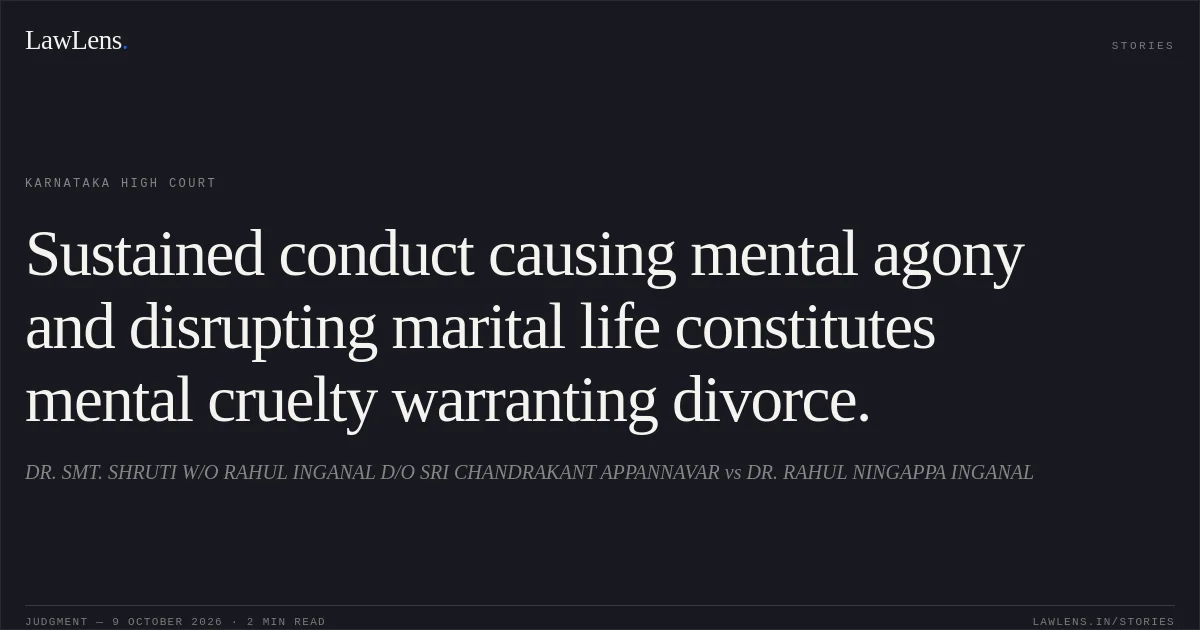
Facts
The parties, both medical practitioners, married on 4 May 2022.
Source reference: paras. 3–15The husband petitioned under Section 13 of the Hindu Marriage Act, alleging that the wife’s repeated quarrels, verbal abuse, and conduct caused him mental cruelty.
Source reference: paras. 3–15The wife denied those allegations and alleged ill-treatment by the husband and his family.
Source reference: paras. 3–15After receiving the parties’ evidence, the Family Court dissolved the marriage on 26 June 2024.
Source reference: paras. 3–15The wife appealed under Section 19(1) of the Family Courts Act, 1984.
Source reference: paras. 3–15The High Court also considered whether permanent alimony should be awarded to the wife.
Source reference: para. 31Issues
1. Whether the Family Court was justified in dissolving the marriage on the ground of cruelty, and whether its decree should be set aside.
Source reference: para. 18(i)2. Whether the wife should be awarded permanent alimony.
Source reference: para. 31Law Applied
Section 13 of the Hindu Marriage Act permits dissolution of marriage on the ground of cruelty.
Source reference: para. 29Relying on Samar Ghosh v. Jaya Ghosh, (2007) 4 SCC 511, the Court applied the principle that mental cruelty must be assessed on a comprehensive appraisal of the parties’ matrimonial life: ordinary irritations and isolated quarrels are insufficient, but persistent conduct causing serious mental anguish or making it unreasonable to expect the parties to continue living together may constitute cruelty.
Source reference: para. 29The appeal was brought under Section 19(1) of the Family Courts Act, 1984.
Source reference: case headingThe Court awarded permanent alimony but did not identify a statutory provision as the basis for doing so.
Source reference: para. 31Reasoning
The Court considered the parties’ evidence and the husband’s account of repeated quarrels, including incidents during the honeymoon and at home, and found that the conflict had persisted from the beginning of the marriage.
Source reference: paras. 23–30It concluded that the parties lacked mutual respect and effective communication, had lived apart, and that the relationship could not be revived; it therefore treated the conduct proved as more than ordinary marital “wear and tear” under the principles in Samar Ghosh.
Source reference: paras. 23–30Although the wife was also professionally qualified, the Court considered that her income did not match the standard of living during the marriage and that financial support was needed for her to maintain her status.
Source reference: para. 31Holding
The Court answered the challenge to the divorce decree in the negative and dismissed the wife’s appeal, confirming the Family Court’s judgment and decree dated 26 June 2024.
It additionally directed the husband to pay the wife permanent alimony of ₹20,00,000.
Source reference: para. 31Acts & Sections Cited
2 provisions across 2 statutes referred to in this judgment. Each provision opens on LawLens.
Family Courts Act, 19841
Hindu Marriage Act, 19551
Original Court PDF
DR. SMT. SHRUTI W/O RAHUL INGANAL D/O SRI CHANDRAKANT APPANNAVARvsDR. RAHUL NINGAPPA INGANAL
Click to open original judgment
Original judgment, available to read, download and summarize on LawLens.in
![Authorities must consider employees’ claims under cited precedents, subject to similarity and applicable rules.. Anwar Ul Hassan Chesti vs D/o Health And Medical Education Ut Of Jammu & Kashmir. CAT - ['Srinagar']. LawLens](/stories/thumbnails/authorities-must-consider-employees-claims-under-cited-precedents-subject-to-similarity-an-ea3a30d13510422ca1f750e161753fd2.webp)