Facts
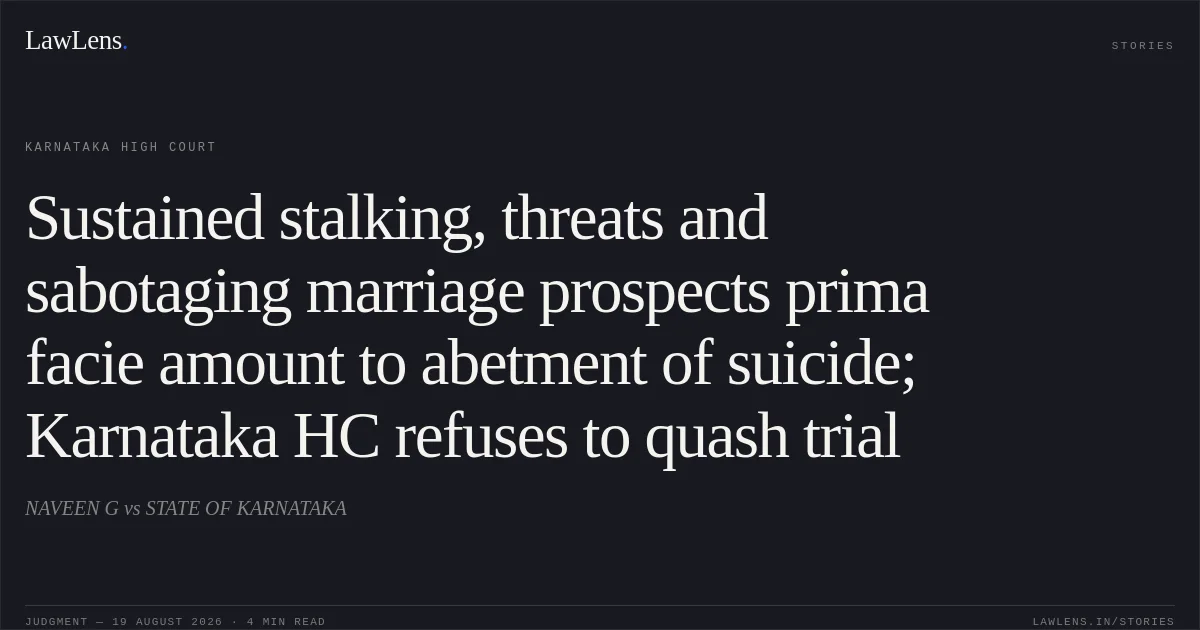
The petitioner was prosecuted in C.C. No.15565 of 2025 for offences under Sections 75, 78 and 108 of the Bharatiya Nyaya Sanhita, 2023 (“BNS”), arising from Crime No.138 of 2025 registered by Nelamangala Town Police Station.
Source reference: para. 2The deceased, Bhavana, aged 22, allegedly came into contact with the petitioner while studying nursing. The prosecution alleged that, despite her unwillingness, the petitioner repeatedly pursued her, insisted that she marry or enter into a relationship with him, followed her to her workplace, compelled her to accompany him, retained photographs of them together and threatened to circulate them if she refused his demands.
Source reference: paras. 2–4He allegedly interfered with her matrimonial prospects by contacting prospective grooms and informing them that he and Bhavana were in a relationship.
Source reference: paras. 3–4After an earlier suicide attempt by Bhavana on 5 July 2025, the family intervened and the petitioner allegedly assured them that he would desist; however, the alleged conduct continued. Bhavana died by suicide on 29 July 2025, following which the police investigated and filed a charge-sheet.
Source reference: paras. 3–4, 10–11The petitioner sought quashing of the proceedings under Section 528 of the Bharatiya Nagarik Suraksha Sanhita, 2023 (“BNSS”).
Source reference: no citationIssues
Whether the allegations in the complaint and charge-sheet prima facie disclosed the offences of sexual harassment and stalking under Sections 75 and 78 of the BNS.
Source reference: para. 12Whether the alleged continuing conduct of the petitioner constituted instigation, intentional aid or other legally sufficient abetment of suicide under Sections 45 and 108 of the BNS.
Source reference: paras. 13.1, 16Whether the High Court should exercise its inherent jurisdiction under Section 528 of the BNSS to quash the criminal proceedings at the pre-trial stage.
Source reference: paras. 14–16, 23Law Applied
Section 75 of the BNS criminalises specified forms of sexual harassment, while Section 78 criminalises repeated following or attempted contact despite a clear indication of disinterest.
Source reference: para. 12Section 108 punishes abetment of suicide, and its operation is governed by Section 45, which defines abetment through instigation, conspiracy or intentional aid.
Source reference: paras. 13–13.1The Court applied the principle that “instigation” involves goading, urging, provoking, inciting or encouraging the commission of an act, and may arise from a continuing course of conduct creating circumstances in which the deceased is left with no reasonable alternative, subject to proof of the requisite mens rea.
Source reference: para. 14.1, citing Ramesh Kumar v. State of Chhattisgarh and Chitresh Kumar Chopra v. State (NCT of Delhi)It also relied on Amalendu Pal v. State of West Bengal for the principle that harassment must be accompanied by a positive act proximate to the suicide.
Source reference: para. 14.1At the quashing stage, the Court cannot assess the veracity or sufficiency of evidence or conduct a mini-trial; it must determine whether the allegations, taken at face value, prima facie constitute the alleged offences.
Source reference: paras. 14–16, citing Rajeev Kourav v. Baisahab, Mahendra K.C. v. State of Karnataka and State of Haryana v. Bhajan LalThe Court also considered Abhinav Mohan Delkar v. State of Maharashtra, which emphasises that abetment requires a proximate act and an inferable conscious intention to drive the victim to suicide.
Source reference: para. 14.3Reasoning
The Court held that the allegations, read cumulatively rather than as isolated incidents, disclosed a continuing course of coercive conduct: persistent pursuit despite the deceased’s disinterest, threats concerning private photographs, stalking, obstruction of matrimonial negotiations and continued interference even after an earlier suicide attempt and intervention by the family and elders.
Source reference: paras. 10–11, 17–20These allegations prima facie satisfied the statutory contours of sexual harassment and stalking under Sections 75 and 78 of the BNS.
Source reference: para. 12For Section 108, the Court found prima facie material indicating instigation and goading through the petitioner’s persistent coercive conduct, and proximity through the continuation of that conduct shortly before the deceased’s suicide.
Source reference: paras. 16, 18–22Although the petitioner relied on the absence of a direct command to commit suicide and lack of proximity, the Court held that the alleged conduct could not be evaluated piecemeal and that the petitioner’s mens rea and causal connection were matters for evidence at trial.
Source reference: paras. 19–22Applying the restrictive principles governing Section 528 BNSS, the Court concluded that the case did not fall within any category warranting quashing, since the prosecution was neither inherently improbable nor devoid of prima facie material.
Source reference: paras. 14–16, 23Holding
The High Court answered the issues against the petitioner. It held that the complaint and charge-sheet prima facie disclosed offences under Sections 75, 78 and 108 of the BNS and that the allegations of persistent pursuit, coercion, interference with matrimonial prospects and conduct continuing after an earlier suicide attempt required adjudication at trial.
The petition under Section 528 BNSS was dismissed, and the proceedings in C.C. No.15565 of 2025 before the II Additional Civil Judge and JMFC, Nelamangala, were permitted to continue.
Source reference: para. 25Acts & Sections Cited
13 provisions across 4 statutes referred to in this judgment. Each provision opens on LawLens.
Bharatiya Nagarik Suraksha Sanhita, 20231
Bharatiya Nyaya Sanhita, 20234
Indian Penal Code, 18604
Code of Criminal Procedure, 19734
Original Court PDF
NAVEEN GvsSTATE OF KARNATAKA
Click to open original judgment
Original judgment, available to read, download and summarize on LawLens.in