Facts
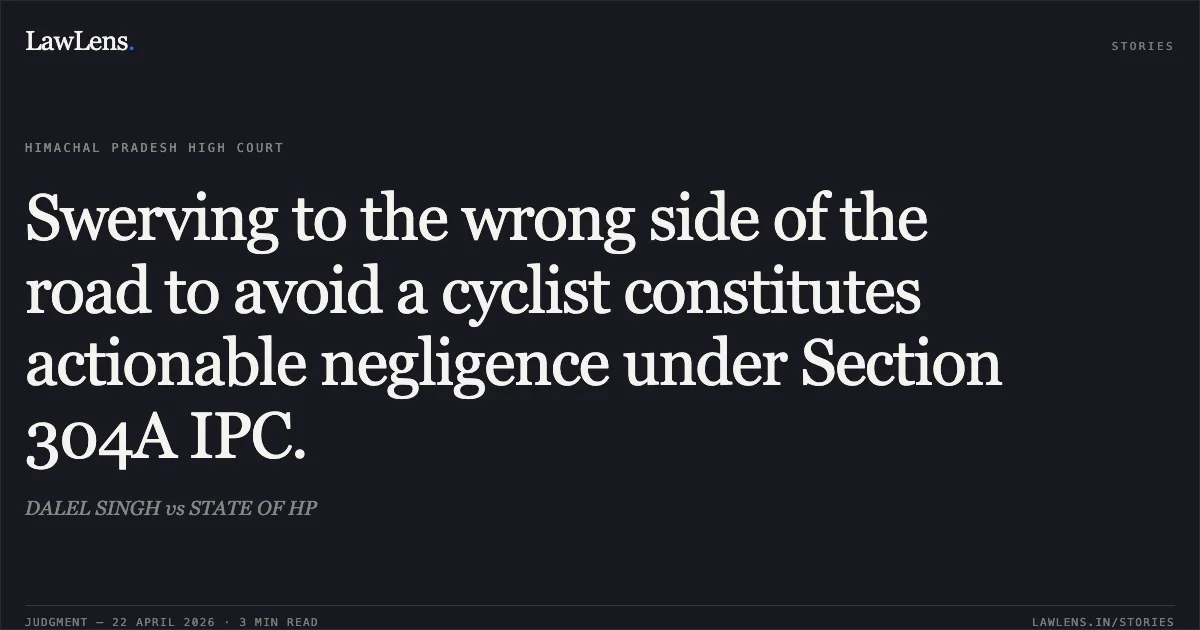
The petitioner (accused), driving a "Tikra Coach" bus (HP-20-4957) on March 15, 2007, hit a cyclist and subsequently swerved to the wrong side of the road, colliding with a motorcycle.
Source reference: para. 2The collision resulted in the immediate death of two persons, Surinder Kumar and Rohit, and caused injuries to the cyclist, Hussan Lal.
Source reference: para. 2, 37The Trial Court convicted the accused under Sections 279, 337, and 304A of the IPC, sentencing him to two years of simple imprisonment.
Source reference: para. 6The Appellate Court upheld these findings on January 24, 2015.
Source reference: para. 7The petitioner moved the High Court in revision, arguing that the accident occurred due to an error of judgment while attempting to save the cyclist, thus seeking protection under Section 81 of the IPC.
Source reference: para. 8, 10Issues
1. Whether the High Court, in its revisional jurisdiction, can re-appreciate evidence to overturn concurrent findings of fact regarding the negligence of the driver.
Source reference: para. 13-172. Whether the act of the accused is protected under the doctrine of necessity as per Section 81 of the IPC.
Source reference: para. 27-283. Whether the benefits of the Probation of Offenders Act, 1958, should be extended to a convict under Section 304A of the IPC in cases of fatal road accidents.
Source reference: para. 41-44Law Applied
The court applied Section 397 of the CrPC, which limits revisional jurisdiction to correcting patent defects, jurisdictional errors, or perversity rather than re-evaluating evidence.
Source reference: para. 13-16Substantively, it applied Section 81 of the IPC (Doctrine of Necessity), which excuses acts done in good faith to prevent "greater harm".
Source reference: para. 27The court relied on the Rules of the Road Regulations, 1989, specifically Rule 2 regarding the duty to drive on the left.
Source reference: para. 30The principle from Fagu Moharana v. State that driving on the wrong side constitutes negligence.
Source reference: para. 30Regarding sentencing, it followed Dalbir Singh v. State of Haryana, which mandates deterrent punishment for rash driving and discourages the use of the Probation of Offenders Act for Section 304A offenses.
Source reference: para. 41-42Reasoning
The court observed that the petitioner’s identity as the driver was established by his own defense strategy—specifically the cross-examination suggestions that he swerved to save a cyclist, which binds the accused as per Balu Sudam Khalde v. State of Maharashtra.
Source reference: para. 25-26The court rejected the Section 81 IPC defense, reasoning that crushing two people to death to avoid hitting one cyclist does not constitute "lesser harm".
Source reference: para. 28Technical evidence, including the site plan (Ext.PW14/A) and photographs (Ext.P3), proved the bus was on the extreme right (wrong) side of the road.
Source reference: para. 29, 32Furthermore, the fact that the motorcycle was dragged for 30 feet indicated high speed and an inability to control the heavy vehicle, satisfying the criteria for "rash and negligent" conduct.
Source reference: para. 34-35The court noted that in the absence of jurisdictional error or perversity, concurrent factual findings cannot be disturbed.
Source reference: para. 18, 40Holding
The High Court held that the doctrine of necessity under Section 81 IPC is inapplicable when the harm caused (multiple deaths) is greater than the harm avoided.
The court held that the benefit of probation cannot be granted in Section 304A cases involving professional drivers and fatal consequences, emphasizing the need for a "fear psyche" and deterrence to curb the "galloping trend" of road accidents.
Source reference: para. 41-44The High Court dismissed the revision petition, affirming the conviction and the two-year sentence.
Source reference: para. 45, 47Acts & Sections Cited
4 provisions across 2 statutes referred to in this judgment. Each provision opens on LawLens.
Indian Penal Code, 18603
Probation of Offenders Act, 19581
Original Court PDF
DALEL SINGHvsSTATE OF HP
Click to open original judgment
Original judgment, available to read, download and summarize on LawLens.in