Facts
The Appellant filed Indian Patent Application No. 450/DELNP/2015 for a pharmaceutical combination comprising a B-Raf inhibitor (Encorafenib), an EGFR inhibitor (Cetuximab/Erlotinib), and optionally a PI3K-alpha inhibitor (Alpelisib) for treating proliferative diseases
Source reference: para 1, 3.1Despite providing clinical trial data showing synergistic effects—specifically a 12% reduction in tumor progression for dual therapy and 2% tumor regression for triple therapy—the Deputy Controller refused the application on June 30, 2023
Source reference: para 2.5, 3.4, 3.17The refusal was grounded in lack of inventive step under Section 2(1)(ja), and non-patentability under Sections 3(d) (derivatives of known substances) and 3(i) (method of treatment) of the Patents Act, 1970
Source reference: p. 1, para 1Issues
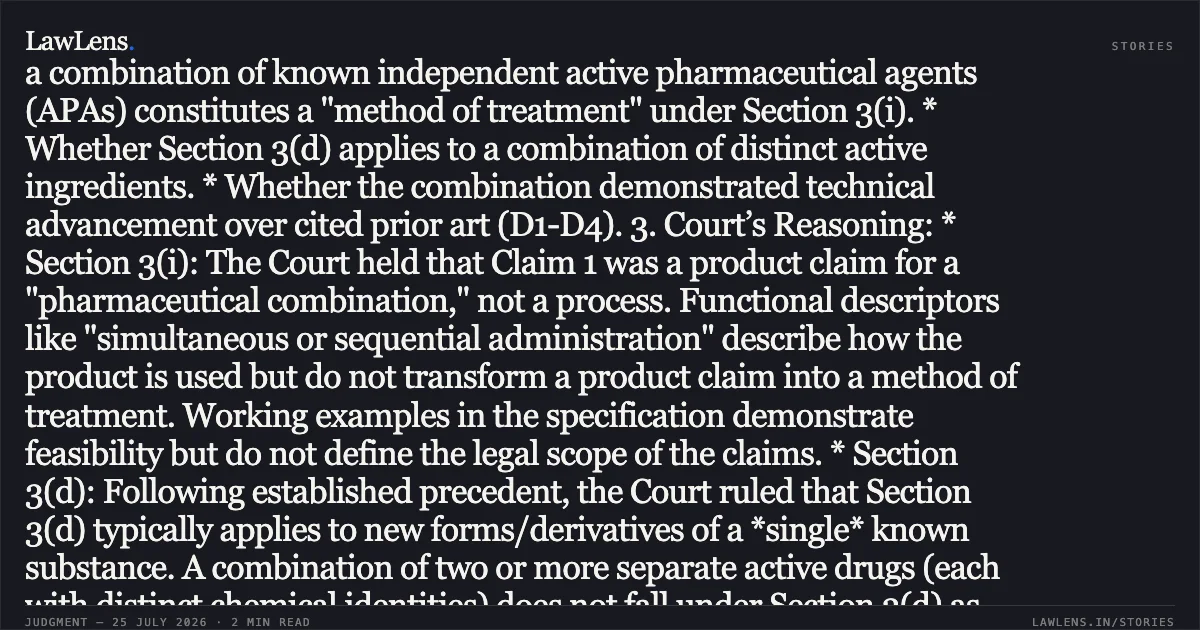
1. Whether the pharmaceutical combination constitutes a non-patentable "method of treatment" under Section 3(i)
Source reference: para 452. Whether the combination falls under the Section 3(d) prohibition against new forms of known substances without enhanced efficacy
Source reference: para 37, 393. Whether the claimed invention lacks an inventive step under Section 2(1)(ja) in view of prior arts D1-D4
Source reference: para 3.17, 4.3Law Applied
Section 3(i) of the Patents Act, 1970, which excludes processes for the medicinal treatment of humans but does not bar product/composition claims
Source reference: para 47, 51Regarding Section 3(d), it followed the principle from Topotarget UK Ltd. v. Controller General of Patents, holding that a combination of separate active drugs cannot be treated as "derivatives" of each other
Source reference: para 41Section 2(1)(ja) for inventive step, where the court looked for technical advancement over prior art
Source reference: para 1, 3.17Bayer Pharma Aktiengesellschaft v. Controller of Patents to establish that working examples (dosage/schedules) in a specification demonstrate feasibility and do not convert a product claim into a method of treatment
Source reference: para 50Reasoning
The Court found the Controller’s objection under Section 3(i) misplaced, noting that Claim 1 is framed as a "pharmaceutical combination" (a product) and the administration terms are merely functional descriptors, not method steps
Source reference: para 48, 51On Section 3(d), the Court observed that the Controller failed to identify any "known substance" from which the combination was derived and noted that a mix of independent active agents falls outside the scope of "derivatives" mentioned in the Section 3(d) Explanation
Source reference: para 42, 43Regarding inventive step, the Court analyzed prior arts D1-D4 and determined that none disclosed the specific combination of Encorafenib and Cetuximab/Erlotinib
Source reference: para 25, 29The Court held that the Controller failed to explain how a Person Skilled in the Art (PSITA) would be motivated to select and combine these specific compounds from the broad teachings of the prior art
Source reference: para 28, 35The Court credited the Appellant’s clinical data as evidence of technical advancement and surprising results (tumor regression) which the Controller failed to properly rebut
Source reference: para 31, 36Holding
The Court answered the issues in favor of the Appellant, holding that the claims are product claims not hit by Section 3(i), do not fall under Section 3(d) as they are not simple derivatives, and possess a prima facie inventive step ignored by the Controller
The Court set aside the impugned order and remanded the application to the Controller for de novo reconsideration, with directions to dispose of the application within six months after providing a fresh hearing
Source reference: para 54, 55Acts & Sections Cited
4 provisions across 1 statute referred to in this judgment. Each provision opens on LawLens.
Patents Act, 19704
Original Court PDF
Array Biopharma IncvsDeputy Controller Of Patents And Designs
Click to open original judgment
Original judgment, available to read, download and summarize on LawLens.in