Facts
The Tahsildar received information that rice was being removed from a Karnataka State Food and Civil Supplies Corporation godown and loaded onto a lorry for alleged illegal transportation. He, along with food and revenue officials and two panch witnesses, raided the godown. The complaint alleged that 65 bags had been loaded and 177 more were ready for loading, amounting to 242 bags of rice weighing 12,100 kg; the rice and empty jute bags were seized under a mahazar.
Source reference: p. 3–5On the Tahsildar’s complaint, the police registered Crime No. 135/2020 for alleged offences under Sections 3 and 7 of the Essential Commodities Act, 1955. The petitioners sought quashing under Section 482 Cr.P.C., principally challenging the Tahsildar’s authority to conduct the raid and lodge the complaint, and disputing that a spot mahazar had been drawn.
Source reference: p. 5–7, 10Issues
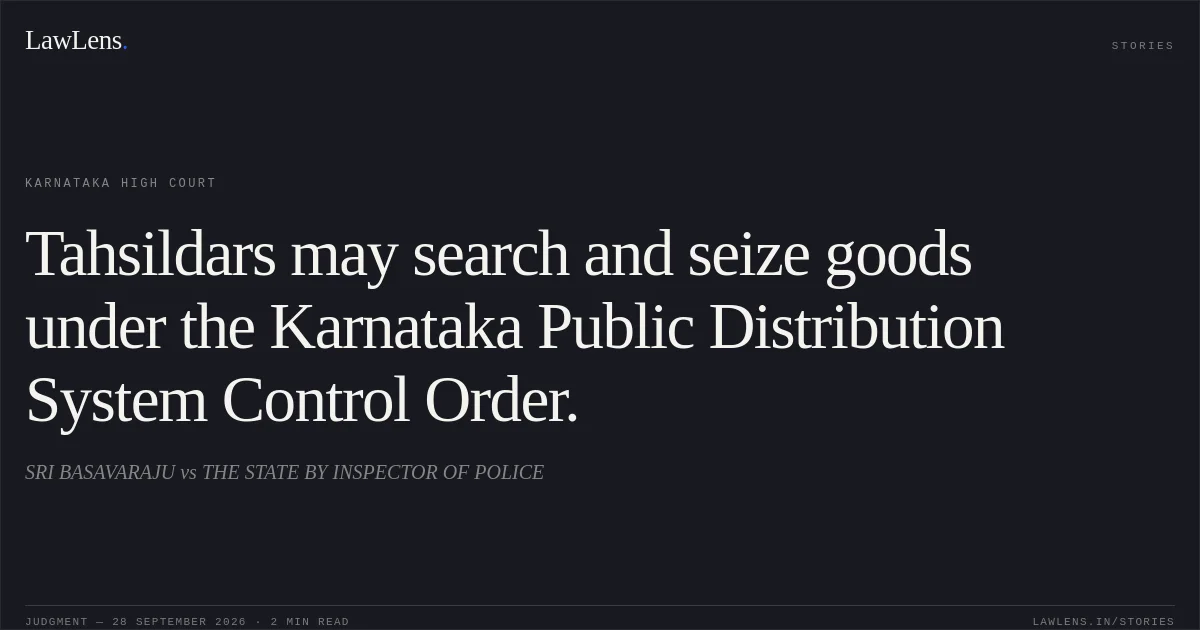
Whether the Tahsildar was empowered to search the godown and seize the rice under the Karnataka Essential Commodities (Public Distribution System) Control Order, 1992.
Source reference: p. 8–10Whether the alleged absence of a spot mahazar, or the asserted defect in the Tahsildar’s authority to complain, warranted quashing the complaint and FIR under Section 482 Cr.P.C.
Source reference: p. 5–7, 10–11Law Applied
Sections 3 and 7 of the Essential Commodities Act, 1955, provide the basis for penal action for contravention of an order regulating essential commodities; Section 11 restricts cognizance of an offence under the Act to a written report by a public servant.
Source reference: p. 5–6Regulation 19(1) of the Karnataka Essential Commodities (Public Distribution System) Control Order, 1992 empowers specified officials, including a Tahsildar, to search and seize where there is reason to believe that the Order has been or is being contravened.
Source reference: p. 8–10The Court also referred to Section 100 Cr.P.C. in connection with search procedure and cited Lalitha Kumari v. State of U.P., (2014) 2 SCC 1, on registration of an FIR in cognizable cases, but distinguished it on the facts.
Source reference: p. 7, 9–10Section 482 Cr.P.C. provides the jurisdiction invoked by the petitioners to seek quashing.
Source reference: p. 2, 5Reasoning
The Court held that Regulation 19(1) expressly conferred search-and-seizure powers on a Tahsildar, rejecting the petitioners’ contention that the Tahsildar lacked authority to conduct the raid.
Source reference: p. 8–10It distinguished the petitioners’ reliance on Lalitha Kumari because that case involved a police officer conducting the raid, whereas the raid here was conducted by an official empowered under the PDS Control Order.
Source reference: p. 7, 9–10The Court also found that the record disclosed a spot mahazar and seizure of the rice, including the bags already loaded and those prepared for loading; it therefore rejected the contention that no mahazar had been conducted.
Source reference: p. 10In light of those materials, it found no basis to exercise Section 482 jurisdiction to quash the proceedings.
Source reference: p. 10–11Holding
The Court answered the authority and mahazar challenges against the petitioners and dismissed the criminal petition.
The complaint and FIR in Crime No. 135/2020 were not quashed.
Source reference: p. 11Acts & Sections Cited
7 provisions across 3 statutes referred to in this judgment. Each provision opens on LawLens.
Code of Criminal Procedure, 19732
Essential Commodities Act, 19554
Indian Penal Code, 18601
Original Court PDF
SRI BASAVARAJUvsTHE STATE BY INSPECTOR OF POLICE
Click to open original judgment
Original judgment, available to read, download and summarize on LawLens.in