Facts
The petitioner claimed 50 cents in S.No. 282/3 under a registered sale deed dated 17.06.2004.
Source reference: paras. 2, 5–6, 10–11; pp. 3–6, 10–11The sixth respondent claimed 2.10 acres in the same survey number under a court-auction sale certificate dated 04.12.2006 and sought a survey.
Source reference: paras. 2, 5–6, 10–11; pp. 3–6, 10–11After the petitioner’s earlier writ petition and appeal were dismissed with liberty for him to participate in the enquiry, he did not appear at the enquiry, and the Tahsildar directed the survey.
Source reference: paras. 2, 5–6, 10–11; pp. 3–6, 10–11During the present writ proceedings, an initial survey was conducted and later a resurvey was ordered. The resulting sketch placed the petitioner’s 50 cents in a position inconsistent with the boundary descriptions in the parties’ title documents.
Source reference: paras. 17–19; pp. 16–18Issues
1. Whether the authorities could survey and determine a disputed boundary between privately owned lands under the Tamil Nadu Survey and Boundaries Act, 1923
Source reference: paras. 12–14; pp. 12–142. Whether the survey order was liable to be set aside for want of a proper opportunity to the petitioner
Source reference: paras. 10–12; pp. 10–123. Whether the survey sketch correctly identified the parties’ properties by reference to their title documents and, if not, what further relief was appropriate
Source reference: paras. 18–19; pp. 17–18Law Applied
Under Section 3(i) and (ii) of the Tamil Nadu Survey and Boundaries Act, 1923, “Government land” includes land not forming part of an “estate,” whether owned by the Government or a private person; accordingly, the Act’s survey provisions are not confined to Government-owned land.
Source reference: paras. 12–14; pp. 12–14Section 10 empowers a survey officer, after necessary inquiry, to determine and record a disputed boundary, with notice of the decision to affected parties and registered holders; the Act provides an appeal under Section 11, a second appeal under Section 12-A, revision under Section 12-B, and a suit to establish rights under Section 14.
Source reference: paras. 13–14; pp. 13–14A survey determination does not itself resolve title or possession, which remain matters for the civil court.
Source reference: para. 15; p. 15*E. Achuthan Nair v. P. Narayanan Nair*, (1987) 4 SCC 71, recognizes the civil nature of boundary disputes but does not make a civil suit the exclusive remedy where Section 10 applies.
Source reference: para. 15; p. 15The Court distinguished *Rajavel v. Muthusamy*, W.A.(MD) No. 3204 of 2025, because the definition of “Government land” was not considered there.
Source reference: para. 14; p. 14Reasoning
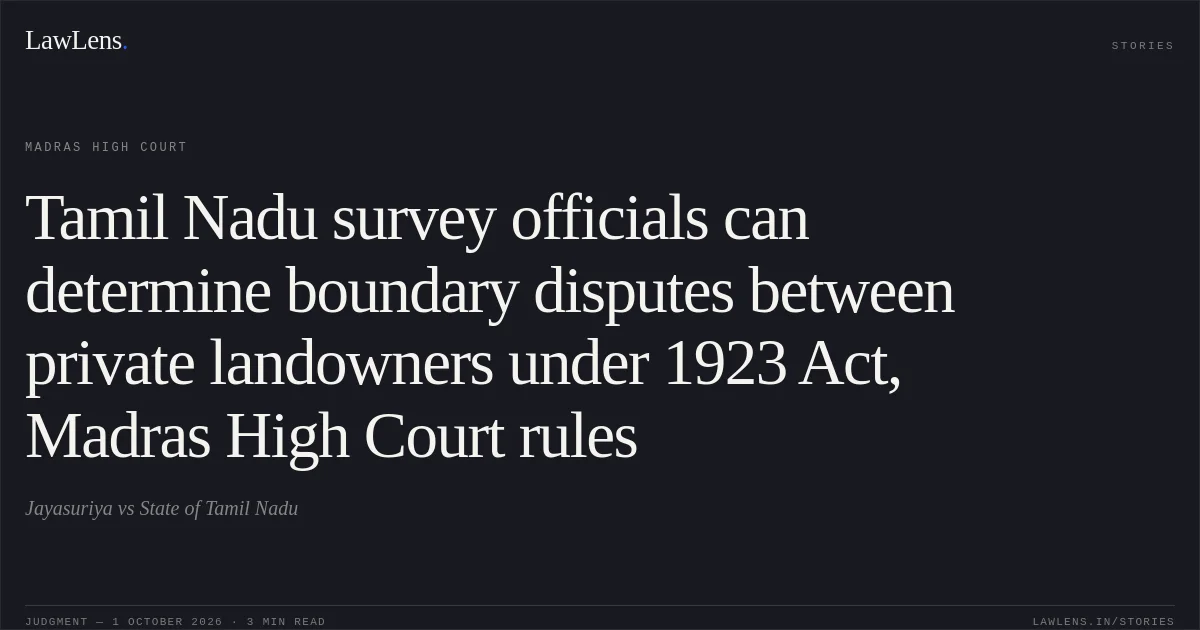
The Court rejected the petitioner’s jurisdictional objection because the Act’s definition of “Government land” extends to land outside an estate, including privately owned land, and Section 10 authorizes boundary determination after inquiry.
Source reference: paras. 12–14; pp. 12–14It also rejected the natural-justice challenge: the petitioner had been expressly given an opportunity to appear at the enquiry but did not do so.
Source reference: paras. 10–11; pp. 10–11However, the survey sketch itself was inconsistent with the parties’ title documents: those documents placed the petitioner’s property to the east of the sixth respondent’s property, whereas the sketch showed the sixth respondent’s property as the petitioner’s northern boundary.
Source reference: paras. 8–9, 18–19; pp. 8–9, 17–18The Court therefore declined to accept the sketch and directed a further survey based on the documents’ boundary descriptions and extents, without treating the survey as a final determination of title.
Source reference: paras. 9, 19; pp. 9, 18Holding
The Court did not quash the order directing a survey and held that the Act permits boundary surveys of private lands outside an estate.
It disposed of the writ petition by directing the fourth respondent to resurvey and earmark both parties’ properties by reference to their title documents and stated extents.
Source reference: paras. 16, 19–20; pp. 16, 18–19If the properties could not be identified on that basis, the parties were to be relegated to the civil court.
Source reference: paras. 16, 19–20; pp. 16, 18–19No costs were ordered.
Source reference: paras. 16, 19–20; pp. 16, 18–19Acts & Sections Cited
7 provisions across 1 statute referred to in this judgment. Each provision opens on LawLens.
TAMIL NADU SURVEY AND BOUNDARIES ACT, 19237
Original Court PDF
JayasuriyavsState of Tamil Nadu
Click to open original judgment
Original judgment, available to read, download and summarize on LawLens.in