Facts
The batch comprised petitions by retired employees and family members of deceased employees seeking retirement benefits, family pension, revisions and arrears.
Source reference: pp. 2–3Their representations to the relevant departments, institutions or societies had remained pending, in some instances since 2024.
Source reference: pp. 2–3The respondents cited pending writ proceedings or a need for further documents as reasons for not deciding them.
Source reference: pp. 2–3The Court examined the Government’s existing instructions on acknowledgement and time-bound disposal of grievance petitions, including the Tamil Nadu Government Office Manual.
Source reference: pp. 5–10Issues
Whether the respondents could leave the petitioners’ representations concerning pension and retirement benefits undecided, rather than seek any missing material and pass a decision within the prescribed time.
Source reference: pp. 2–3, 10–12Whether directions were required to ensure that Government departments comply with existing timelines and address failures to do so.
Source reference: pp. 13–18Law Applied
Article 350 of the Constitution recognises a person’s right to submit a representation for redress of a grievance.
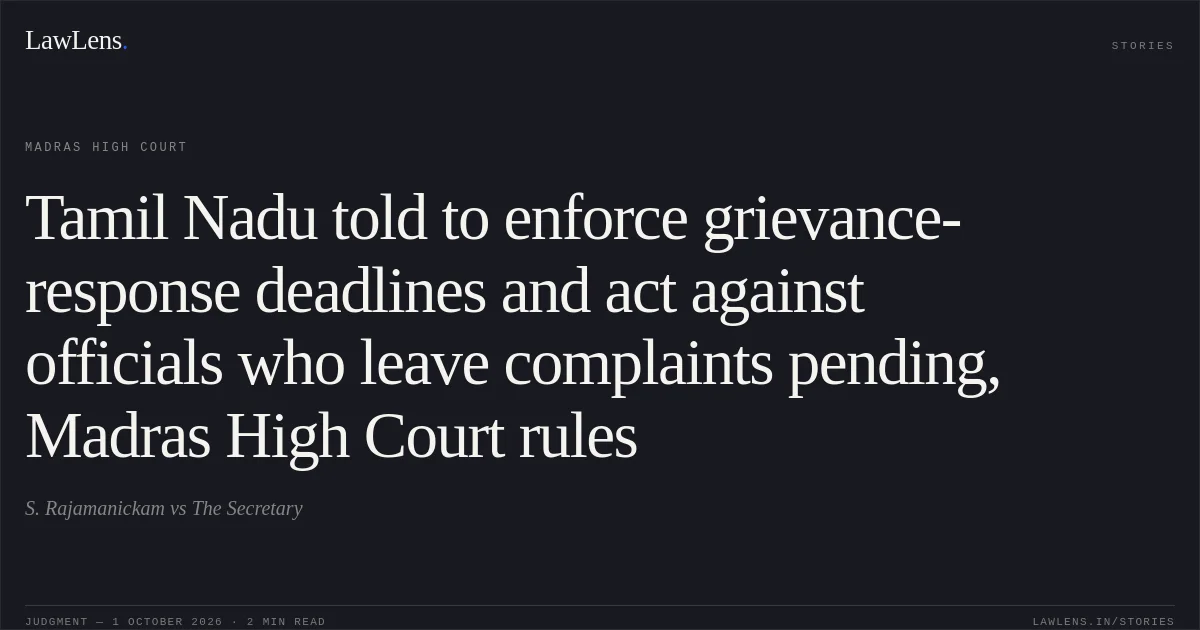
Source reference: p. 14Government instructions, including G.O.Ms.No.99 dated 21.09.2015 and G.O.Ms.No.73 dated 11.06.2018, require grievance petitions to be disposed of by a reasoned order within a maximum period of thirty days or one month, with the applicant informed if additional time is required.
Source reference: pp. 6–10The Office Manual also provides for monitoring complaints concerning delay in pension and gratuity.
Source reference: pp. 6–10Rule 20 of the Tamil Nadu Government Servants Conduct Rules requires integrity and devotion to duty and treats habitual failure to perform assigned tasks within time as lack of devotion to duty.
Source reference: pp. 15–16The Court relied on S.P. Moorthy v. District Collector, Kancheepuram and W.P.No.32798 of 2024 on timely, reasoned disposal of representations, and on Vijayalechumi Gopalapillai v. Principal Secretary to Government regarding the duty to decide representations.
Source reference: pp. 7–10, 15It also referred to Government of India v. P. Venkatesh, which cautioned against routine “dispose of the representation” orders, and G. Soundarrajan v. District Registrar on the burden of routine mandamus petitions.
Source reference: pp. 11–13Reasoning
The Court found that representations had remained pending despite clear Government instructions prescribing time limits and requiring applicants to be told when further information or time was needed.
Source reference: pp. 3, 10–17A pending writ petition or a need for additional documents did not justify indefinite inaction; the authority should communicate any deficiency and decide the representation.
Source reference: pp. 3, 10–17Such delay both derelicted an administrative duty and compelled avoidable litigation, consuming judicial time and public and private resources.
Source reference: pp. 3, 10–17Given the repeated non-compliance, the Court considered it necessary not only to direct decisions in the individual cases but also to require Government-level instructions and effective monitoring.
Source reference: pp. 16–17Holding
The Court directed the Chief Secretary and the Secretary to Government, Human Resource and Management Department, to instruct all departments to follow the prescribed timelines, effectively monitor disposal, and consider appropriate disciplinary action where an officer fails without sufficient cause to dispose of a representation in time.
In the individual petitions, the respective respondents were directed to consider and dispose of the petitioners’ representations on their merits and in accordance with law within three months from receipt of the order; the Court did not itself determine entitlement to the claimed benefits.
Source reference: p. 18The writ petitions were disposed of with no order as to costs.
Source reference: p. 18Original Court PDF
S. RajamanickamvsThe Secretary
Click to open original judgment
Original judgment, available to read, download and summarize on LawLens.in