Facts
The petitioner, a former college lecturer, claimed that her employers deducted tax at source (TDS) from her salary for assessment years 2010–11 to 2013–14 but failed to correctly report the deductions, resulting in discrepancies in Form 26AS and outstanding tax demands.
Source reference: p. 4–8She had sought rectification from the Income Tax Officer in 2016, enclosing salary and TDS documents, but the requests had not been addressed.
Source reference: p. 4–8The petitioner sought to quash the demand notices and obtain directions for the TDS issue to be resolved.
Source reference: p. 3Issues
1. Whether the petitioner could be required to pay outstanding tax where she claimed that the relevant TDS had already been deducted from her salary by her employers, notwithstanding that it was not fully reflected in Form 26AS.
Source reference: p. 8–92. Whether the Income Tax authorities were required to examine the petitioner’s evidence, verify the deductions with the employers, and consider rectification of the demands.
Source reference: p. 9, 31–33Law Applied
Section 205 of the Income Tax Act, 1961 bars calling upon an assessee to pay tax to the extent it has been deducted at source; Section 201 treats a person who fails to deduct or, after deducting, fails to pay tax as an assessee-in-default, while Sections 192 and 203 respectively address the employer’s duty to deduct tax on salary and furnish a certificate of deduction.
Source reference: p. 10–23, 25–30Section 199 and Rule 37BA concern credit for TDS, including the requirement that the tax be paid to the Central Government for credit.
Source reference: p. 10–23, 25–30The Court relied on the principles in *Kartik Vijaysinh Sonavane v. CIT* (2022) 440 ITR 11 (Guj), *Chintan Bindra v. CIT* (2024) 470 ITR 346 (Del), and the Orissa High Court’s decision in *Malay Kar v. Union of India*, 2024 (II) ILR-CUT 796, as well as the CBDT circular dated 1 June 2015 and office memorandum dated 11 March 2016, for the proposition that a TDS-credit mismatch should not result in coercive recovery from the assessee to the extent tax was deducted.
Source reference: p. 10–23, 25–30Reasoning
The Court noted the mismatch between the TDS claimed and the amounts appearing in Form 26AS, alongside the petitioner’s materials indicating that deductions may have been made.
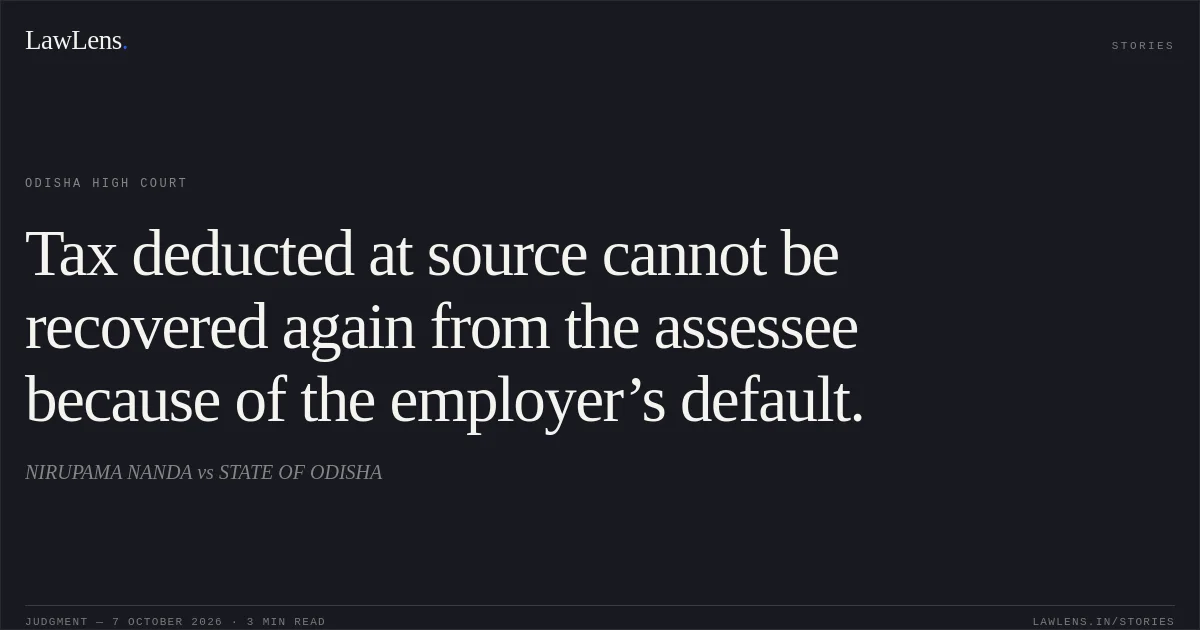
Source reference: p. 7–9, 31It held that, if TDS had in fact been deducted from her salary, the petitioner should not bear the consequences of an employer’s failure to deposit or correctly report it; the Department could investigate and pursue the employer as the alleged defaulting deductor.
Source reference: p. 12–13, 22–23Because the factual position still required verification, the Court directed the petitioner to submit supporting certificates and documents and required the competent officer, if necessary, to obtain records from or summon the employers before deciding whether to rectify the demands.
Source reference: p. 31–33Holding
The writ petition was disposed of with directions rather than an immediate quashing of the demands.
The petitioner was directed to approach the Income Tax Officer within 15 days with the relevant documents and a comprehensive application.
Source reference: p. 31–33The officer was to facilitate referral to the competent jurisdictional officer if needed; that officer was to verify the TDS claim, including by calling for employer records, and take necessary action to rectify or amend the demands if satisfied.
Source reference: p. 31–33The exercise was to be completed within three months of the petitioner’s first appearance.
Source reference: p. 31–33No order as to costs was made.
Source reference: p. 31–33Acts & Sections Cited
13 provisions across 2 statutes referred to in this judgment. Linked provisions open on LawLens.
Income Tax Act, 1961
Income-tax Act, 20251
Original Court PDF
NIRUPAMA NANDAvsSTATE OF ODISHA
Click to open original judgment
Original judgment, available to read, download and summarize on LawLens.in