Facts
The petitioner challenged an assessment order dated 24 December 2025 for FY 2021–22.
Source reference: para. 3-5; p. 2-3The respondent had uploaded notices to the GST portal, but the petitioner said it was unaware of them and had not received the show-cause notice.
Source reference: para. 3-5; p. 2-3The petitioner consequently did not reply, and the respondent passed the impugned order without providing a personal hearing.
Source reference: para. 3-5; p. 2-3The petitioner offered to pay 25% of the disputed tax to obtain a fresh consideration; the respondent did not oppose remand subject to that payment.
Source reference: para. 3-5; p. 2-3Issues
Whether the assessment order should be set aside where notices were uploaded to the GST portal but the petitioner received no personal hearing and did not respond
Source reference: para. 7-9; p. 3-5Whether remand for fresh consideration should be made conditional on payment of 25% of the disputed tax
Source reference: para. 10; p. 5Law Applied
Section 169(1) of the GST Act recognizes prescribed modes of service, including service through the GST portal and other modes such as registered post acknowledgment due (RPAD).
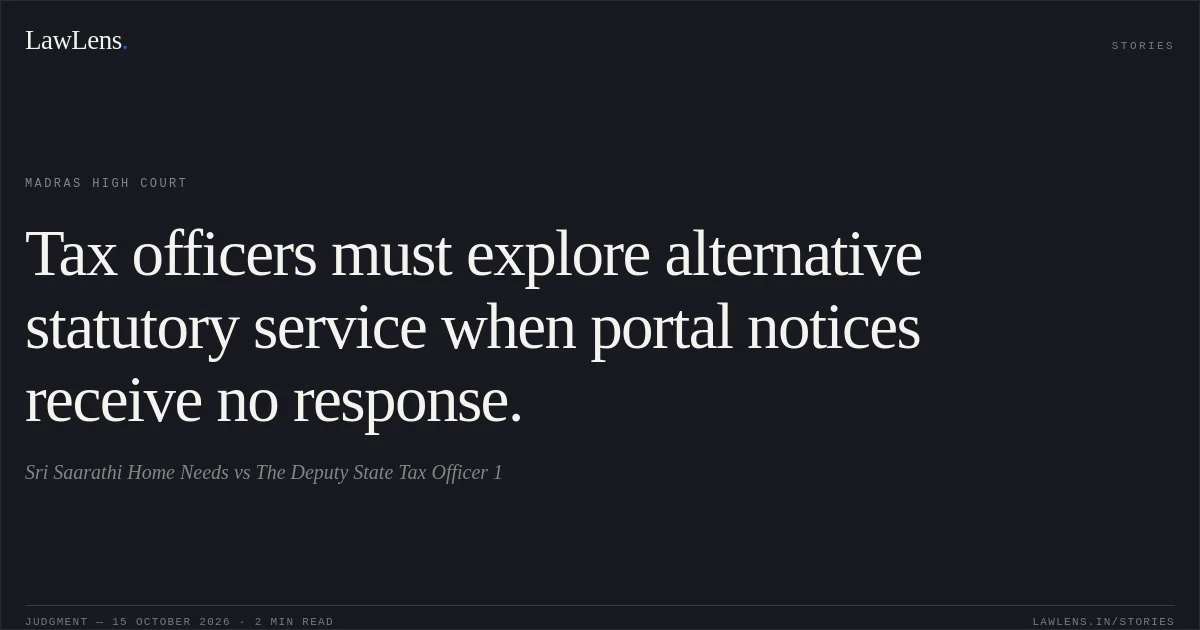
Source reference: para. 8-9; p. 4-5The Court held that although portal service is a valid mode, where a taxpayer does not respond to repeated portal notices, the officer should consider using another prescribed mode to achieve effective service.
Source reference: para. 8-9; p. 4-5An ex parte order should not be founded merely on formal compliance where reasonable steps could be taken to provide an effective opportunity to respond.
Source reference: para. 8-9; p. 4-5The Court also applied the requirement of a personal hearing before fresh adjudication.
Source reference: para. 10; p. 5No precedent was cited.
Source reference: para. 8-9; p. 4-5; para. 10; p. 5Reasoning
The Court accepted that uploading notices to the GST portal constitutes valid service, but distinguished formal validity from effective notice in the circumstances.
Source reference: para. 7-10; p. 3-5Given the petitioner’s non-response, the officer should have considered other modes under Section 169(1), preferably RPAD, rather than proceeding without an effective opportunity to participate.
Source reference: para. 7-10; p. 3-5The absence of a personal hearing further supported setting aside the order.
Source reference: para. 7-10; p. 3-5In view of the petitioner’s offer and the respondent’s position, the Court ordered remand subject to payment of 25% of the disputed tax.
Source reference: para. 7-10; p. 3-5Holding
The writ petition was disposed of and the assessment order was set aside, with the setting aside to take effect upon the petitioner’s payment of 25% of the disputed tax within four weeks of receiving the order.
Any amount already recovered or deposited may be adjusted against that payment.
Source reference: para. 10-11; p. 5-6The petitioner must file its reply and supporting documents within three weeks of payment; thereafter, the respondent must give 14 days’ clear notice fixing a personal hearing and pass fresh orders on the merits and in accordance with law.
Source reference: para. 10-11; p. 5-6No costs were ordered.
Source reference: para. 10-11; p. 5-6Acts & Sections Cited
1 provisions across 1 statute referred to in this judgment. Each provision opens on LawLens.
Central Goods and Services Tax Act, 20171
Original Court PDF
Sri Saarathi Home NeedsvsThe Deputy State Tax Officer 1
Click to open original judgment
Original judgment, available to read, download and summarize on LawLens.in