Facts
The petitioner challenged ex parte assessment orders dated 10 February 2026 and 4 March 2026, with consequential DRC-07 orders, for the 2024–25 tax period.
Source reference: pp. 2–3The notices had been uploaded to the GST portal, but the petitioner said he was unaware of them and had not received the original notices.
Source reference: pp. 2–3The respondent acknowledged that no personal hearing had been provided.
Source reference: pp. 2–3The petitioner offered to pay 25% of the disputed tax in each petition, and the respondent consented to remand on that condition.
Source reference: pp. 2–3, 5Issues
Whether the ex parte assessment orders should be set aside where notices were uploaded to the GST portal but no personal hearing was provided
Source reference: pp. 2–4Whether the matters should be remanded subject to payment of 25% of the disputed tax in each petition
Source reference: pp. 3, 5Law Applied
Section 169(1) of the GST Act provides for valid modes of service, including service through the GST portal and other prescribed methods.
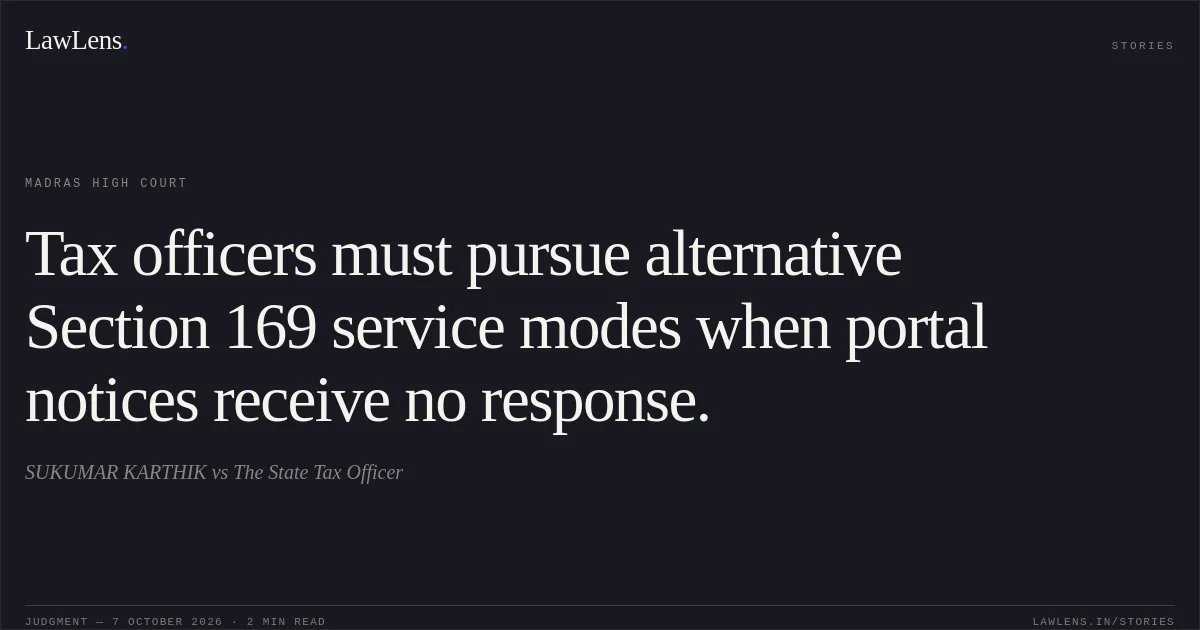
Source reference: pp. 4–5Although portal service is sufficient, where a taxpayer does not respond to notices, the officer should consider other available modes of service—preferably registered post with acknowledgment due—to make service effective rather than merely formal.
Source reference: pp. 4–5The Court also treated the absence of a personal hearing before the impugned orders as a relevant procedural deficiency.
Source reference: pp. 3–4Reasoning
The Court accepted that portal service was legally sufficient but considered that the petitioner’s lack of response should have prompted the officer to explore other modes of service under Section 169(1), particularly before proceeding ex parte.
Source reference: pp. 4–5The respondent also admitted that no personal hearing had been afforded.
Source reference: pp. 4–5In light of those circumstances, and the petitioner’s offer to pay 25% of the disputed tax in each matter, the Court found remand appropriate.
Source reference: pp. 4–5Holding
The Court set aside the orders dated 10 February 2026 and 4 March 2026 and remanded both matters for fresh consideration, subject to the petitioner paying 25% of the disputed tax in each petition within four weeks of receiving the order; setting aside would take effect upon payment.
The petitioner was to file replies and supporting documents within three weeks of payment.
Source reference: pp. 5–6The respondent was then to give 14 days’ clear notice fixing a personal hearing and pass fresh orders on the merits and in accordance with law.
Source reference: pp. 5–6The writ petitions were disposed of without costs.
Source reference: p. 6Acts & Sections Cited
1 provisions across 1 statute referred to in this judgment. Each provision opens on LawLens.
Central Goods and Services Tax Act, 20171
Original Court PDF
SUKUMAR KARTHIKvsThe State Tax Officer
Click to open original judgment
Original judgment, available to read, download and summarize on LawLens.in