Facts
The High Court had admitted the Revenue’s appeal under Section 260A of the Income Tax Act, 1961, and formulated substantial questions of law.
Source reference: paras. 3–6Birla Corporation filed a cross-objection raising questions that the Court considered linked to a reframed question concerning Section 14A and Rule 8D.
Source reference: paras. 3–6The cross-objection’s questions had not yet been admitted.
Source reference: paras. 3–6The Court therefore considered its maintainability before addressing the substantive issues.
Source reference: paras. 3–6Issues
Whether a respondent may file a cross-objection in an appeal before the High Court under Section 260A of the Income Tax Act, 1961, by virtue of Section 260A(7) and Order XLI Rule 22 of the Code of Civil Procedure, 1908?
Source reference: paras. 1, 7–10, 23–24Whether such a cross-objection must itself raise a substantial question of law within the scope of Section 260A?
Source reference: para. 35Law Applied
Section 260A(7) of the Income Tax Act provides that, save as otherwise provided in that Act, the CPC provisions relating to appeals to the High Court apply, as far as may be, to appeals under Section 260A.
Source reference: para. 24Order XLI Rule 22 CPC permits a respondent who has not appealed to support the decree and to file a cross-objection against an adverse part of it; Order XLII Rule 1 applies Order XLI, as far as may be, to appeals from appellate decrees.
Source reference: para. 23Section 100 CPC governs second appeals on substantial questions of law, while Section 103 concerns the High Court’s power to determine certain issues of fact in a second appeal.
Source reference: paras. 23, 28The Court also relied on Hari Shankar Rastogi v. Sham Manohar regarding cross-objections in second appeals, Bikram Singh v. Principal Commissioner of Income-Tax on the nature of a Section 260A appeal, and Municipal Corporation of Delhi v. International Security & Intelligence Agency Ltd. on the procedural character of a cross-objection.
Source reference: paras. 27, 31, 38Reasoning
The Court read Section 260A(7) as incorporating applicable CPC procedures into Section 260A appeals.
Source reference: paras. 31–37Because Order XLI Rule 22 permits cross-objections and Order XLII applies Order XLI to second appeals, the Court found no incompatibility between that procedure and Section 260A.
Source reference: paras. 31–37The absence of an express cross-objection provision in Section 260A did not exclude the procedural right, particularly given the Court’s view that a Section 260A appeal is akin to a second appeal.
Source reference: paras. 31–37The Court distinguished Section 253, which expressly governs cross-objections before the Tribunal, from Section 260A, which incorporates CPC appeal procedure.
Source reference: para. 37It nevertheless held that a cross-objection cannot expand the High Court’s jurisdiction: it must concern an adverse part of the Tribunal’s order and raise a substantial question of law under Section 260A.
Source reference: para. 35Holding
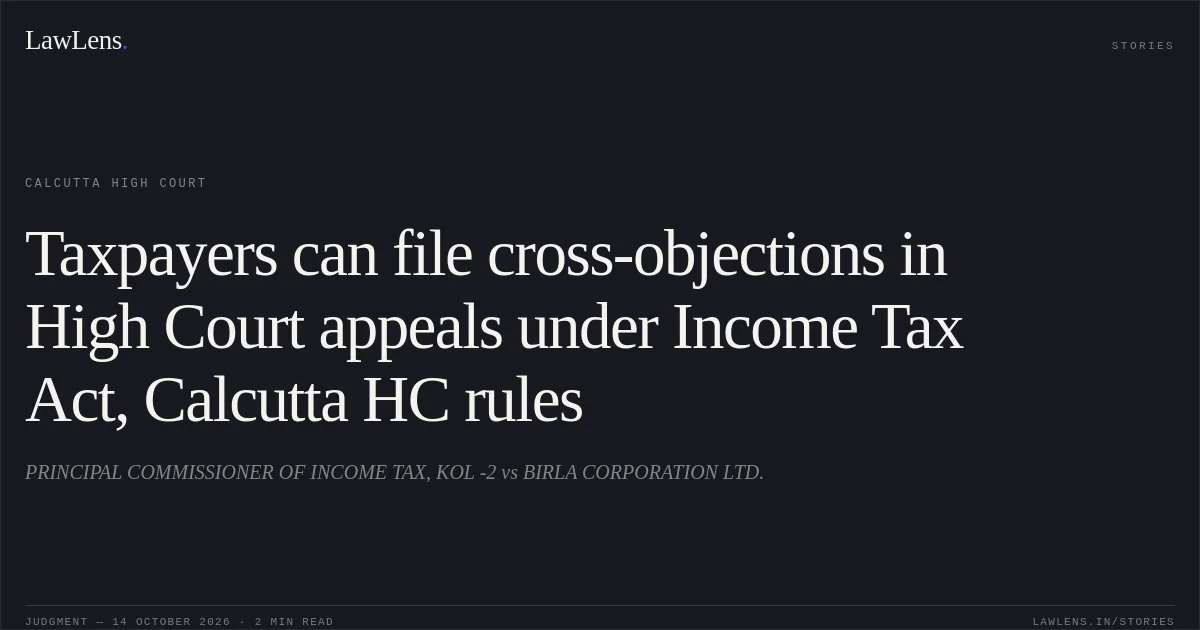
The Court held that cross-objections are maintainable in appeals under Section 260A, subject to the requirement that they raise substantial questions of law within that section’s scope.
It declined to follow Smt. Jyoti Kumari v. Assistant Commissioner of Income-Tax and Principal Commissioner of Income-Tax v. Nagar Dairy Pvt. Ltd.
Source reference: para. 40The appeal was listed for hearing on 30 November 2026 to consider formulation of the substantial questions of law raised by the respondent; there was no order as to costs.
Source reference: paras. 42–43Acts & Sections Cited
3 provisions across 2 statutes referred to in this judgment. Each provision opens on LawLens.
Code of Civil Procedure, 19082
Central Excise Act, 19441
Original Court PDF
PRINCIPAL COMMISSIONER OF INCOME TAX, KOL -2vsBIRLA CORPORATION LTD.
Click to open original judgment
Original judgment, available to read, download and summarize on LawLens.in