01Facts
The respondents were initially appointed as teachers on consolidated pay on a contractual basis.
p. 2 · ¶ 2By G.O.Ms.No.99, School Education Department, dated 27 June 2006, the Government granted them regular time-scale pay with effect from 1 June 2006, subject to the terms of the Government Order.
p. 2 · ¶ 2–3The respondents nevertheless sought retrospective regularisation and seniority from their initial dates of appointment, along with consequential monetary and service benefits.
p. 2 · ¶ 2The Single Judge allowed their writ petition, relying on an earlier Division Bench judgment in W.A.No.3904 of 2019.
p. 3 · ¶ 5Subsequently, the earlier judgment relied upon by the Single Judge was recalled in review, and connected writ appeals filed by the Government were allowed.
pp. 3–7 · ¶ 6, 35–3702Issues
i.Whether the respondents were entitled to retrospective regularisation, seniority, and consequential service benefits from their initial appointment dates, despite G.O.Ms.No.99 granting regular time-scale pay only from 1 June 2006?
pp. 2–3 · ¶ 2–5ii.Whether the Single Judge could grant such relief by relying on the subsequently recalled judgment in W.A.No.3904 of 2019?
pp. 3–7 · ¶ 6iii.Whether the respondents’ delayed challenge to the applicable Government Orders disentitled them from seeking retrospective service benefits?
pp. 4–6 · ¶ 29–3303Law Applied
The Court applied the terms of G.O.Ms.No.99, School Education Department, dated 27 June 2006, under which teachers appointed on consolidated pay were entitled to regular time-scale pay only with effect from 1 June 2006, and held that service benefits could not be granted beyond the Government’s unchallenged policy decision.
p. 2 · ¶ 3 · p. 3 · ¶ 5The Court relied on the principles that delay and laches may defeat relief under Article 226 and that similarly situated persons cannot automatically claim the benefit of a judgment obtained by others after substantial delay, as stated in S.S. Balu v. State of Kerala, (2009) 2 SCC 479.
pp. 4–5 · ¶ 32It also relied on Ghulam Rasool Lone v. State of J&K, (2009) 15 SCC 321, which recognises that the writ remedy is discretionary and may be refused on grounds of delay and laches, having regard to its consequences.
p. 5 · ¶ 33Further, an order that has been recalled in review cannot form the basis for granting relief.
pp. 6–7 · ¶ 35–3704Reasoning
The respondents had accepted the benefit and terms of G.O.Ms.No.99, under which regular time-scale pay was granted from 1 June 2006, but did not establish any legal basis for retrospective regularisation or seniority from their initial contractual appointments.
pp. 2–3 · ¶ 2–5Since the Government Order remained unchallenged, the Court held that the respondents could not obtain service benefits inconsistent with it through a writ of mandamus.
p. 3 · ¶ 5The Single Judge’s reliance on W.A.No.3904 of 2019 was no longer sustainable because that judgment had subsequently been recalled in review; the connected writ petitions and appeals had consequently been dismissed or allowed in favour of the State.
pp. 3–7 · ¶ 6The respondents’ delayed claim also attracted the doctrine of laches, particularly because granting retrospective seniority could adversely affect the accrued rights and promotion prospects of other teachers.
pp. 4–6 · ¶ 29–3405Holding
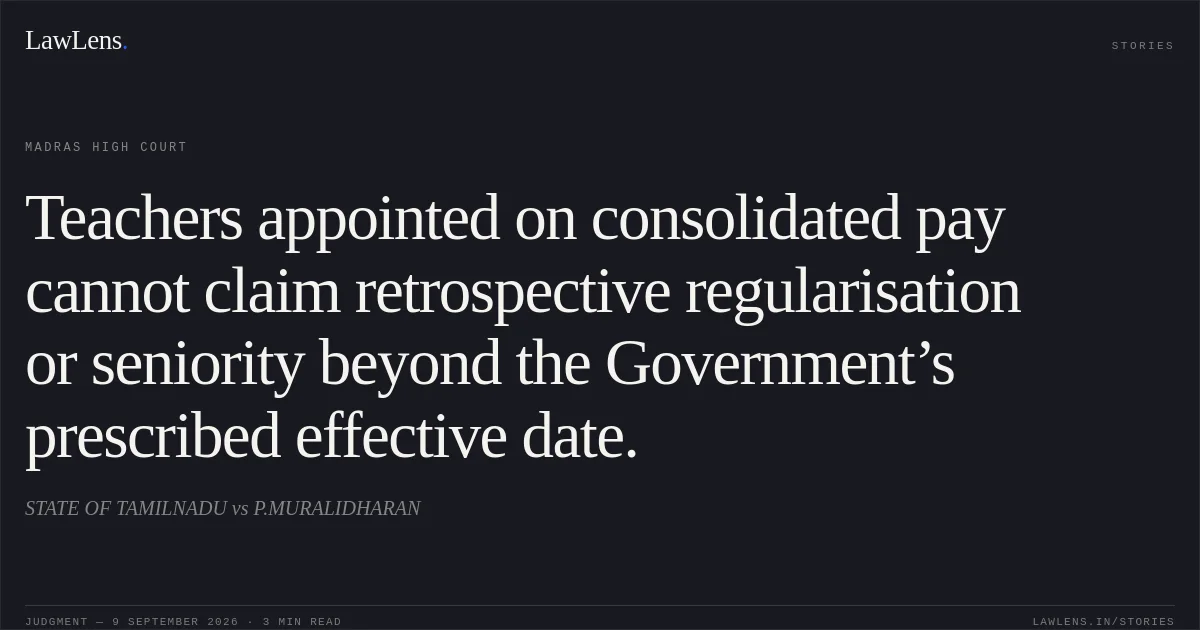
The Division Bench held that the respondents were entitled to service benefits only from 1 June 2006, in accordance with G.O.Ms.No.99 dated 27 June 2006, and not from their initial dates of appointment.
p. 7 · ¶ 7The writ order dated 10 February 2020 in W.P.No.2221 of 2020 was set aside, the writ appeal was allowed, and the connected miscellaneous petition was closed without costs.
p. 7 · ¶ 8Original Court PDF
STATE OF TAMILNADUvsP.MURALIDHARAN
Click to open original judgment
Original judgment, available to read, download and summarize on LawLens.in