Facts
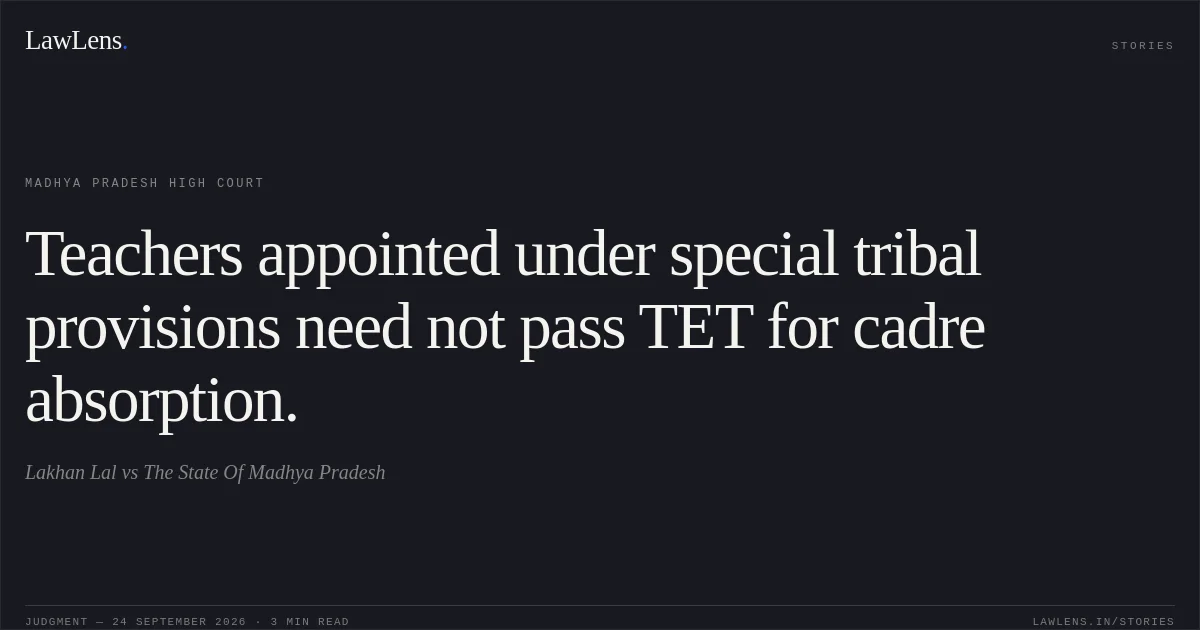
The petitioners, who were appointed as Samvida Shala Shikshaks (Language), Grade III under the Madhya Pradesh Panchayat Samvida Shala Shikshak (Employment and Conditions of Contract) Rules, 2005, sought permission to resume duties and extension of the benefit of appointment/absorption in the Adhyapak Samvarg under the Madhya Pradesh Panchayat Adhyapak Samvarg Rules, 2008, without being required to pass the Teachers Eligibility Test (TET).
Source reference: para. 1Their claim had been rejected by the respondents through order dated 15.11.2019.
Source reference: para. 1Notice was issued on 16.01.2026, but the respondents did not file a reply despite repeated opportunities. On 12.08.2026, the Court granted a final opportunity of four weeks and directed that, in default, the matter would be decided in accordance with an already decided identical case. The respondents still failed to file their reply.
Source reference: paras. 2–3The Court noted that the common impugned order dated 15.11.2019 had already been quashed in Kartar Singh Badretiya and Others v. State of Madhya Pradesh and Others, W.P. No. 901/2020, decided on 31.10.2025.
Source reference: para. 5Issues
1. Whether the petitioners, being similarly situated to the employees covered by the decision in Kartar Singh Badretiya, were entitled to the same relief, including the benefit of the Adhyapak Samvarg under the 2008 Rules?
Source reference: paras. 5, 92. Whether the petitioners could be denied the benefit of their earlier appointments on the ground that they had not passed the TET under the 2018 Rules and subsequent departmental orders?
Source reference: pp. 6–10, paras. 5, 8–11 of the quoted judgment3. Whether the impugned order dated 15.11.2019 was liable to be quashed and the petitioners permitted to resume and continue their duties with consequential benefits?
Source reference: paras. 1, 5, 9Law Applied
The Court exercised jurisdiction under Article 226 of the Constitution of India.
Source reference: para. 1It applied the Madhya Pradesh Panchayat Samvida Shala Shikshak Rules, 2005, particularly Rules 6 and 7, holding that persons appointed under the special provisions for primitive tribes under Rule 7 were not required to pass the TET prescribed under Rule 6.
Source reference: pp. 6–7, para. 5 of the quoted judgmentIt further applied the principle of equality in service jurisprudence stated in State of Karnataka v. C. Lalitha, (2006) 2 SCC 747, namely that similarly situated employees should be treated alike and should not be denied the same benefit merely because only some of them approached the Court.
Source reference: para. 7The Court followed Kartar Singh Badretiya, whose directions were made applicable mutatis mutandis.
Source reference: paras. 5–6, 9Reasoning
The Court found that the respondents had failed to contest the petition despite repeated opportunities and had not disputed the applicability of the decision in Kartar Singh Badretiya.
Source reference: paras. 2–4Since the impugned order dated 15.11.2019 was common to the petitioners and had already been quashed in that case, the Court held that the petitioners were entitled to identical treatment.
Source reference: para. 5The reasoning in Kartar Singh Badretiya established that appointments made under the special tribal provisions of Rule 7 of the 2005 Rules were not conditional upon passing the TET under Rule 6, and that the State could not retrospectively discriminate against such employees by relying on the 2018 Rules or later departmental instructions.
Source reference: pp. 6–10, paras. 5, 10–11 of the quoted judgmentApplying the principle in C. Lalitha, the Court held that the petitioners’ entitlement could not depend merely on whether they had individually litigated earlier.
Source reference: paras. 7–8Holding
The petition was disposed of in terms of Kartar Singh Badretiya.
The directions in that case were held applicable to the petitioners mutatis mutandis and with full force.
Source reference: para. 9Consequently, the petitioners were entitled to the benefit of the Adhyapak Samvarg under the 2008 Rules, continuation or restoration of service, permission to perform their duties, and consequential benefits in accordance with the earlier judgment.
Source reference: pp. 10–11, para. 12 of the quoted judgmentThe respondents were required to extend the same benefits already granted to similarly situated employees; however, back wages were subject to the principle of “no work, no pay”.
Source reference: p. 10, para. 12 of the quoted judgmentActs & Sections Cited
2 provisions across 1 statute referred to in this judgment. Linked provisions open on LawLens.
M.P. Panchayat Raj Avam Gram Swaraj Adhiniyam, 19932
Original Court PDF
Lakhan LalvsThe State Of Madhya Pradesh
Click to open original judgment
Original judgment, available to read, download and summarize on LawLens.in