01Facts
Respondent No. 2, a Police Inspector of the DSB Unit, Raichur, lodged a complaint on 03.09.2024 alleging that staff in the CDR Section of the District Police Office were illegally accessing and disclosing confidential Call Detail Records and location details to unauthorised persons.
¶ 2Petitioner No. 1 (Accused No. 1), a Police Constable in the Raichur CDR Unit, allegedly deleted CDR details of three mobile numbers in the complainant's presence and disclosed that he had acted at the instance of Accused No. 7, from whom he obtained a separate mobile phone and SIM.
¶ 3Petitioner No. 2 (Accused No. 2), a Police Constable in the Bidar CDR Unit, allegedly accessed and shared CDRs and location data of nine numbers pertaining to M.D. Akbar with Accused Nos. 3–8, including through a WhatsApp group named "Mumbai Trip".
¶ 4The petitioners were entrusted with providing CDR and Cell Area Position data to Investigating Officers, and Accused Nos. 3–6 allegedly sought the relatives' call details to trace M.D. Akbar.
¶ 15Crime No. 13/2024 was registered, and a charge-sheet was filed in C.C. No. 4776/2025 for offences under Sections 316(5), 318(4), 49, 238 r/w 3(5) of the BNS, Section 26 of the Indian Telegraph Act, 1885, and Section 72 of the IT Act, 2000. The Magistrate took cognizance.
¶ 5Petitioners contended that TSP reports show blank procurement details and "No" procurement dates, that the DSB negative report found no requisition letters, that the offences are not made out, and that Accused No. 2's implication rests on unverified messages.
¶ 7–10The respondents contended that a co-accused had spoken to the petitioners' involvement, DVRs were recovered at their instance, and CDRs show contact via the "Mumbai Trip" group.
¶ 12–13Accused Nos. 3 and 5 earlier obtained quashing of the Section 26 proceedings in Crl.P. No. 200189/2026 (order dated 23.02.2026).
¶ 1602Issues
i.1. Whether the charge-sheet material discloses prima facie grounds to sustain proceedings against the petitioners for offences under the BNS and the IT Act, or whether the allegations of falsity and absence of ingredients warrant quashing at this stage.
¶ 7–10, 18–19ii.2. Whether proceedings under Section 26 of the Indian Telegraph Act, 1885 can be sustained after its repeal by the Telecommunications Act, 2023.
¶ 16, 1903Law Applied
The court relied on Sections 316(5) and 318(4) (criminal breach of trust and cheating), Section 49, Section 238 r/w Section 3(5) of the BNS, and Section 72 of the IT Act, 2000, which govern the alleged misuse of confidential data, disappearance of evidence, and common intention.
¶ 9, 18–19The court applied Section 26 of the Indian Telegraph Act, 1885, which the court held had been repealed by the Telecommunications Act, 2023 and therefore could not be sustained.
¶ 16, 19The court's approach to quashing rests on the principle that, where prima facie material exists in the charge-sheet, the petitioners' defence (including claims of false implication) must be tested at trial.
¶ 18The petitioners relied on Anand Kumar Mohatta v. State (NCT of Delhi), (2019) 11 SCC 706, and Raj Lalit Soni v. State of Karnataka, Crl.P. No. 16742/2025 (dated 01.04.2026), but the judgment does not expressly discuss their principles.
¶ 11The petition was filed under Section 528 BNSS (Section 482 CrPC).
Provisions in the judgment · 9 · Linked ones open on LawLens
Bharatiya Nagarik Suraksha Sanhita, 2023 Section 528
Code of Criminal Procedure, 1973 Section 482
Indian Telegraph Act, 1885 Section 26
Information Technology Act, 2000 Section 72
Bharatiya Nyaya Sanhita, 2023 Section 316Section 318Section 49Section 238Section 3
04Reasoning
The court rejected the TSP-report and DSB-report arguments as matters of evidence not suitable for resolution at the quashing stage. It relied on the statements of CWs 1–22, the CDRs showing frequent contact between the petitioners and Accused Nos. 3–6, the findings of the departmental enquiry, and the fact that enquiry witnesses were cited and supported the charge-sheet allegations.
¶ 17Given the petitioners' status as Police Constables entrusted with confidential duties and bound by their oath, the court held that the allegation of vengeful false implication could not be accepted at this stage.
¶ 18On the Telegraph Act, the court distinguished the earlier quashing of Accused Nos. 3 and 5. Those accused faced only the Section 26 charge, whereas the petitioners also faced BNS and IT Act charges, so they were not similarly situated.
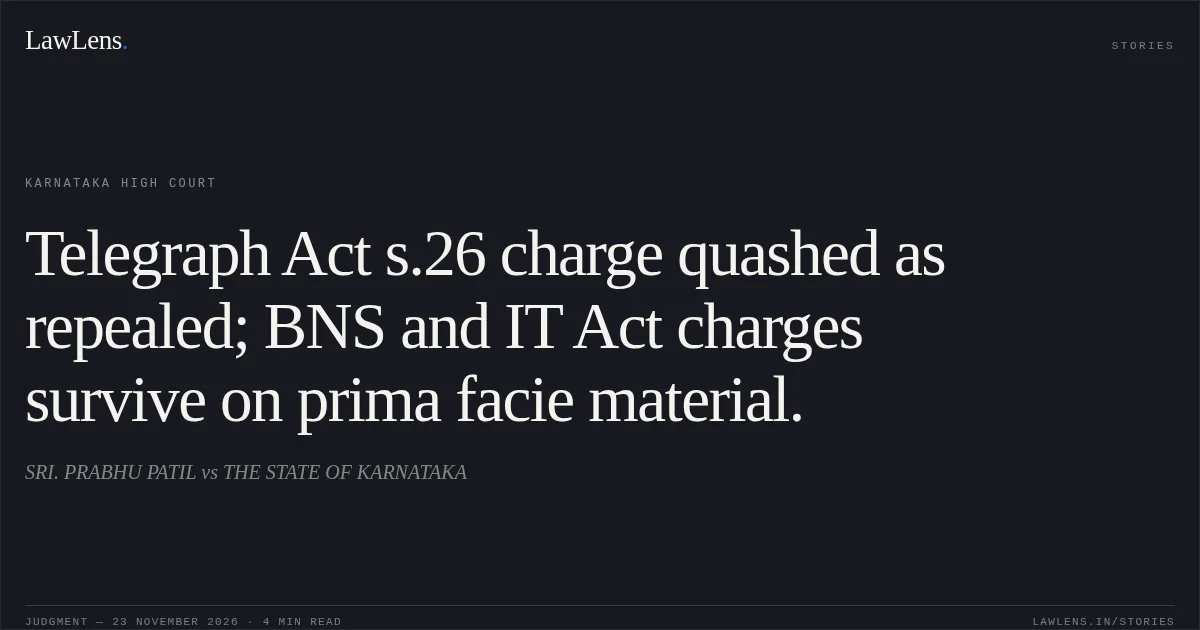
¶ 16The court quashed the Section 26 proceedings, because that enactment is no longer in force, but left the BNS and IT Act proceedings intact.
¶ 1905Holding
The court held that prima facie material exists against the petitioners for the BNS and IT Act offences, so those proceedings cannot be quashed at this stage and the petitioners' contentions must be tested at trial.
¶ 18–19The court held that the Section 26 Telegraph Act proceedings cannot be sustained following the repeal of that Act by the Telecommunications Act, 2023. The petition is allowed in part. The proceedings against the petitioners (Accused Nos. 1 and 2) in C.C. No. 4776/2025 under Section 26 of the Indian Telegraph Act, 1885 are quashed. Proceedings for the offences under Sections 316(5), 318(4), 49, 238 r/w 3(5) of the BNS and Section 72 of the IT Act, 2000 shall continue.
¶ 16, 19 · Order · ¶ i–iiiOriginal Court PDF
SRI. PRABHU PATILvsTHE STATE OF KARNATAKA
Click to open original judgment
Original judgment, available to read, download and summarize on LawLens.in