01Facts
The respondent (complainant) entered into an UG cable work arrangement with accused No.3, Yogananda K.C., the authorised representative of accused No.1, MR Pro Tech Pvt. Ltd., for work on specified survey numbers in Uragaduru village.
¶ 2 · pp. 2–3After about 30% completion and a demand for payment, accused No.3 issued cheque No. 465188 dated 19.12.2022 for ₹25,00,000 drawn on Ujjivan Small Finance Bank.
¶ 2 · p. 3On presentation on 10.03.2023, it was returned "Un-encashed".
¶ 2 · p. 3The complainant lodged a police complaint, and the matter was settled. Accused No.3 paid ₹6,00,000 (NEFT, 16.03.2023) and ₹1,00,000 (03.04.2023) and issued two further cheques for ₹7,00,000 and ₹6,29,000.
¶ 2 · p. 3Both further cheques were dishonoured with the endorsement "Stopped by Drawer".
¶ 3 · p. 4 · ¶ 5 · p. 5The complainant filed a private complaint under s.200 CrPC against the company, accused No.3, and the petitioner (accused No.2). The only allegation against the petitioner is that he is also a contractor known to accused No.3.
¶ 3 · p. 4The Magistrate took cognizance under s.138 NI Act and issued summons to accused No.2.
¶ 3 · p. 4The petitioner sought quashing under s.482 CrPC.
¶ 1 · pp. 1–202Issues
i.1. Whether a person who is neither the drawer nor a signatory to the dishonoured cheques, and against whom the complaint alleges only that he is a contractor known to the drawer, can be proceeded against under s.138 of the NI Act on a theory of vicarious liability.
¶ 6 · pp. 5–6ii.2. Whether the proceedings against accused No.2 are liable to be quashed under s.482 CrPC, even if the allegations in the complaint and sworn statement are taken at face value.
¶ 6 · pp. 6–703Law Applied
Section 138 of the Negotiable Instruments Act, 1881, which penalises dishonour of a cheque.
¶ 1 · p. 1Section 482 of the Code of Criminal Procedure, 1973, which preserves the High Court's inherent power to quash proceedings to prevent abuse of process or secure the ends of justice.
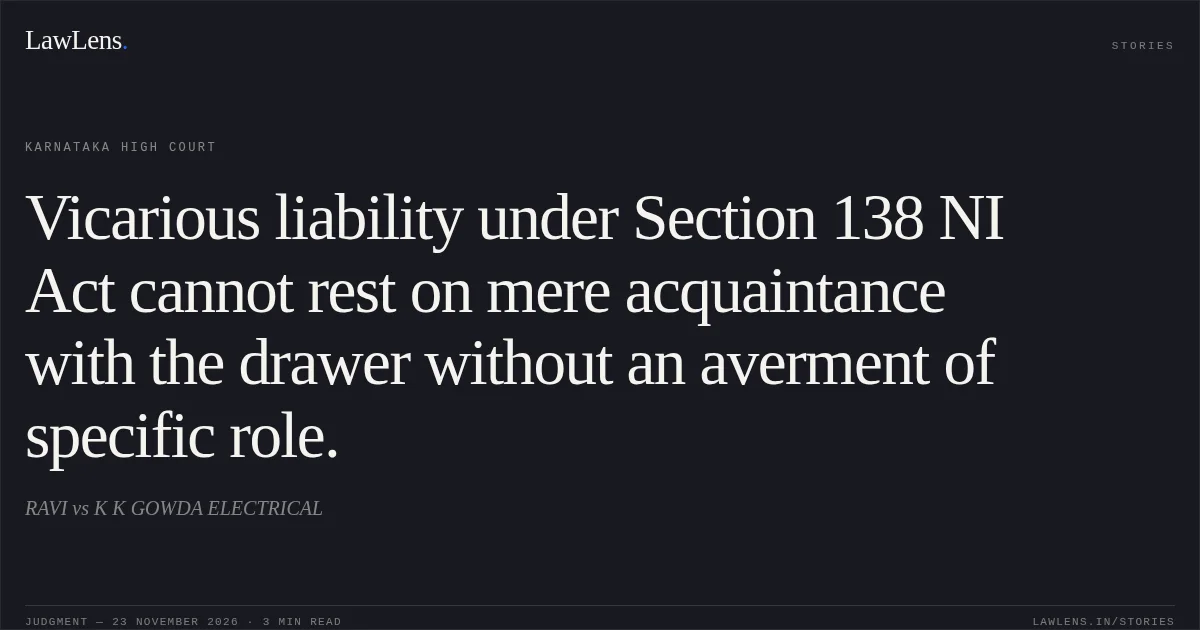
¶ 1 · p. 1Vicarious liability under s.138 cannot be imposed on a person who is not shown to be in charge of, or responsible for, the conduct of the drawer company or the issuance of the cheque. Liability requires a specific averment that the accused was a signatory, an active partner, or a representative with responsibility for the company's affairs, or colluded in issuing the cheque.
¶ 6 · p. 6Provisions in the judgment · 3 · Linked ones open on LawLens
Code of Criminal Procedure, 1973 Section 482Section 200
Negotiable Instruments Act, 1881 Section 138
04Reasoning
The court examined paragraph 4 of the complaint, which alleges that accused No.3 entered the agreement, issued the cheques, and later stopped payment.
¶ 5 · pp. 5–6The court held that accused No.3 alone was the authorised representative of accused No.1 who contracted with the complainant and issued the cheques.
¶ 6 · pp. 5–6The only averment against the petitioner was that he was a contractor known to accused No.3. The court found no allegation that the petitioner signed or issued the cheques, was an active partner, held any representative role in accused No.1, or colluded with accused No.3.
¶ 6 · p. 6Because the complainant's own case admitted that only accused No.3 transacted with him, vicarious liability could not be extended to the petitioner.
¶ 6 · p. 6Taking the complaint at face value, the court concluded that no offence under s.138 was disclosed against the petitioner, so continuing the proceedings would be an abuse of process.
¶ 6 · pp. 6–705Holding
The court answered Issue 1 in the negative. Vicarious liability under s.138 cannot be extended to accused No.2, as the complaint contains no averment establishing his responsibility for the drawer company or the cheques.
¶ 6 · p. 6On Issue 2, the court held that no offence was made out against accused No.2 even on the complaint's face value, so quashing under s.482 CrPC was warranted. The petition is allowed. The proceedings against accused No.2 in C.C. No. 3664/2023 (arising out of PCR No. 341/2023), pending before the I Addl. Civil Judge and JMFC, Shivamogga, are quashed. The proceedings against accused Nos.1 and 3 are not affected by this order.
¶ 6 · pp. 6–7Original Court PDF
RAVIvsK K GOWDA ELECTRICAL
Click to open original judgment
Original judgment, available to read, download and summarize on LawLens.in