Facts
The Opposite Party filed a complaint under Sections 138/141 of the Negotiable Instruments (NI) Act against a company and its directors, alleging that four cheques totaling ₹36,00,000.00 were dishonored due to "insufficient funds".
Source reference: para. 3-4The petitioners, arrayed as Accused Nos. 2, 4, and 5, are "Whole-Time Directors" but were not signatories to the cheques.
Source reference: para. 1-2The Learned Metropolitan Magistrate took cognizance and issued process on April 6, 2024, after conducting a perfunctory inquiry under Section 202 Cr.P.C.
Source reference: para. 2, 5The petitioners moved the High Court to quash the proceedings, arguing that the complaint lacked specific allegations regarding their individual roles and that they could not be held vicariously liable based on "template pleadings".
Source reference: para. 6, 8Issues
1. Whether a "bald statement" in a complaint replicating the statutory language of Section 141 of the NI Act is sufficient to prosecute non-signatory directors.
Source reference: para. 7(I)2. Whether the Magistrate failed to apply judicial mind during the mandatory Section 202 Cr.P.C. inquiry by failing to distinguish between corporate and individual culpability.
Source reference: para. 7(II)3. Whether a Director who is neither the Managing Director nor a signatory can be held vicariously liable without specific pleadings regarding day-to-day management.
Source reference: para. 7(III)Law Applied
Section 141 of the NI Act, which creates a "legal fiction" of vicarious liability for persons "in charge of and responsible to" the company.
Source reference: para. 19-20S.M.S. Pharmaceuticals Ltd. v. Neeta Bhalla (2005), establishing that specific averments are required to bridge the gap between corporate status and criminal liability.
Source reference: para. 9, 21Section 202 of the Cr.P.C. (now Section 225 BNSS), which mandates an inquiry for outstation accused to prevent "weaponization" of process.
Source reference: para. 11, 25Ashok Shewakramani v. State of Andhra Pradesh (2023), requiring "in charge of" and "responsible to" to be read conjunctively.
Source reference: para. 10, 22State of Haryana v. Bhajan Lal (1992) regarding the inherent power to quash facially deficient complaints to protect Article 21 rights.
Source reference: para. 49, 53Reasoning
The Court observed that Paragraph 3 of the complaint merely "parroted" the statutory vocabulary of Section 141 without disclosing any "transactional nexus" or specific overt acts attributed to the petitioners.
Source reference: para. 21-22The Court reasoned that while a Managing Director or signatory is held liable by virtue of office/act, other directors (Tier III) require specific factual anchoring in the complaint, which was "conspicuously silent" here.
Source reference: para. 33-36Regarding procedure, the Court found the Magistrate’s Section 202 inquiry was a "perfunctory ritual" and a "hollow paper compliance" as it failed to distinguish between the liability of the company, the signatory, and the non-signatory directors resident outside the jurisdiction.
Source reference: para. 26-28The Court further noted that the instruments appeared to be "blank security cheques" and that converting them into demand instruments for prosecution required specific authorization pleadings which were absent.
Source reference: para. 44-46Holding
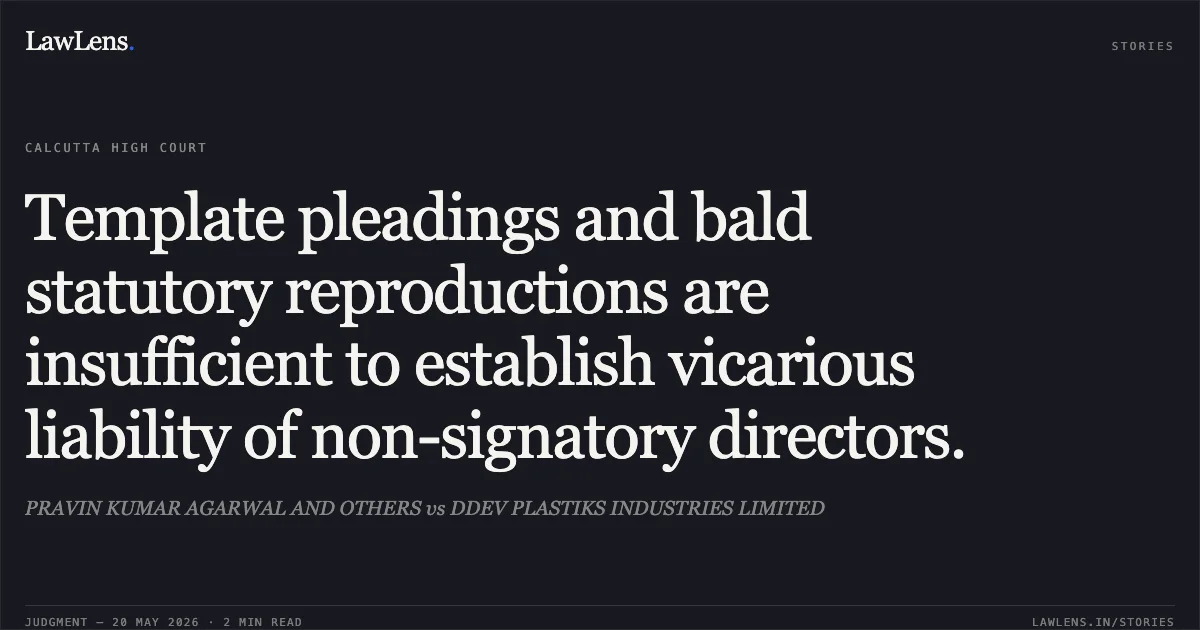
The Court answered all core issues in favor of the petitioners, holding that the "bald statements" were insufficient to sustain prosecution and that the mechanical issuance of process against non-signatory directors constituted an abuse of the process of law.
The Court allowed the revision, quashing the proceedings in Case No. CS-26711 of 2024 strictly against Accused Nos. 2, 4, and 5, while ordering the trial to proceed against the Company and the Signatory.
Source reference: para. 57, 63, 60Acts & Sections Cited
10 provisions across 3 statutes referred to in this judgment. Each provision opens on LawLens.
Bharatiya Nagarik Suraksha Sanhita, 20232
Code of Criminal Procedure, 19734
Negotiable Instruments Act, 18814
Original Court PDF
PRAVIN KUMAR AGARWAL AND OTHERSvsDDEV PLASTIKS INDUSTRIES LIMITED
Click to open original judgment
Original judgment, available to read, download and summarize on LawLens.in