Facts
The petitioner invoked Article 227 of the Constitution challenging the trial court’s order dated 13 July 2026 in Civil Suit No. RCSA-176/2022-A, whereby an application under Order I Rule 10 CPC was allowed and Respondents Nos. 2 to 6 were impleaded as Defendants Nos. 2 to 6.
Source reference: para. 2; p. 1–2The respondents claimed to be devotees of Deity Ram Janki Shri Ram Temple situated at Village Bheelkheda, Tehsil Kalapipal, and sought impleadment owing to their apprehension regarding the petitioner’s claim over property connected with the temple.
Source reference: para. 2; p. 1–2The petitioner contended that the respondents were neither necessary nor proper parties, particularly because earlier litigation between the parties had allegedly been decided in the petitioner’s favour.
Source reference: para. 2; p. 1–2It was further argued that the trial court had allowed impleadment merely on the apprehension of future multiplicity of litigation, without properly considering the petitioner’s objection regarding mala fides.
Source reference: para. 2; p. 1–2Issues
Whether Respondents Nos. 2 to 6, claiming to be devotees of the temple connected with the disputed property, were proper or necessary parties liable to be impleaded under Order I Rule 10(2) CPC?
Source reference: paras. 4, 8–9; p. 2, 5–7Whether the trial court’s order allowing impleadment suffered from illegality, perversity, or material irregularity warranting interference by the High Court under Article 227 of the Constitution?
Source reference: para. 9; p. 6–7Law Applied
The Court applied Order I Rule 10(2) CPC, under which a person may be added as a party where that person ought to have been joined or whose presence is necessary to effectually and completely adjudicate all questions involved in the suit, along with Section 151 CPC preserving the court’s inherent powers to secure the ends of justice and prevent abuse of process.
Source reference: para. 5; p. 2–3Relying on Razia Begum v. Sahebzadi Anwar Begum, AIR 1958 SC 886, the Court reiterated that impleadment is generally a matter of judicial discretion; a party must ordinarily have a direct interest in the subject matter, and the court must assess whether its presence is necessary for complete adjudication.
Source reference: para. 6; p. 3–5Relying on Kasturi v. Iyyamperumal, (2005) 6 SCC 733, the Court distinguished necessary parties—those in whose absence no effective decree can be passed or against whom relief is claimed—from proper parties, whose presence assists the court in completely and effectively adjudicating the issues, even where no relief is directly sought against them.
Source reference: para. 7; p. 5–6The Court also applied the settled limitation on Article 227 jurisdiction, namely, that supervisory power is not to be exercised in the absence of perversity, illegality, impropriety, or a jurisdictional error.
Source reference: para. 9; p. 6–7Reasoning
The Court noted that, although the petitioner asserted private ownership, the record showed that the property was connected with Deity Ram Janki Shri Ram Temple.
Source reference: para. 4; p. 2Respondents Nos. 2 to 6 claimed an interest as devotees and sought participation because the petitioner’s assertions in the suit could affect matters concerning the temple and potentially give rise to further litigation.
Source reference: para. 4; p. 2Applying the principles in Razia Begum and Kasturi, the Court held that the respondents could not, at the impleadment stage, be treated as persons having no relevance to the controversy.
Source reference: paras. 6–9; p. 3–7Their presence could assist in the complete adjudication of the dispute, and the trial court’s apprehension regarding multiplicity of proceedings was not unfounded.
Source reference: paras. 6–9; p. 3–7The petitioner’s reliance on earlier litigation and alleged mala fides did not conclusively establish that the respondents were improper parties; those matters could be considered in the substantive proceedings.
Source reference: paras. 8–9; p. 5–7Since the trial court had exercised its discretion within the scope of Order I Rule 10(2) CPC and no perversity, illegality, or impropriety was demonstrated, Article 227 interference was unwarranted.
Source reference: paras. 8–9; p. 5–7Holding
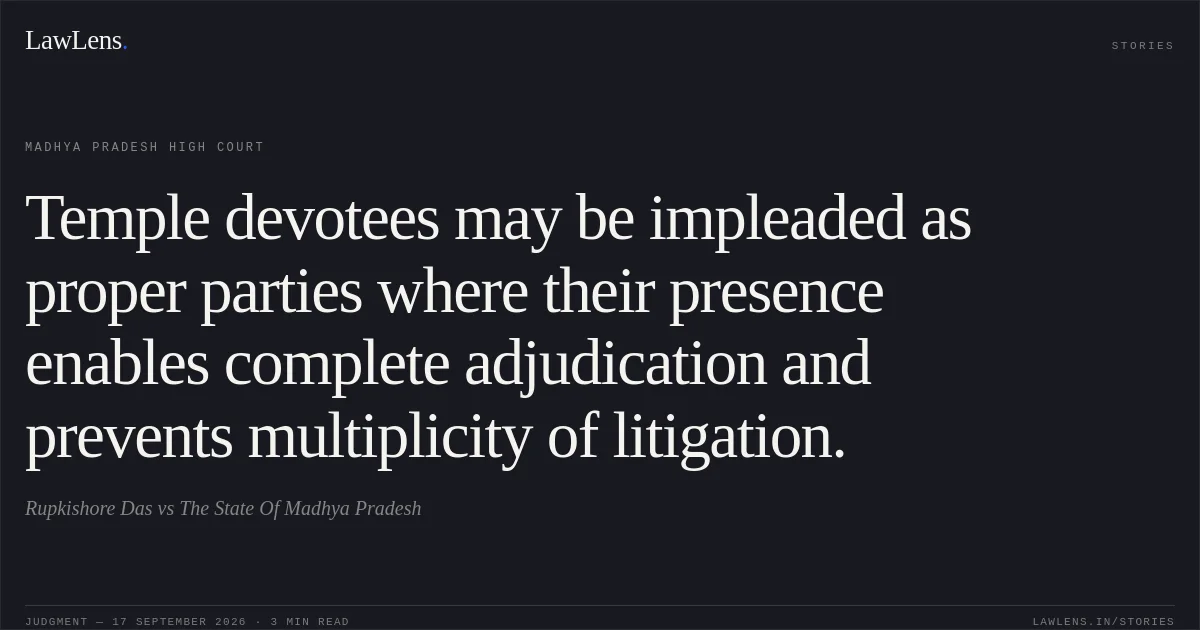
The High Court held that Respondents Nos. 2 to 6 could not be regarded as neither necessary nor proper parties in the circumstances of the case.
Their impleadment was permissible under Order I Rule 10(2) CPC, particularly to enable complete adjudication and avoid possible multiplicity of litigation.
Source reference: paras. 8–9; p. 5–7Finding no perversity, illegality, or impropriety in the trial court’s order dated 13 July 2026, the Court declined to exercise its supervisory jurisdiction under Article 227 and dismissed Miscellaneous Petition No. 5307 of 2026.
Source reference: paras. 9–10; p. 6–7Acts & Sections Cited
2 provisions across 1 statute referred to in this judgment. Each provision opens on LawLens.
Code of Civil Procedure, 19082
Original Court PDF
Rupkishore DasvsThe State Of Madhya Pradesh
Click to open original judgment
Original judgment, available to read, download and summarize on LawLens.in