Facts
On 15 July 1996, the appellant was injured while travelling in a jeep that was struck by a Tempo Trax.
Source reference: p. 2–3, 5The Motor Accident Claims Tribunal found the Tempo Trax driver negligent but dismissed the claim because it considered the injuries insufficiently proved and found no permanent disability.
Source reference: p. 2–3, 5The appellant relied on a medical certificate recording a sutured head wound, contusions and an abrasion, and on evidence of treatment and expenses; the bills produced totalled Rs. 1,591.35.
Source reference: p. 3–4, 6–7She appealed the dismissal.
Source reference: p. 1Issues
1. Whether the Tribunal was justified in dismissing the claim petition entirely despite its finding that the Tempo Trax driver was negligent.
Source reference: p. 22. Whether compensation for bodily injury could be awarded without proof of permanent disability.
Source reference: p. 2, 5–7Law Applied
Section 165 of the Motor Vehicles Act empowers Claims Tribunals to inquire into claims arising from bodily injury caused by the use of a motor vehicle; bodily injury may be temporary or permanent.
Source reference: p. 6Sections 140 and 142, as applicable at the time, concerned no-fault liability and specified categories of permanent disablement, respectively; the Court noted that the appellant did not establish permanent disablement within Section 142.
Source reference: p. 5–6In assessing damages, the Court relied on *R.D. Hattangadi v. Pest Control (India) (P) Ltd.*, identifying pecuniary damages, such as expenses and loss of earnings, and non-pecuniary damages, such as pain and suffering.
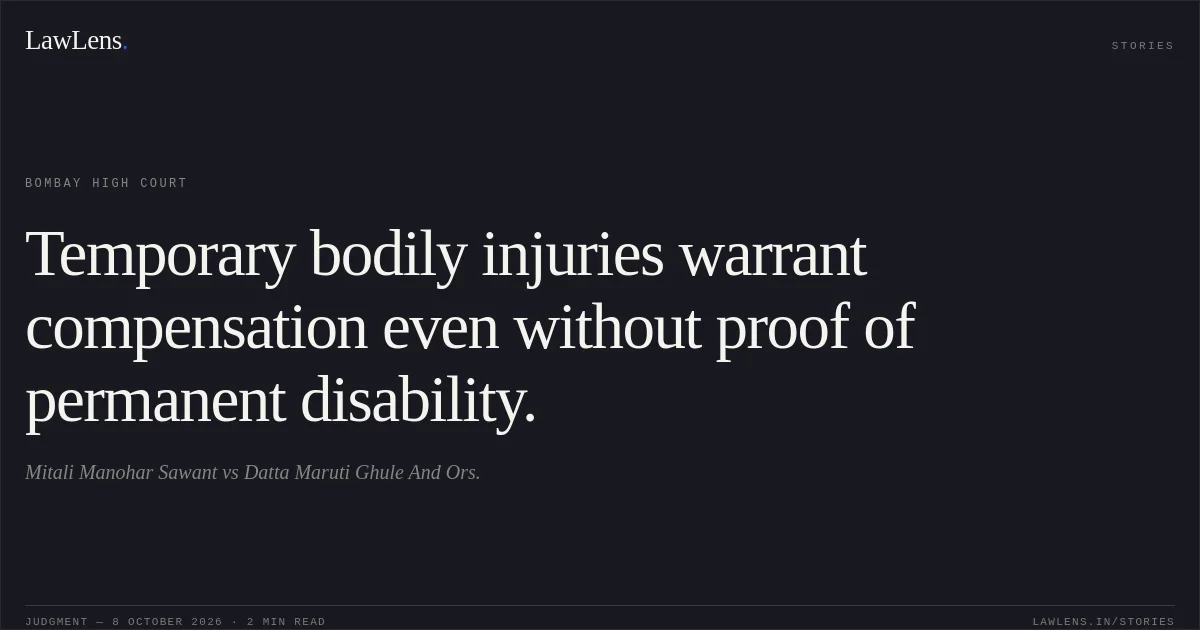
Source reference: p. 7Proof of disability may be necessary to assess disability-related loss of income, but it is not a prerequisite to compensation for established bodily injury.
Source reference: p. 6–7Reasoning
The Tribunal’s finding of negligence was supported by the evidence and was not open to challenge in the claimant’s appeal.
Source reference: p. 4The medical certificate, which was not challenged in cross-examination, described a sutured lacerated wound to the occipital region, with additional contusions and an abrasion; the Court also noted that the appellant could not attend her normal duties for about a month.
Source reference: p. 6–7These facts established bodily injury within Section 165, even without proof of permanent disability.
Source reference: p. 6–7Although the evidence did not establish the claimed Rs. 5,000 in expenses or support a disability-based loss-of-income award, the Court held that compensation was nonetheless due for the injury and associated pain and suffering.
Source reference: p. 7Holding
The Court allowed the appeal, set aside the Tribunal’s dismissal, and held that permanent disability was not required to award compensation for proven bodily injury.
Respondents 1 and 2 were held jointly and severally liable to pay Rs. 25,000, with interest at 7.5% from the date of the claim petition until realization, within eight weeks.
Source reference: p. 8Acts & Sections Cited
10 provisions across 2 statutes referred to in this judgment. Each provision opens on LawLens.
Indian Penal Code, 18603
Motor Vehicles Act, 19887
Original Court PDF
Mitali Manohar SawantvsDatta Maruti Ghule And Ors.
Click to open original judgment
Original judgment, available to read, download and summarize on LawLens.in