Facts
The petitioners were appointed as Steno-Typists, Typists, and Junior Assistants in the District Judiciary across Tamil Nadu on a temporary basis under Rule 16(e)(i) of the Tamil Nadu Judicial Ministerial Service Rules.
Source reference: p.58These appointments were made to meet administrative exigencies, and the petitioners served in different spells with breaks in service, some exceeding ten to fifteen years.
Source reference: p.59-60While some petitioners were terminated, others continued to serve and sought reinstatement, regularisation, or permanent absorption into sanctioned posts in the regular time scale of pay.
Source reference: p.58-60The respondents contended that the appointments were purely temporary, made against non-sanctioned posts, and were not through regular recruitment processes.
Source reference: p.61Issues
1. Whether temporary Steno-Typists, Typists, and Junior Assistants appointed under Rule 16(e)(i) of the Tamil Nadu Judicial Ministerial Service Rules are entitled to regularisation or permanent absorption in the Judicial Department.
Source reference: p.59Law Applied
The Court primarily applied the constitutional principles of equal opportunity in public employment under Articles 14 and 16 of the Constitution of India.
Source reference: p.63The Constitution Bench judgment in State of Karnataka v. Umadevi (2006) 4 SCC 1, which held that appointments to public posts must strictly follow the constitutional scheme and that regularisation cannot be used to bypass regular recruitment rules.
Source reference: p.62-63State of Rajasthan v. Daya Lal (2011) 2 SCC 429, which established that High Courts under Article 226 cannot issue directions for regularisation unless the initial appointment was made via a regular, open competitive process against sanctioned vacant posts.
Source reference: p.67-68Renu v. District and Sessions Judge, Tis Hazari Courts (2014) 14 SCC 50, which mandates strict adherence to recruitment norms in judicial administration.
Source reference: p.70Reasoning
Rule 16(e)(i) explicitly stipulates that temporary appointees have no preferential claim to future appointments and are liable to be terminated without notice.
Source reference: p.59, 61The Court emphasized that regularisation of "back-door" entries violates the fundamental rights of meritorious candidates and the equality clause of the Constitution.
Source reference: p.63-64The petitioners accepted their appointments knowing the temporary nature of the service and therefore cannot now claim permanency.
Source reference: p.66The Court observed that sympathy or long periods of service are insufficient grounds for regularisation in the absence of sanctioned posts and a legal right.
Source reference: p.68-69The Court further clarified that individual discretionary orders from higher courts based on specific facts cannot be treated as precedents to dilute the mandate of the Umadevi case.
Source reference: p.63, 65Holding
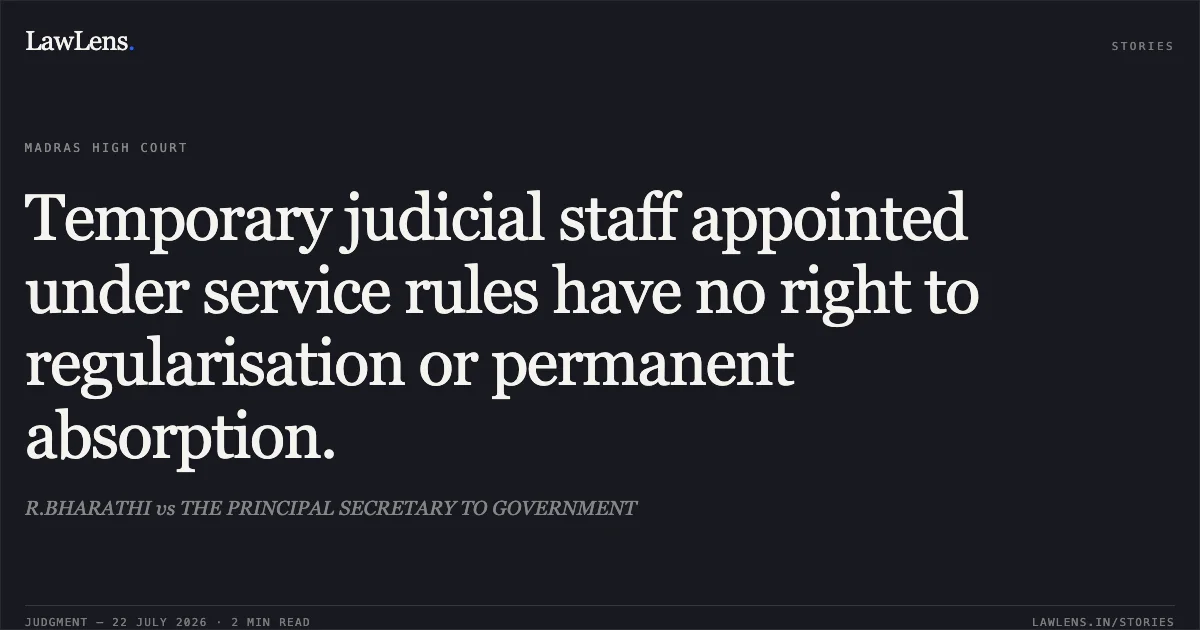
The Court held that the petitioners have no legal right to claim regularisation or permanent absorption, as their appointments were temporary and dehors the relevant recruitment rules.
The writ petitions were disposed of with directions that the Judicial Department must initiate proactive action to fill sanctioned posts through regular annual recruitment processes; terminated or serving temporary employees shall be permitted to participate in future recruitment; and the state may consider granting age relaxation for such candidates.
Source reference: p.74-75Original Court PDF
R.BHARATHIvsTHE PRINCIPAL SECRETARY TO GOVERNMENT
Click to open original judgment
Original judgment, available to read, download and summarize on LawLens.in


