Facts
The Appellants involve former casual labourers (Night Guards) or their legal representatives who served the Department of Posts for several decades.
Source reference: para. 3Under the "Casual Labourers (Grant of Temporary Status and Regularisation) Scheme, 1991," the employees were conferred "temporary status" in 1992.
Source reference: para. 7Pursuant to a 1992 circular, those completing three years of continuous temporary status were to be treated at par with "temporary Group ‘D’ employees".
Source reference: para. 8-9Despite decades of service, the employees were never formally regularised.
Source reference: para. 10Upon superannuation (and in one case, death), the Respondents denied pensionary benefits, asserting that formal regularisation was a mandatory prerequisite for pension eligibility.
Source reference: para. 13The Central Administrative Tribunal (Patna) granted relief, but the High Court of Patna set aside those orders on grounds of delay, laches, and lack of formal regularisation.
Source reference: para. 15-16Issues
1. Whether a temporary status casual labourer, in the absence of a formal order of regularisation, is entitled to pensionary benefits on superannuation.
Source reference: para. 32Law Applied
The "Casual Labourers (Grant of Temporary Status and Regularisation) Scheme, 1991," specifically Clauses 6 and 8 regarding the counting of service and parity with Group 'D' employees.
Source reference: para. 44Rule 10(1-B) of the Central Civil Services (Temporary Service) Rules, 1965, which entitles temporary government servants with ten years of service to superannuation pension and gratuity.
Source reference: para. 71The precedent established in Jagrit Mazdoor Union v. MTNL, which mandated parity for temporary status workers.
Source reference: para. 34, 43State of Jharkhand v. Jitendra Kumar Srivastava, which affirmed that pension is a "property" right under Article 300A of the Constitution.
Source reference: para. 41Reasoning
The 1991 Scheme and the 30.11.1992 circular were intended as progressive beneficial frameworks to align casual labourers with the regular establishment.
Source reference: para. 52, 55While Clause 6 of the Scheme mentions counting 50% service "after regularisation," this is an additional benefit and does not extinguish the independent pensionary entitlement that flows once an employee is treated at par with temporary Group 'D' employees.
Source reference: para. 56-57While "temporary status" workers are distinct in nomenclature, the Scheme grants them parity in "service benefits".
Source reference: para. 68-69Since Rule 10(1-B) of the 1965 Rules grants pension to temporary government servants with 10 years of service, and the Appellants were treated at par with such employees for over 10 years after attaining the relevant status, they met the statutory eligibility criteria.
Source reference: para. 75, 79-80The Court dismissed the "delay and laches" argument, holding that pension is a recurring cause of action.
Source reference: para. 18, 81Holding
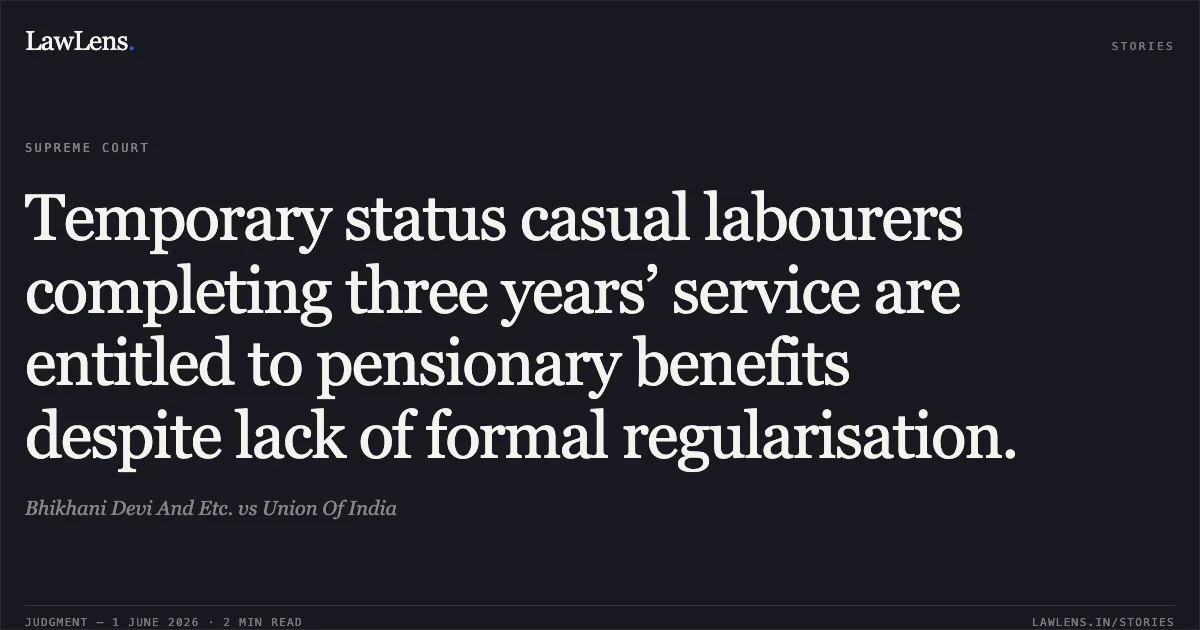
The Court answered the issue in the affirmative, holding that a temporary status casual labourer is entitled to pensionary benefits on superannuation even without formal regularisation.
The Supreme Court set aside the High Court judgments, restored the entitlement to pension, and directed the Respondents to release all pensionary and retiral benefits within three months (with arrears restricted to three years and two months preceding the filing of the Original Applications).
Source reference: para. 81-85Acts & Sections Cited
3 provisions across 2 statutes referred to in this judgment. Linked provisions open on LawLens.
Central Civil Services (Pension) Rules, 19721
Central Civil Services (Classification, Control & Appeal) Rules, 19652
Original Court PDF
Bhikhani Devi And Etc.vsUnion Of India
Click to open original judgment
Original judgment, available to read, download and summarize on LawLens.in


