01Facts
The petitioner was President of the Town Panchayat, Ameenagada.
pp. 5–7After councillors sought a no-confidence meeting, the Chief Officer issued a notice dated 25 September 2026 convening the meeting for 29 September 2026, after the petitioner declined to convene it.
pp. 5–7The petitioner challenged the notice, arguing that it did not provide the minimum ten days’ notice required by the proviso to Section 42(9) of the Karnataka Municipalities Act, 1964.
p. 702Issues
i.Whether the ten-day notice requirement under the proviso to Section 42(9) of the Karnataka Municipalities Act, 1964 is mandatory.
pp. 7–11ii.Whether the notice dated 25 September 2026, fixing the no-confidence meeting for 29 September 2026, complied with that requirement.
p. 7, 1103Law Applied
The Court applied the proviso to Section 42(9) of the Karnataka Municipalities Act, 1964, which requires ten days’ notice before a meeting to consider a no-confidence motion.
pp. 7–11It relied on the Full Bench decision in Sri C. Puttaswamy and Others v. Prema and Others, concerning the corresponding notice requirement under Section 47(3) of the Karnataka Zilla Parishads, Taluk Panchayat Samithis, Mandal Panchayats and Nyaya Panchayats Act, 1983, and on M. Krishnappa v. Chief Officer, which treated the relevant notice provisions as mandatory.
pp. 7–11The Court held that the analogous provisions were pari materia and that non-compliance invalidated the notice.
pp. 7–11Provisions in the judgment · 3 · Linked ones open on LawLens
KARNATAKA MUNICIPALITIES ACT, 1964 Section 42Section 47Section 43
04Reasoning
The notice fixed the meeting for 29 September 2026 but was issued on 25 September 2026, falling short of the statutory ten-day notice period.
pp. 9–11Applying the mandatory character of the requirement, as established by the cited decisions, the Court concluded that the notice could not stand. It rejected the respondents’ position that the earlier communications and the petitioner’s refusal to convene the meeting cured the deficiency.
pp. 9–1105Holding
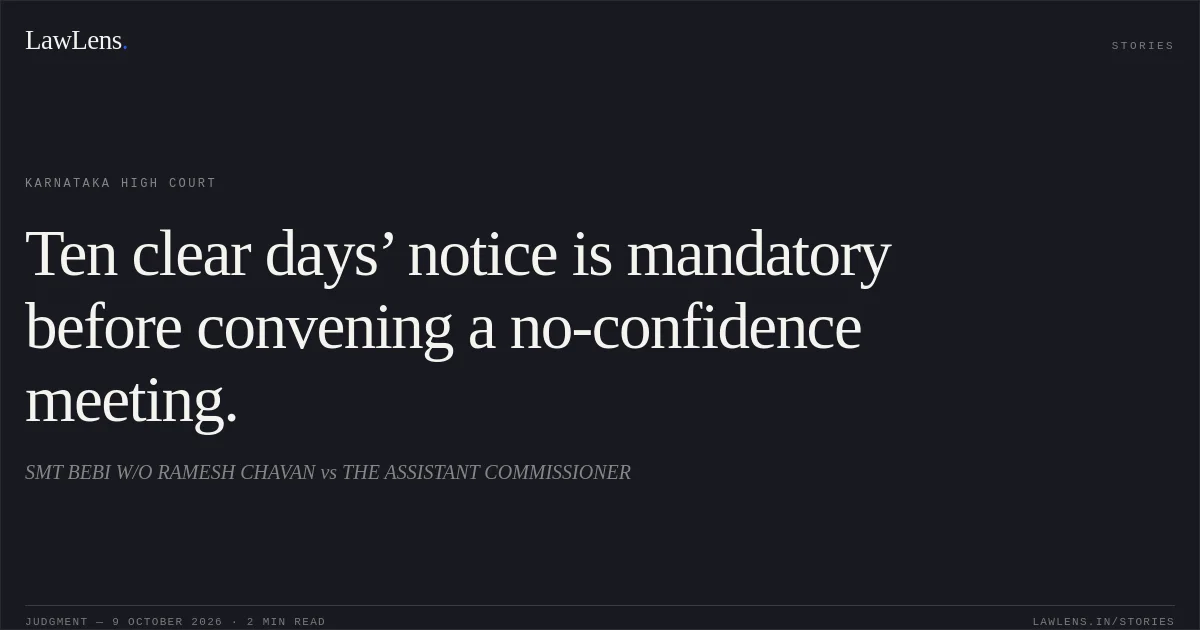
The Court held that the notice did not comply with the mandatory requirement under the proviso to Section 42(9).
pp. 11–13It allowed the petition, quashed the notice dated 25 September 2026, and remitted the matter to the Chief Officer to issue a fresh notice in accordance with Section 42(9), read with Section 47(3), if the councillors so advised.
pp. 11–13Original Court PDF
SMT BEBI W/O RAMESH CHAVANvsTHE ASSISTANT COMMISSIONER
Click to open original judgment
Original judgment, available to read, download and summarize on LawLens.in