Facts
The appellants (plaintiffs) filed an eviction suit under the M.P. Accommodation Control Act, 1961, asserting they purchased the suit property in 1958 and let it to the defendant in 1996.
Source reference: paras. 1, 3They alleged the defendant defaulted on rent from 2001 and failed to vacate despite a claimed bona fide need for the first plaintiff's son.
Source reference: para. 4The defendant denied the landlord-tenant relationship, asserting his father had purchased the property from a different owner decades prior.
Source reference: para. 5Although the trial court struck off the defendant’s defense for failing to deposit rent arrears, it ultimately dismissed the suit, finding no evidence of a tenancy.
Source reference: paras. 6-7The plaintiffs appealed, arguing that since the defense was struck, their evidence should be accepted as unrebutted.
Source reference: para. 8Issues
1. Whether the striking off of a defendant's defense under tenancy laws obligates the court to accept the plaintiff’s claims without further proof of the landlord-tenant relationship.
Source reference: para. 132. Whether the plaintiffs successfully established their title and the existence of a tenancy through the oral and documentary evidence provided.
Source reference: paras. 14, 23Law Applied
M.P. Accommodation Control Act, 1961, specifically Section 12 regarding grounds for eviction and Section 13(6) regarding the consequences of failing to deposit rent.
Source reference: paras. 1, 6Modula India v. Kamakshya Singh DEO: even if a defense is struck off, the burden remains on the plaintiff to prove their case, and the defendant retains a limited right to assist the court by cross-examining witnesses to highlight inconsistencies.
Source reference: para. 13Order VI Rule 17 of the CPC regarding amendment of pleadings for possession based on title.
Source reference: paras. 10, 23Reasoning
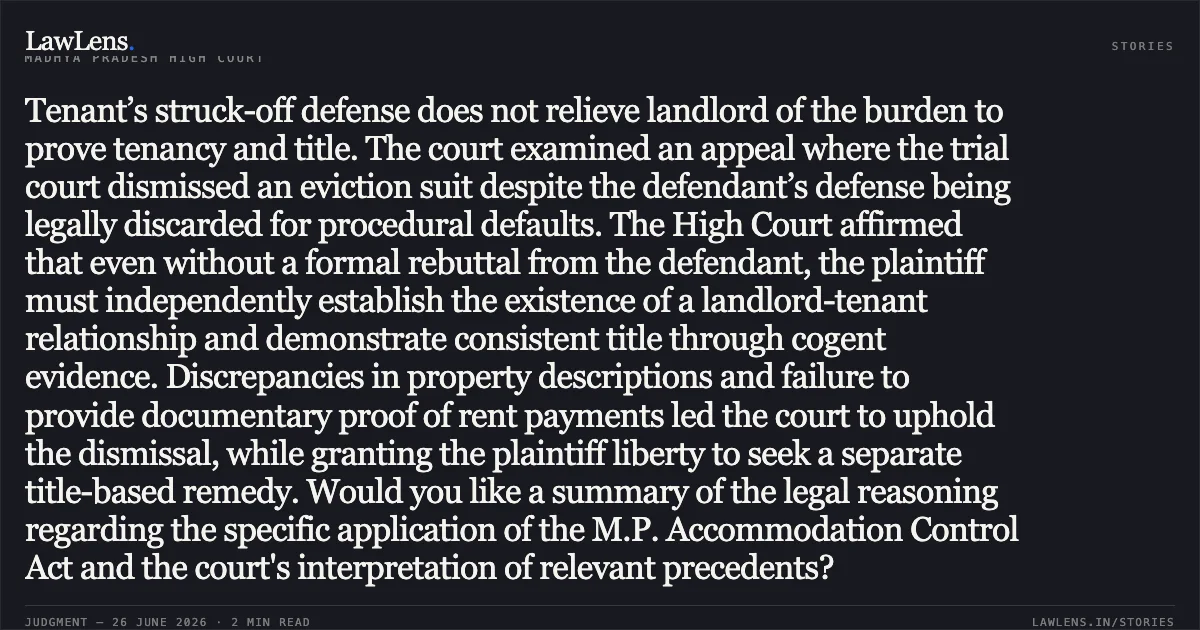
The High Court determined that striking the defense does not result in an automatic decree; the plaintiffs must still prove their version of facts.
Source reference: para. 14Upon reviewing the testimony, the court found significant inconsistencies regarding the creation of the tenancy, noting that the alleged witnesses did not provide specific or corroborative details.
Source reference: para. 15The court observed a total lack of documentary evidence for rent payments and found the five-year delay in seeking eviction after the alleged "bona fide need" arose to be suspicious.
Source reference: paras. 16-17The court identified a mismatch between the property boundaries described in the 1958 sale deed and those listed in the plaint.
Source reference: para. 20The court reasoned that because the identity of the house was in question and the tenancy remained unproven, the trial court’s dismissal was legally sound.
Source reference: paras. 22-24Holding
The High Court dismissed the appeal and upheld the trial court's judgment, holding that the plaintiffs failed to discharge their burden of proving a landlord-tenant relationship.
The High Court clarified that the defendant’s inability to lead evidence did not relieve the plaintiffs of the duty to provide cogent proof, while granting the plaintiffs liberty to file a separate suit specifically for recovery of possession based on title.
Source reference: paras. 14, 26Acts & Sections Cited
2 provisions across 1 statute referred to in this judgment. Each provision opens on LawLens.
Code of Civil Procedure, 19082
Original Court PDF
LaxminarayanvsGanesh Chandra Tiwari
Click to open original judgment
Original judgment, available to read, download and summarize on LawLens.in