Facts
The Plaintiff/Appellant filed a suit for possession, declaration, and permanent injunction regarding shop nos. 2 and 3 in property no. 9/196, Madangir, New Delhi.
Source reference: p. 3The property was originally allotted by the DDA to Sh. Khairati Lal, who inducted Defendant No. 1 (Jabbar Khan) as a tenant in 1991.
Source reference: p. 3, 13Following the death of Khairati Lal and his son Kishan Lal, the legal heirs (Defendants No. 2 and 3) executed a General Power of Attorney (GPA) and Agreement to Sell in favor of the Plaintiff in 2015.
Source reference: p. 2, 4Defendant No. 1 refused to vacate, claiming he had acquired ownership rights by paying "Pagri" and a lump sum of Rs. 2,20,000 to the heirs.
Source reference: p. 4, 15The Trial Court dismissed the suit, holding the Plaintiff failed to prove absolute ownership as he lacked a registered Sale Deed and the transferors lacked clear title from the DDA.
Source reference: p. 6, 7Issues
1. Whether the Plaintiff/Appellant established sufficient locus standi as Landlord/Owner to maintain the suit.
Source reference: p. 82. Whether the status of Defendant No. 1 remained that of a tenant or had converted to an owner.
Source reference: p. 133. Whether the suit was barred by Section 50 of the Delhi Rent Control (DRC) Act, 1958.
Source reference: p. 18Law Applied
The court applied Section 27 of the Limitation Act, 1963, regarding the extinguishment of property rights if not challenged within the limitation period.
Source reference: p. 10It relied on Suraj Lamps & Industries Pvt. Ltd. v. State of Haryana, which establishes that an Agreement to Sell/GPA does not confer absolute ownership but can protect possession or establish a landlord-tenant relationship.
Source reference: p. 12The court applied Section 116 of the Indian Evidence Act (estoppel of tenant).
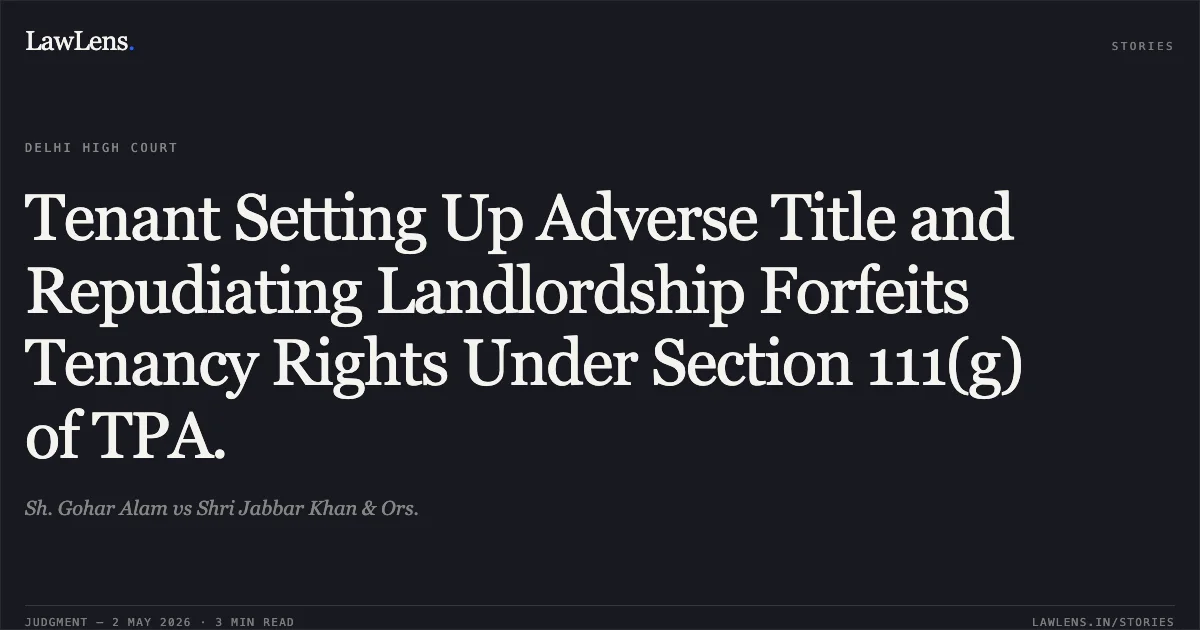
Source reference: p. 15The court applied Section 111(g) of the Transfer of Property Act, 1882, regarding the forfeiture of lease when a tenant renounces their character by setting up title in themselves.
Source reference: p. 18, 19Reasoning
The Court found that while the Plaintiff could not be "declared" an absolute owner without a Sale Deed under Suraj Lamps, the GPA executed by the admitted legal heirs of the original allottee (whose rights were preserved via Section 27 of the Limitation Act) validly authorized the Plaintiff to act as a landlord.
Source reference: p. 11, 12Regarding Defendant No. 1, the Court observed that "Pagri" payments do not confer ownership, and the Defendant had previously admitted his tenancy in judicial proceedings in 2009.
Source reference: p. 14, 15The Court reasoned that because Defendant No. 1 unequivocally renounced his status as a tenant by claiming independent ownership in his written statement, a "forfeiture" of the lease occurred under Section 111(g)(2) of the TPA.
Source reference: p. 22Consequently, the protection typically afforded to tenants under the DRC Act was lost, making the civil suit for possession maintainable.
Source reference: p. 22Holding
The Court held that (1) the Plaintiff, while not an absolute owner, proved a superior title as a landlord via the GPA; (2) Defendant No. 1's claim of ownership was legally unsubstantiated; and (3) Defendant No. 1 suffered forfeiture of tenancy rights by denying the landlord's title.
The High Court set aside the Trial Court's judgment and decreed the suit in favor of the Plaintiff. The Court ordered the Respondent to hand over possession and granted a permanent injunction against creating third-party interests.
Source reference: p. 22, 23Acts & Sections Cited
3 provisions across 2 statutes referred to in this judgment. Each provision opens on LawLens.
Code of Civil Procedure, 19082
Limitation Act, 19631
Original Court PDF
Sh. Gohar AlamvsShri Jabbar Khan & Ors.
Click to open original judgment
Original judgment, available to read, download and summarize on LawLens.in