Facts
The Appellants (plaintiffs) are tenants of three shops at Station Road, Raigarh, a tenancy originating in 1973 under the late Prakashwati Jagatramka
Source reference: para 2(i)Following the death of the original owners, multiple parties (Respondents/Defendants 1-5) asserted rival claims of ownership and landlordship, with several initiating separate eviction proceedings before the Rent Controller
Source reference: para 2(i)-(ii)Faced with conflicting demands for rent and eviction notices from different parties, the Appellants filed an interpleader suit in the Civil Court seeking a declaration of the lawful landlord and a permanent injunction against interference
Source reference: para 2(iii)Defendant No. 1 filed an application under Order 7 Rule 11 of the CPC, contending the suit was barred by law
Source reference: para 3Both the Trial Court and the First Appellate Court rejected the plaint, holding the suit maintainable neither under the CPC nor the Chhattisgarh Rent Control Act, 2011
Source reference: para 5Issues
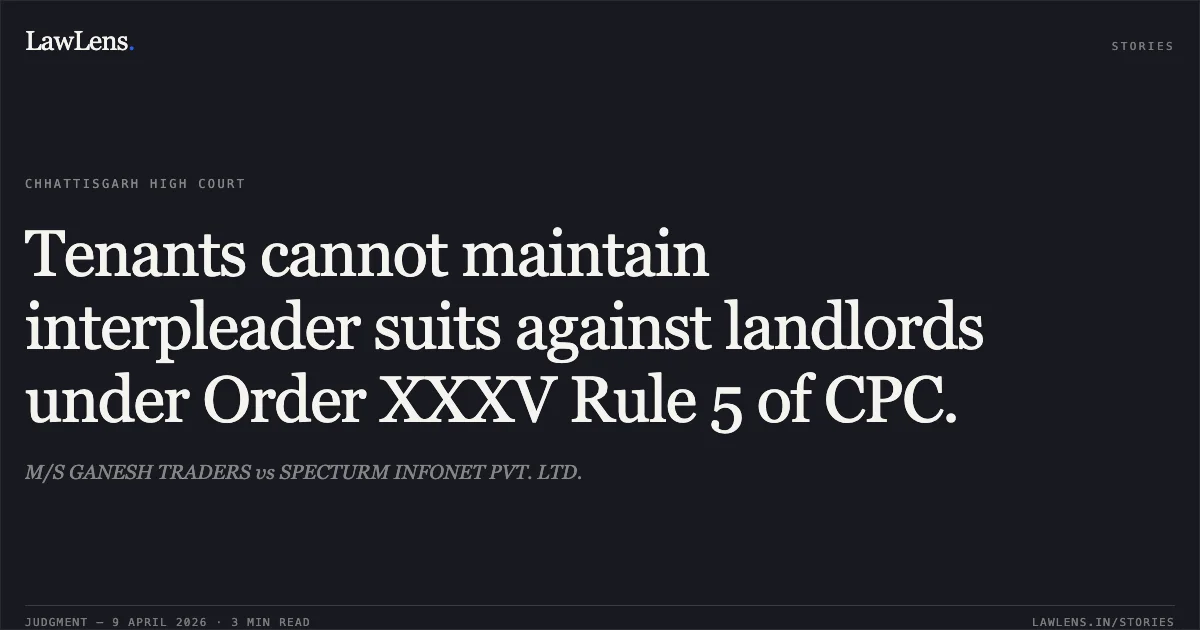
1. Whether a tenant is legally permitted to institute an interpleader suit against their landlord(s) under Order 35 Rule 5 of the CPC
Source reference: para 92. Whether the jurisdiction of the Civil Court to decide landlord-tenant title disputes is barred by Section 6 of the Chhattisgarh Rent Control Act, 2011
Source reference: para 10-113. Whether the concurrent findings of the lower courts give rise to any "substantial question of law" warranting interference under Section 100 of the CPC
Source reference: para 15-17Law Applied
The Court primarily applied Order 35 Rule 5 of the CPC, which expressly bars agents from suing their principals and tenants from suing their landlords for the purpose of compelling them to interplead
Source reference: para 9It further relied on Section 6(1) of the Chhattisgarh Rent Control Act, 2011, which mandates the constitution of a Rent Control Tribunal to adjudicate disputes regarding rent and tenancy issues, including the rights, title, and obligations of landlords and tenants
Source reference: para 10The Court adhered to the principles of Section 100 CPC and State of Rajasthan v. Shiv Dayal, holding that concurrent findings of fact cannot be disturbed in a second appeal unless they are perverse or recorded de hors the pleadings
Source reference: para 15, 19Reasoning
The Court observed that the Appellants failed to satisfy the mandatory procedural requirements for interpleader suits under Order 35 Rules 1 and 5 of the CPC
Source reference: para 8, 11Specifically, Rule 5 contains a statutory prohibition against tenants instituting such suits against their landlords
Source reference: para 9The Court further reasoned that the Chhattisgarh Rent Control Act, 2011, is a special statute intended to provide a comprehensive mechanism for adjudicating landlord-tenant disputes, including those involving title and rights, thereby ousting the jurisdiction of the Civil Court in such matters
Source reference: para 11-13The Court rejected the Appellants' argument that the title dispute fell under the "Explanation" to Section 6 (which reserves general title disputes for Civil Courts), noting that the core of the dispute was a landlord-tenant conflict specifically governed by the Act
Source reference: para 11, 13As the lower courts correctly applied these statutory bars, the High Court found no perversity or legal infirmity that would constitute a substantial question of law
Source reference: para 16-17Holding
The High Court dismissed the Second Appeal and upheld the judgments of the lower courts
It held that the interpleader suit was not maintainable due to the express bar under Order 35 Rule 5 of the CPC and the exclusive jurisdiction conferred upon the Rent Control Tribunal by Section 6 of the Chhattisgarh Rent Control Act, 2011
Source reference: para 11-12The Court granted the Appellants liberty to seek redressal before the appropriate legal forum
Source reference: para 23Acts & Sections Cited
10 provisions across 2 statutes referred to in this judgment. Each provision opens on LawLens.
Code of Civil Procedure, 19087
Chhattisgarh Rent Control Act, 20113
Original Court PDF
M/S GANESH TRADERSvsSPECTURM INFONET PVT. LTD.
Click to open original judgment
Original judgment, available to read, download and summarize on LawLens.in


