Facts
The Directorate of Education, Government of NCT of Delhi, issued six Sports Equipment Tenders (SETs) and one Outdoor Gym Equipment Tender for government schools, sports coaching centres and sports centres in Delhi NCR
Source reference: paras. 2, 4(a), p. 2The appellants challenged, under Article 226, several tender conditions, including past-performance and turnover requirements, non-availability of certain Micro and Small Enterprise (MSE) relaxations, mandatory earnest-money deposit, the requirement of a Delhi office and Delhi/NCR warehouse for the preceding three years under Clause 2.17, and compulsory physical submission of samples
Source reference: paras. 4(b)–(h), pp. 2–5The respondents defended the conditions as operationally necessary for prompt supply, installation, servicing, maintenance and verification of sports equipment intended for schoolchildren
Source reference: paras. 4(i)–(k), pp. 5–6The Delhi High Court dismissed the writ petition: it examined and upheld the challenge to the Outdoor Gym Tender on merits, but declined to examine the SET conditions because the challenge was delayed, the petitioners had not participated in those tenders, and the procurement process had substantially progressed
Source reference: paras. 5–8, pp. 6–9Before the Supreme Court, the appellants withdrew their challenge to the two tenders that had already been awarded and pursued the challenge only to the remaining five SETs
Source reference: paras. 10–13, p. 9By then, the remaining SETs had reached financial evaluation
Source reference: para. 22, pp. 14–15Issues
Whether the challenge to the conditions of the six Sports Equipment Tenders was maintainable when the appellants had not participated in those tenders and had approached the Court after substantial progression of the procurement process
Source reference: paras. 5(a), 7–8, pp. 6–9; paras. 19–26, pp. 12–16Whether the impugned tender conditions—including the Delhi office/warehouse requirement, past-performance and turnover criteria, MSE-related conditions and physical-sample submission requirements—were arbitrary, irrational, exclusionary or contrary to the applicable GeM procurement framework so as to warrant interference under Article 226
Source reference: para. 5(b), p. 6; paras. 11–12, pp. 9–10Whether the appellants’ challenge was liable to be rejected on the ground of delay and laches, having regard to the stage reached in the tender process and the public interest involved in procuring equipment for government-school students
Source reference: paras. 5(c)–(d), pp. 6–9; paras. 19–27, pp. 12–16Whether Vinishma Technologies Pvt. Ltd. v. State of Chhattisgarh & Anr., 2025 INSC 1182, rendered Clause 2.17 invalid or conclusively governed the present case
Source reference: paras. 28–34, pp. 16–19Law Applied
Judicial review of tender conditions under Article 226 is exercised with restraint, particularly because procurement involves specialised administrative and commercial assessment; courts should not rewrite tender terms unless they are demonstrably arbitrary, irrational, discriminatory or unrelated to the procurement objective
Source reference: paras. 5(b), 19, pp. 6, 12–13In public procurement, delay and laches are assessed not merely by counting calendar days but by examining the stage reached in the tender process, the rights or interests accrued to participating bidders, and the consequences for public interest
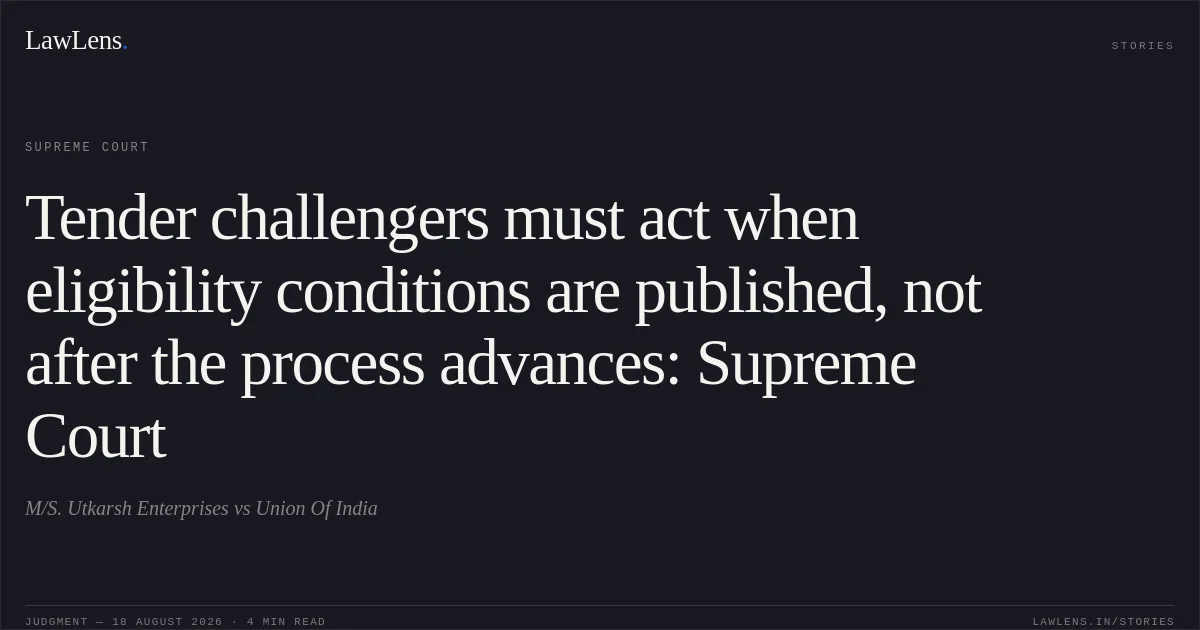
Source reference: paras. 19–20, pp. 12–13A challenge to an eligibility condition ordinarily arises when the condition is published; a bidder who considers itself excluded must challenge it with due expedition, and representations or legal notices do not ordinarily justify a belated approach where the bidder knew of its alleged ineligibility from the outset
Source reference: paras. 23–25, pp. 14–15The Court also considered Gaurav Enterprises v. GTB Hospital & Anr., which recognised that a delayed facial challenge to tender conditions, after substantial advancement of the process, may be refused on delay and laches alone
Source reference: para. 8, p. 8Vinishma Technologies held that a condition confining eligibility to prior supplies made to government agencies within a particular State was arbitrary and disproportionate where it created an artificial local barrier unrelated to competence or quality
Source reference: paras. 28–31, pp. 16–18However, its application depends on the wording, object and operational context of the impugned condition
Source reference: paras. 32–34, pp. 18–19Reasoning
The Supreme Court held that the appellants knew of the impugned eligibility requirements when the tenders were published, yet filed the writ petition approximately four months later, after one SET had been awarded and the remaining tenders had progressed through document verification and physical-sample evaluation to financial evaluation
Source reference: paras. 21–25, pp. 13–15The appellants’ non-participation in the SETs and their reliance on prior representations did not cure the lack of diligence
Source reference: paras. 23–26, pp. 14–16Interference at that stage would prejudice bidders who had complied with the conditions and undergone technical evaluation, while also delaying procurement of equipment intended for approximately 16 lakh schoolchildren and valued at about Rs. 34 crore
Source reference: para. 27, p. 16The Court therefore declined to undertake a merits-based adjudication of the SET conditions.
Source reference: no citationAlthough Vinishma invalidated a State-specific past-supply requirement, Clause 2.17 here required a functional office in Delhi and a warehouse in Delhi/NCR to facilitate prompt supply, installation, inspection, servicing, maintenance and replacement; it was characterised by the respondents as operational rather than as a requirement that the bidder be headquartered in Delhi
Source reference: paras. 32–34, pp. 18–19Consequently, Vinishma did not decisively govern the present clause, and the validity of Clause 2.17 was left open for consideration in an appropriate case
Source reference: paras. 34–35, pp. 19–20Holding
The Supreme Court dismissed both civil appeals and affirmed the Delhi High Court’s judgment
The challenge to the remaining five SETs was rejected on the ground of delay, laches, non-participation and the advanced stage of the procurement process; the Court did not finally determine the validity of Clause 2.17 or the allied tender conditions on merits
Source reference: para. 35, p. 20The challenge to the already-awarded Outdoor Gym Tender and one SET was not pursued before the Supreme Court
Source reference: para. 10, p. 9Pending applications were disposed of and there was no order as to costs.
Source reference: para. 37, p. 20Original Court PDF
M/S. Utkarsh EnterprisesvsUnion Of India
Click to open original judgment
Original judgment, available to read, download and summarize on LawLens.in