Facts
The Petitioner, a Joint Venture, participated in a tender process (NIT No. 15/2024-25) for piped water supply schemes under the "Har Ghar Nal Jal" project
Source reference: para. 3The Petitioner was declared technically qualified and emerged as the lowest (L-1) bidder
Source reference: para. 5Due to delays caused by the Model Code of Conduct, the Executive Engineer twice requested and obtained the Petitioner's consent to extend bid validity under Clause 15.2 of the Standard Bidding Document (SBD)
Source reference: paras. 4, 6, 12Despite these extensions being recommended by the Chief Engineer, the Petitioner received an e-mail on 02.12.2025 stating the tender was cancelled without assigned reasons, followed by a fresh re-tender notification (NIT No. 04/2025-26)
Source reference: paras. 2, 7Issues
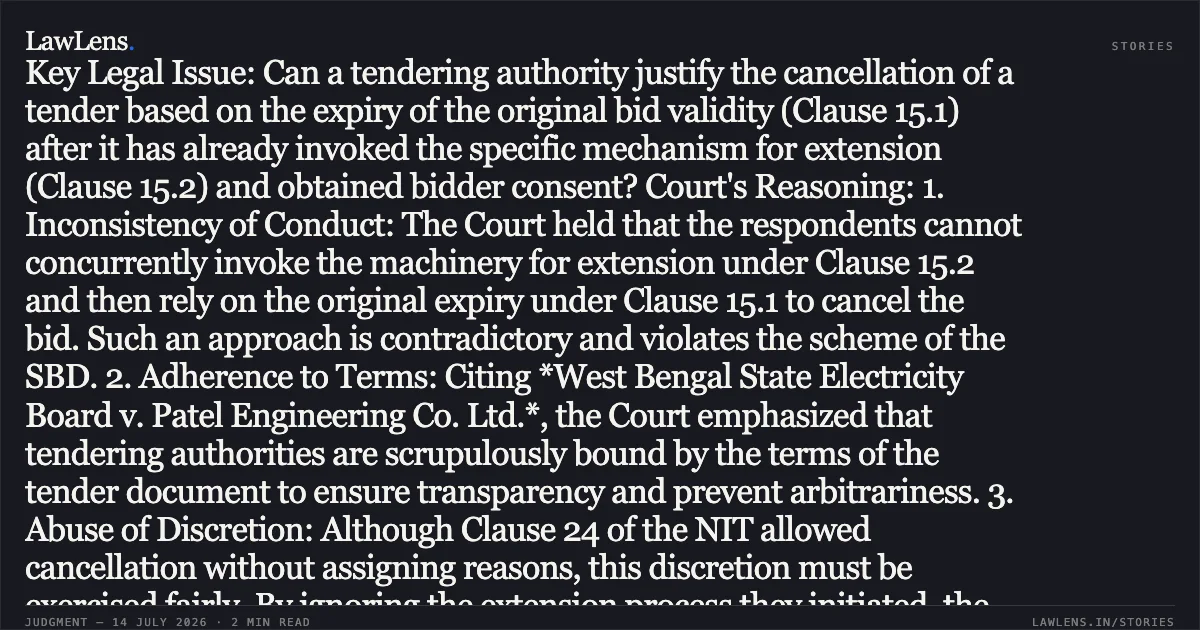
1. Whether, after having invoked the procedure under Clause 15.2 of the SBD and obtaining consent for extension, the respondents can justify cancellation based on the expiry of the original bid validity under Clause 15.1
Source reference: para. 16(i)2. Whether the decision to cancel Tender ID No. 89096 and issue a fresh tender is legally sustainable in the facts and circumstances of the case
Source reference: para. 16(ii)Law Applied
The Court primarily interpreted Clauses 15.1 (initial 180-day bid validity) and 15.2 (mechanism for extension via bidder consent) of the Standard Bidding Document
Source reference: para. 18-19The State and its agencies are bound to adhere strictly to the instructions in the tender document to maintain transparency and the rule of law, citing West Bengal State Electricity Board v. Patel Engineering Co. Ltd.
Source reference: para. 24The standard of judicial review in contractual matters permits interference if the decision-making process is arbitrary, irrational, or suffers from procedural impropriety, as established in Tata Cellular v. Union of India
Source reference: para. 28Reasoning
The Court found that while Clause 15.1 sets a default expiry, Clause 15.2 provides a specific remedial mechanism which the Respondents actively invoked
Source reference: paras. 19-20The Court reasoned that the Respondents cannot "blow hot and cold" by using Clause 15.2 to keep the bid alive and then later cite the expiry under Clause 15.1 to justify a cancellation
Source reference: para. 22, 25Although the Respondents claimed power under Clause 24 of the NIT to reject bids without reasons, the Court determined that such discretion must be exercised consistently with other tender conditions
Source reference: para. 29The failure of the Respondents to explain why the extension process (which they initiated) was not concluded rendered the subsequent cancellation arbitrary and procedurally inconsistent with the SBD
Source reference: para. 31-32Holding
The Court answered Issue (i) in the negative and Issue (ii) in favor of the Petitioner
The Court quashed the cancellation communication dated 02.12.2025 and the consequential Re-Tender (NIT No. 04/2025-26)
Source reference: para. 35The matter was remitted to the competent authority to take a fresh, reasoned decision on Tender ID No. 89096 in strict accordance with the SBD terms and the Court's observations
Source reference: para. 36The writ petition was allowed
Source reference: para. 37Acts & Sections Cited
3 provisions across 1 statute referred to in this judgment. Each provision opens on LawLens.
Commercial Documents Evidence Act, 19393
Original Court PDF
J and S Joint Venture (JV)vsThe State of Bihar
Click to open original judgment
Original judgment, available to read, download and summarize on LawLens.in


