Facts
The Petitioner, a registered partnership firm, challenged the Amravati Municipal Corporation's (Respondent No. 1) rejection of its technical bid for a road maintenance e-tender.
Source reference: para. 2The Petitioner’s bid was rejected because it allegedly failed to meet Clause 3(ज) of the tender, which required executing similar work valued at approximately ₹1 crore during the last three financial years.
Source reference: para. 8, 21Respondent No. 4 and 5 (son and father) were found responsive, and Respondent No. 4 was declared the lowest bidder.
Source reference: para. 5The Petitioner alleged that the rejection was arbitrary, that Clause 3(ज) allowed for cumulative calculation over three years rather than ₹1 crore in a single year, and that the participation of related Respondents 4 and 5 constituted cartelization.
Source reference: para. 7-8, 11Issues
1. Whether the Respondent Corporation’s interpretation of Clause 3(ज), requiring ₹1 crore work in a single financial year, was arbitrary or perverse.
Source reference: para. 31, 392. Whether the participation of related parties (father and son) as independent bidders amounted to illegal cartelization.
Source reference: para. 2, 473. Whether the Petitioner was denied a fair opportunity to cure technical deficiencies in violation of natural justice.
Source reference: para. 44-45Law Applied
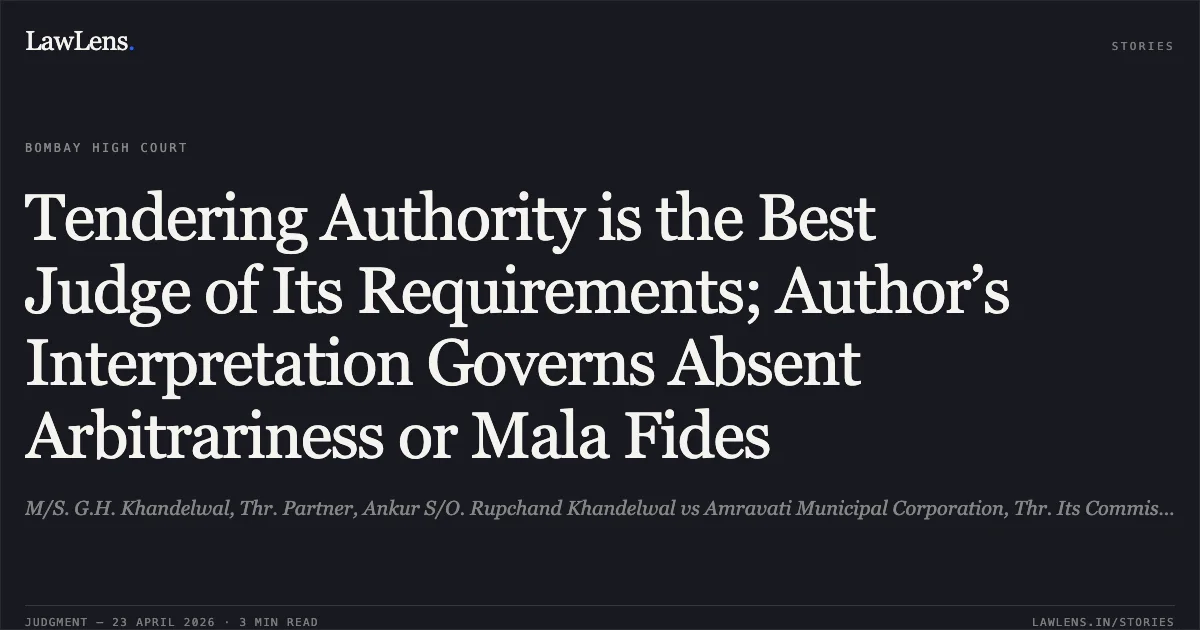
The court applied the principle that the author of a tender document is the best judge of its requirements and its interpretation should be deferred to unless it is proved to be arbitrary or mala fide (Afcons Infrastructure Ltd. v. Nagpur Metro Rail Corpn. Ltd.).
Source reference: para. 40It followed the Tata Cellular v. Union of India guidelines, emphasizing that judicial review is concerned with the decision-making process rather than the merits.
Source reference: para. 34Furthermore, it relied on Silppi Constructions Contractors v. Union of India and Michigan Rubber (India) Ltd. v. State of Karnataka, holding that State authorities have wide latitude in formulating and evaluating tender conditions to ensure technical capacity.
Source reference: para. 35-36On cartelization, the court maintained that mere suspicion or familial relationship is insufficient to prove collusion without evidence of bid-rigging or price manipulation.
Source reference: para. 47-50Reasoning
The Court observed that while Clause 3(ज) possessed some ambiguity regarding "cumulative" vs "single-year" value, the Corporation’s interpretation (requiring the threshold in a single year) was a "possible and reasoned" one intended to evaluate technical capacity.
Source reference: para. 41-43The Court noted that the Petitioner was granted an specific opportunity via communication dated 10.12.2025 to cure deficiencies, which it failed to do satisfactorily, thus no violation of natural justice occurred.
Source reference: para. 44-45Regarding cartelization, the Court found that Respondents 4 and 5 were independent registered contractors and that the tender did not prohibit related entities from bidding.
Source reference: para. 48In the absence of evidence showing an abuse of dominance or price fixing, the familial relationship did not vitiate the process.
Source reference: para. 49The Court concluded that the evaluation was a technical administrative function where the judiciary should exercise restraint.
Source reference: para. 53Holding
The Court dismissed the writ petition, holding that the rejection of the Petitioner’s bid was based on an objective assessment and did not suffer from perversity.
The Court clarified that the tendering authority’s interpretation of its own conditions is paramount and that allegations of cartelization must be supported by cogent material rather than conjecture.
Source reference: para. 49-50All interim reliefs were vacated, and the prayer to stay the operation of the judgment was rejected.
Source reference: para. 55Original Court PDF
M/S. G.H. Khandelwal, Thr. Partner, Ankur S/O. Rupchand KhandelwalvsAmravati Municipal Corporation, Thr. Its Commissioner, Amravati And Ors.
Click to open original judgment
Original judgment, available to read, download and summarize on LawLens.in