Facts
The Petitioner challenged a Notice Inviting Tender (NIT) dated 05.06.2026 issued by the Municipal Corporation of Delhi (MCD) for toll collection and the upgrade of the Radio Frequency Identification (RFID) system to a Multi-Lane Free Flow (MLFF) system
Source reference: p.1-2The Petitioner specifically challenged the technical eligibility criterion requiring experience of operating a minimum of 122 lanes under a single contract for at least two years
Source reference: para. 2, 8The Petitioner argued this was restrictive, as the Respondent had previously withdrawn similar conditions in 2025, calling them anti-competitive
Source reference: para. 5-6The Respondent contended the condition was necessary for the high-tech MLFF transition mandated by the Supreme Court in M.C. Mehta v. Union of India to be completed by October 2026
Source reference: para. 13.2-13.3Out of seven bidders, three (excluding the Petitioner) successfully met the impugned criteria
Source reference: para. 11Issues
1. Whether the technical eligibility criteria requiring experience of 122 lanes under a single contract is arbitrary, irrational, or violative of Articles 14 and 19(1)(g) of the Constitution
Source reference: para. 32. Whether the court should interfere with the administrative policy decisions of a tendering authority in the exercise of its power of judicial review
Source reference: para. 3, 21Law Applied
The Court applied the principle of judicial restraint in tender matters, noting that the award of contracts is a commercial function where the State is afforded "play in the joints"
Source reference: para. 16-17Relying on Tata Cellular v. Union of India, it held that judicial review is limited to the decision-making process rather than the merits
Source reference: para. 17Under Michigan Rubber (India) Ltd. v. State of Karnataka, the executive has the primary domain to fix eligibility criteria unless they are mala fide or arbitrary
Source reference: para. 18The Court utilized the "three-question test" from Jagdish Mandal v. State of Orissa to determine if the process was intended to favor someone, was irrational/arbitrary, or affected public interest
Source reference: para. 19stipulated criteria under Article 14 must ensure a level playing field but do not mandate the dilution of standards to accommodate specific bidders
Source reference: para. 20, 32Reasoning
The Court reasoned that the transition from conventional tolling to an integrated MLFF system involving ANPR and RFID integration across 244 lanes was a work of significant complexity, justifying higher experience standards
Source reference: para. 23It rejected the Petitioner's argument that experience across multiple smaller contracts is equivalent to a single large integrated contract, stating such commercial assessments belong to the tendering authority
Source reference: para. 24The Court found the Respondent’s reversal from its 2025 position (where it called the 122-lane rule restrictive) was justified by new circumstances, namely the technology-driven MLFF mandate and strict timelines imposed by the Supreme Court
Source reference: para. 27-28Regarding competitiveness, the Court observed that since three other bidders qualified and similar criteria exist in other states, the condition was not "tailor-made" to exclude competition
Source reference: para. 29The Petitioner's failure to qualify was attributed to its inability to meet criteria independently after the dissolution of its previous Joint Venture, rather than any inherent arbitrariness in the NIT
Source reference: para. 26Holding
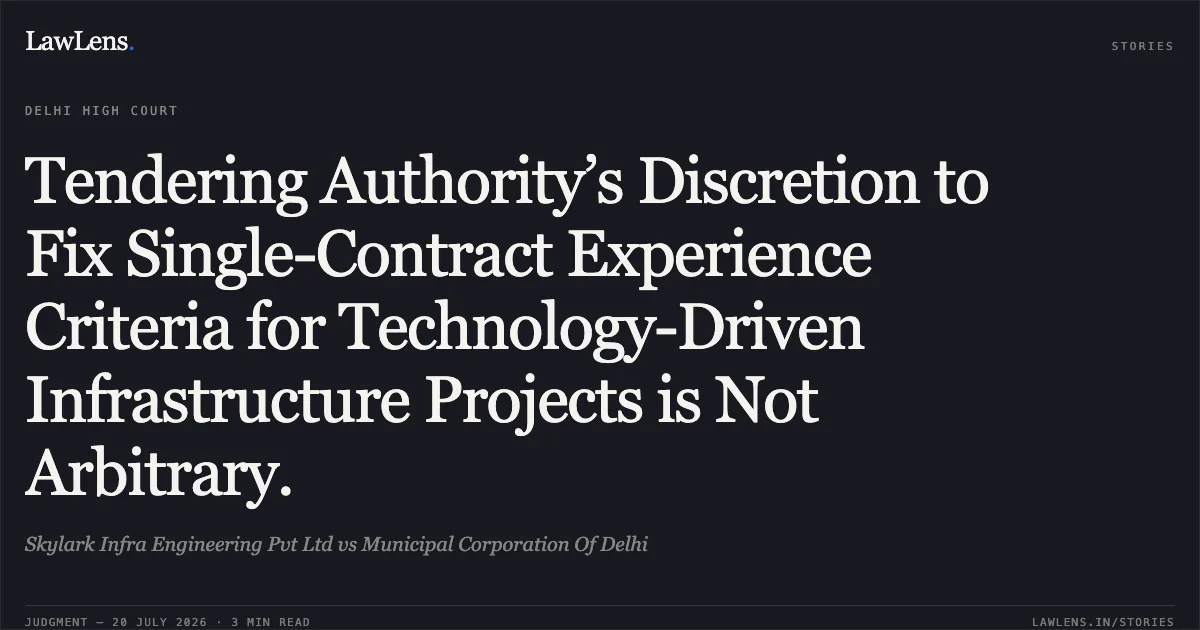
The Court answered the issues in the negative, holding that the impugned eligibility criteria had a rational nexus with the objective of ensuring timely and efficient implementation of the MLFF system
The Court found no violation of Article 14 or 19(1)(g), as the Petitioner’s financial strength cannot substitute for specific operational experience
Source reference: para. 30, 33The Writ Petition was dismissed, and all pending applications were closed
Source reference: para. 36Original Court PDF
Skylark Infra Engineering Pvt LtdvsMunicipal Corporation Of Delhi
Click to open original judgment
Original judgment, available to read, download and summarize on LawLens.in