Facts
The appellant joined the Indian Council of Agricultural Research (ICAR) in 1978 and was later appointed as Assistant Director General, Agricultural Research Information System (ADG-ARIS) on 15.01.1998 for a five-year term "or until further orders, whichever is earlier"
Source reference: p. 2During his tenure, he claimed whistleblower status regarding financial irregularities
Source reference: p. 2Subsequently, ICAR issued an order on 31.01.2001 curtailing his tenure and reverting him to his prior post of Senior Scientist based on "unsatisfactory" and "below average" Annual Assessment Reports (AARs) for 1998-2000
Source reference: p. 3, 9Although a separate departmental enquiry later exonerated him of specific misconduct charges, the Central Administrative Tribunal (CAT) and the Delhi High Court upheld the curtailment of his tenure
Source reference: p. 1-2, 4Issues
1. Whether the appellant was entitled to the protection of Article 311 of the Constitution of India against his reversion
Source reference: p. 4-52. Whether the appellant had an enforceable legal right to complete the full five-year tenure as ADG-ARIS
Source reference: p. 53. Whether the order of reversion based on AARs was punitive or cast a stigma on the appellant’s career
Source reference: p. 7-8Law Applied
The Court clarified that Article 311 does not apply to employees of ICAR, an autonomous society.
Source reference: p. 5Regarding judicial review of administrative discretion, the Court relied on Deputy General Manager v. Ajai Kumar Srivastava, which limits review to the decision-making process, not the merits.
Source reference: p. 6It applied the principle from Pavanendra Narayan Verma v. Sanjay Gandhi P.G.I. of Medical Sciences, holding that language regarding "unsatisfactory work" in a termination/reversion order does not constitute a legal stigma.
Source reference: p. 8It further followed State of U.P. v. Gobardhan Lal, establishing that transfers and reversions are incidents of service and allegations of mala fides must be supported by concrete evidence, not conjectures.
Source reference: p. 10Reasoning
The Court reasoned that the appellant's appointment letter explicitly reserved the right to curtail tenure via "further orders," meaning no absolute right to a five-year term existed.
Source reference: p. 5It found that Article 311 was inapplicable as ICAR is not a direct "civil post" under the Union.
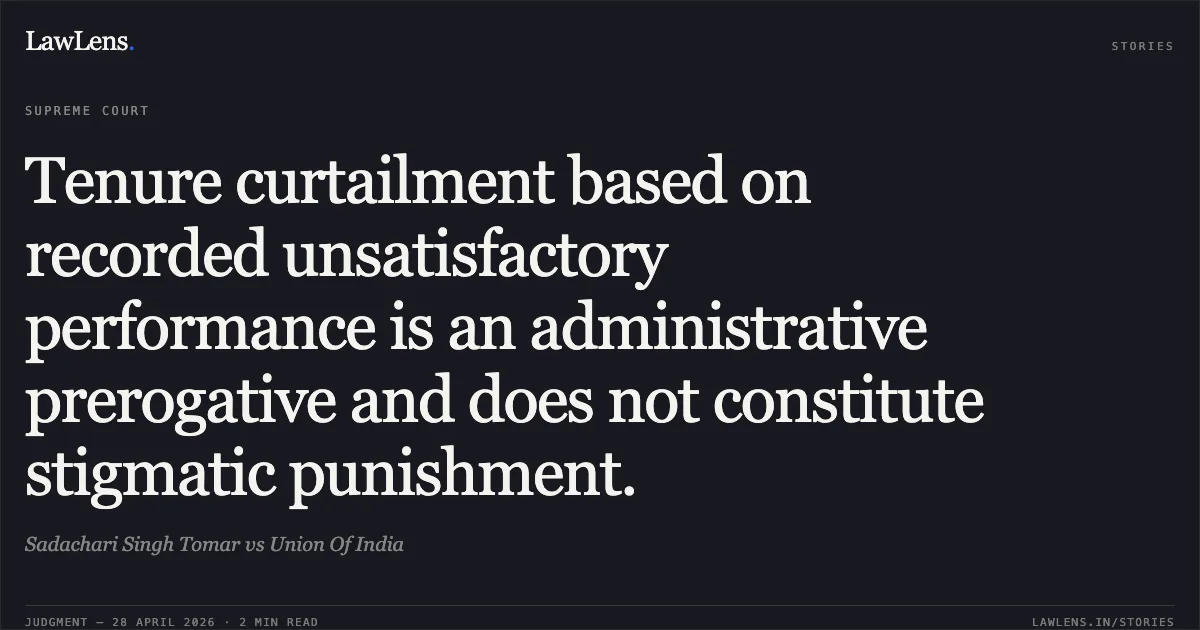
Source reference: p. 5On the issue of stigma, the Court determined that using AARs to judge suitability is a routine administrative exercise; describing performance as "below average" is not punitive but merely an assessment of unsuitability.
Source reference: p. 9The Court dismissed the whistleblower/retaliation claims, noting that the appellant failed to provide clear, cogent evidence of mala fides beyond the sequence of events.
Source reference: p. 10Finally, it held that the separate enquiry into misconduct did not prevent the authority from curtailing tenure based on overall performance assessment.
Source reference: p. 11Holding
The Court held that: (1) Article 311 is not attracted to ICAR employees; (2) There was no enforceable right to a fixed tenure given the conditional appointment order; and (3) The order of reversion was a non-stigmatic administrative action based on validly communicated AARs.
The Supreme Court dismissed the appeals and upheld the High Court’s judgment; as the appellant had already superannuated and received retiral benefits, no further relief was required.
Source reference: p. 11-12Original Court PDF
Sadachari Singh TomarvsUnion Of India
Click to open original judgment
Original judgment, available to read, download and summarize on LawLens.in


