Facts
The petitioner, who secured 132.77 marks in the Patwari recruitment examination conducted by Vyapam, was initially bypassed but later sent for training and appointed as a Patwari in District Morena following previous litigation
Source reference: para 4Within a month of his appointment on 19.08.2013, his services were terminated on 27.09.2013, an order subsequently quashed by the High Court in W.P. No. 7225/2013 with a direction for reinstatement
Source reference: para 4Instead of reinstating him, the respondents conducted a re-verification of his educational documents and issued the impugned order dated 30.03.2015, cancelling his selection and eligibility on the grounds that his DCA/PGDCA certificate from the University of Technology and Sciences (UTS), Raipur, was fabricated and the university lacked authorization
Source reference: para 4-5During the current proceedings, a communication from the University dated 08.04.2026 verified the certificate as genuine
Source reference: para 9Issues
1. Whether the termination of a regular government employee on allegations of submitting forged documents is valid without conducting a full-fledged departmental inquiry under the statutory rules
Source reference: para 12-132. Whether certificates issued by private universities in Chhattisgarh prior to the Supreme Court's cut-off date of 11.02.2005 remain valid for employment purposes
Source reference: para 11, 20Law Applied
Madhya Pradesh Civil Services (Classification, Control and Appeal) Rules, 1966, specifically Rule 3 and Rule 14, which mandate a regular departmental inquiry for government servants before passing punitive or stigmatic orders
Source reference: para 12, 14, 20Article 311(2) of the Constitution of India, which provides constitutional safeguards against arbitrary dismissal
Source reference: para 13, 16The court further applied the precedent from Prof. Yashpal Ors. v. State of Chhattisgarh Ors. (2005), establishing that degrees from invalidated private universities remained valid if obtained prior to 11.02.2005
Source reference: para 4, 11Punjab State Electricity Board v. Leela Singh (2007), which held that allegations of fraud in obtaining appointment must be proven in a formal inquiry
Source reference: para 17Reasoning
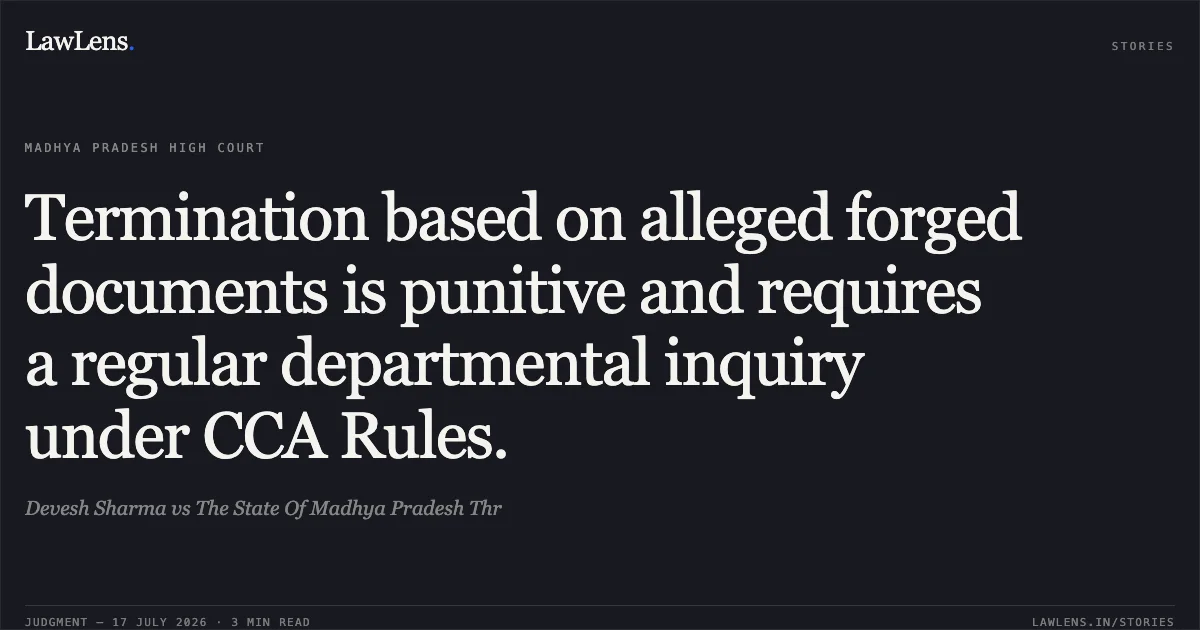
The court reasoned that since the petitioner was a regular appointee, any termination based on allegations of "forgery" or "fraud" is inherently stigmatic and punitive, requiring strict adherence to the 1966 CCA Rules
Source reference: para 13, 18-19The Collector’s administrative verification was deemed a "preliminary fact-finding exercise" that could justify initiating an inquiry but could not serve as a substitute for one
Source reference: para 20, 23Applying the Prof. Yashpal doctrine, the court noted the petitioner's certificate predated the 2005 cut-off and was confirmed genuine by the University's 2026 report, thereby negating the "fraud" motive
Source reference: para 11, 22The court found the case identical to Sandeep Sharma v. State of M.P. (2015), where the same respondent's actions were quashed for failing to hold a departmental inquiry
Source reference: para 21-22Consequently, the lack of a charge sheet, inquiry officer, or opportunity to rebut evidence rendered the termination a violation of natural justice and Article 311(2)
Source reference: para 23-24Holding
The court answered both issues in the negative, holding that an employer cannot summarily terminate an employee on disputed findings of forgery without a statutory inquiry
The court set aside the impugned order dated 30.03.2015. Since the petitioner was already working under an interim order, a specific reinstatement order was unnecessary, but the court directed the respondents to grant him all consequential benefits forthwith. The respondents were granted liberty to take fresh action only if the University/Society formally declares the certificate forged in the future
Source reference: para 25(i)-(iii)Acts & Sections Cited
4 provisions across 1 statute referred to in this judgment. Linked provisions open on LawLens.
Chhattisgarh Niji Kshetra Vishwavidhyalaya (Sthapana Aur Viniyaman) Adhiniyam, 20024
Original Court PDF
Devesh SharmavsThe State Of Madhya Pradesh Thr
Click to open original judgment
Original judgment, available to read, download and summarize on LawLens.in