Facts
The Petitioner, a Patwari in Garoth, District Mandsaur, was accused of demanding bribes from villagers in 2003
Source reference: para. 2Following a preliminary investigation, he was suspended and served a charge-sheet alleging absence from headquarters, negligence, and bribery
Source reference: para. 3A Departmental Enquiry was instituted after the Petitioner denied the charges
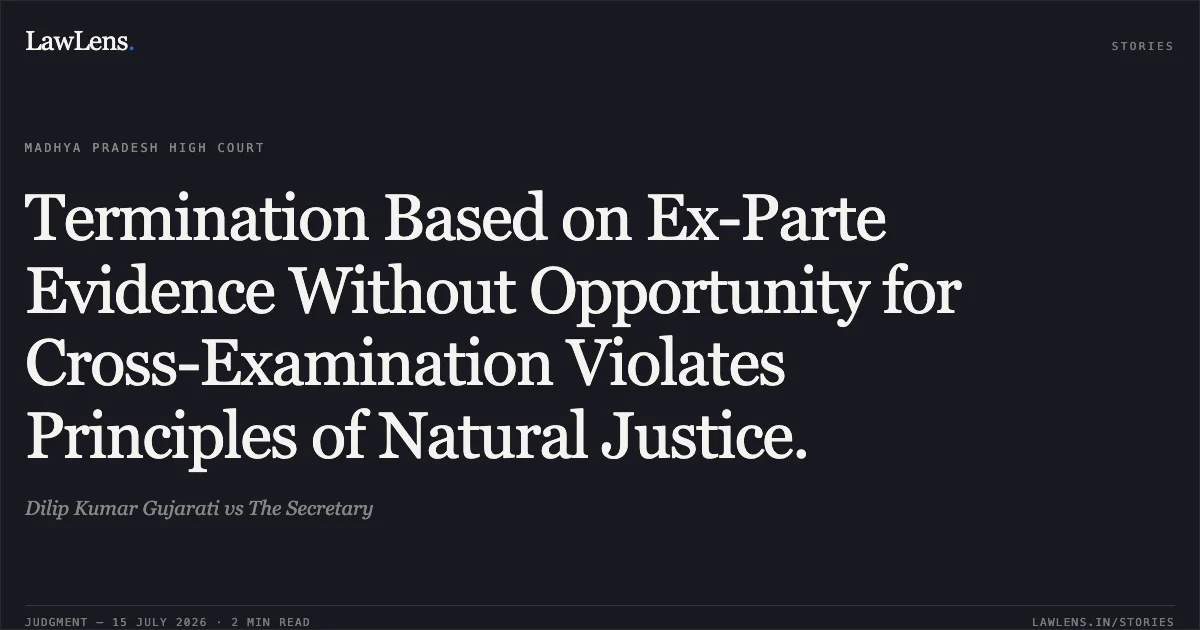
Source reference: para. 4During the enquiry, the Tehsildar recorded evidence from witnesses ex-parte
Source reference: para. 4Relying on this evidence, the Petitioner was terminated on 13.07.2004
Source reference: para. 4Subsequent appeals to the Collector and Revenue Commissioner were dismissed
Source reference: para. 5The Petitioner challenged these orders before the High Court, alleging a violation of natural justice due to the lack of opportunity to cross-examine witnesses and procedural lapses under the Departmental Inquiry Code
Source reference: para. 6Issues
1. Whether the termination order was legally sustainable given that the evidence of prosecution witnesses was recorded ex-parte, depriving the Petitioner of the right to cross-examine
Source reference: para. 9, 102. Whether the Court should exercise its power of judicial review under Article 226 to set aside the orders and remand the matter for fresh enquiry
Source reference: para. 8, 12Law Applied
The Court applied Article 226 of the Constitution of India, emphasizing that judicial review is limited to the decision-making process rather than the merits of the decision
Source reference: para. 8It relied on the fundamental principles of natural justice, specifically the right to cross-examination as a safeguard for delinquent employees to test witness veracity
Source reference: para. 10The Court also referenced procedural frameworks including Rule 23 and Rule 30 of the M.P. Civil Services (Classification, Control and Appeal) Rules, 1966, and Article 326 of the Departmental Inquiry Code regarding the conduct of disciplinary proceedings and notice requirements
Source reference: para. 5, 6Reasoning
The Court observed that the fundamental flaw in the disciplinary process was the recording of ex-parte evidence
Source reference: para. 9While the respondents contended that the Petitioner deliberately remained absent, the Court held that the extreme penalty of termination cannot be based on "entirely untested testimonies"
Source reference: para. 11The Court reasoned that cross-examination is the most potent mechanism to verify allegations, especially in cases of grave charges like bribery
Source reference: para. 10Because the disciplinary authority failed to ensure a specific and effective opportunity for cross-examination, the process suffered from a "fatal procedural flaw"
Source reference: para. 11The Court determined that while it cannot act as a court of appeal, it must intervene when the decision-making process is vitiated by such irregularities
Source reference: para. 8, 12Holding
The Court allowed the Writ Petition and quashed the termination order dated 13.07.2004 and the subsequent appellate orders
The Court held that the denial of cross-examination rendered the termination legally unsustainable
Source reference: para. 11The matter was remanded to the Disciplinary Authority to resume the enquiry from the stage of evidence, ensuring the Petitioner is granted an adequate opportunity to cross-examine witnesses
Source reference: para. 13(c)Reinstatement for the purpose of the enquiry was ordered, while backwages and consequential benefits were made contingent upon the final outcome of the remanded proceedings
Source reference: para. 13(d)Original Court PDF
Dilip Kumar GujarativsThe Secretary
Click to open original judgment
Original judgment, available to read, download and summarize on LawLens.in