Facts
The petitioner worked as a Workshop Assistant/Class-IV at UIT, RGPV, Shivpuri, on a contractual basis through a private outsourcing agency, Scientific Security Management Services Pvt. Ltd.
Source reference: pp. 2–3After his one-day leave request was rejected, the agency issued a warning alleging negligence and unauthorised absence, and terminated his engagement.
Source reference: pp. 2–3The petitioner alleged that he had applied for leave, that his reply was not considered, and that he was not given a proper opportunity to be heard.
Source reference: pp. 2–3He sought quashing of the termination order and reinstatement with consequential benefits.
Source reference: pp. 2–3The State opposed the petition on the ground that the agency was private and the dispute arose from a contractual relationship.
Source reference: pp. 2–3The Court considered maintainability under Article 226 and did not examine the merits of the termination.
Source reference: pp. 6–7Issues
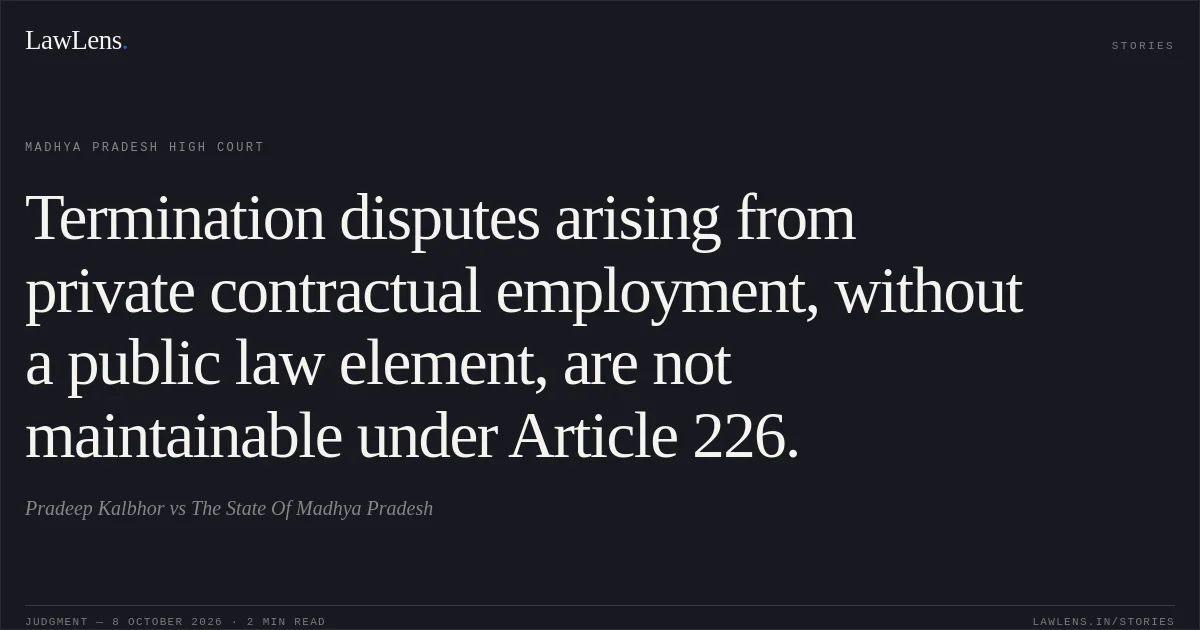
Whether a writ petition under Article 226 is maintainable to challenge termination by a private outsourcing agency where the petitioner has shown no statutory right or public-law element in the dispute
Source reference: pp. 3, 6–7Whether the petitioner’s allegations concerning the leave application, warning letter, and failure to consider his reply made the termination dispute amenable to writ review
Source reference: p. 6Law Applied
Article 226 permits writ review of a person or body discharging a public duty or function where the challenged action has a public-law element; it does not ordinarily permit enforcement of purely private contractual rights.
Source reference: pp. 4–6In St. Mary’s Education Society v. Rajendra Prasad Bhargava, (2023) 4 SCC 498, the Supreme Court held that an employee’s service dispute with a body performing public functions is not, without more, amenable to Article 226 where the employment terms are not governed by statutory provisions and the challenged action lacks a public-law element.
Source reference: pp. 4–5In Army Welfare Education Society v. Sunil Kumar Sharma, 2024 SCC OnLine SC 168, relying on Binny Ltd. v. V. Sadasivan, the Supreme Court reiterated that a writ may issue against a private body only where a public-law element is present, not to enforce a purely private contract.
Source reference: p. 6Reasoning
The petitioner was not appointed by RGPV or the State; he was engaged through a private outsourcing agency, and the challenged termination concerned that contractual engagement.
Source reference: p. 3He showed neither a statutory right against the agency nor material establishing that it was owned or controlled by the State or was an authority under Article 12.
Source reference: p. 6The fact that he was deployed at RGPV did not alter the agency’s private character.
Source reference: p. 6His complaints about the leave request, warning letter, reply, and termination related to the contractual employer–employee relationship and did not establish a public-law dispute.
Source reference: p. 6The Court therefore declined to assess whether the termination was procedurally or otherwise unlawful.
Source reference: pp. 6–7Holding
The Court held that the petition was not maintainable under Article 226 and dismissed it on that ground.
The petitioner remained free to pursue any other remedy available in law, and the Court expressly stated that it had expressed no opinion on the merits of his claim.
Source reference: p. 7Original Court PDF
Pradeep KalbhorvsThe State Of Madhya Pradesh
Click to open original judgment
Original judgment, available to read, download and summarize on LawLens.in