Facts
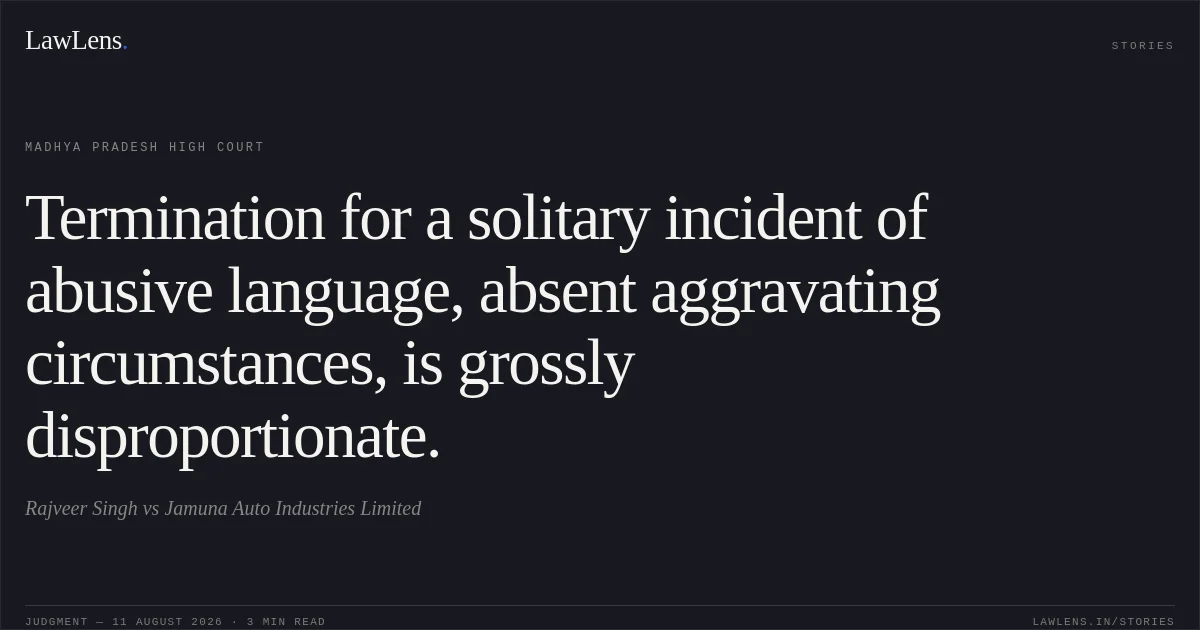
The petitioner, employed as a Blacksmith in the respondent’s assembly department since 1997, was involved in an incident dated 25.03.2015 in which he allegedly used filthy and abusive language against his supervisor and co-employees. He was suspended, charge-sheeted, subjected to a domestic enquiry, and ultimately terminated by order dated 02.12.2015.
Source reference: paras. 1–4The petitioner contended that the enquiry was illegally conducted ex parte after he was allegedly prevented from entering the factory premises on 17.10.2015. The Labour Court held the domestic enquiry to be legal and valid by order dated 29.09.2021 and, by Award dated 22.06.2022, upheld the termination. The petitioner challenged both orders under Article 227 of the Constitution.
Source reference: paras. 1–4, 9Issues
1. Whether the domestic enquiry was vitiated for violation of natural justice because the petitioner was proceeded against ex parte on 17.10.2015.
Source reference: paras. 10–122. Whether termination of the petitioner for a solitary incident of using filthy and abusive language was grossly disproportionate to the proved misconduct.
Source reference: paras. 13, 16–213. Whether the High Court, in exercise of supervisory jurisdiction under Article 227, should interfere with the Labour Court’s decision on the quantum of punishment.
Source reference: paras. 13, 16, 21–22Law Applied
The Court applied the principles of natural justice governing domestic enquiries and held, relying on Bondar Singh v. Nihal Singh, (2003) 4 SCC 161, that evidence cannot ordinarily be considered on a fact not pleaded.
Source reference: paras. 10–12On punishment, it applied the doctrine of proportionality, under which disciplinary punishment must be commensurate with the proved misconduct and may be judicially interfered with where it is outrageously disproportionate or shocks the conscience of the Court, as recognised in Collector Singh v. L.M.L. Limited, (2015) 2 SCC 410.
Source reference: para. 16The Court also relied on Rama Kant Misra v. State of Uttar Pradesh, AIR 1982 SC 1552, and Ved Prakash Gupta v. Delton Cable India (P) Ltd., AIR 1984 SC 914, which establish that a solitary instance of abusive language, absent aggravating circumstances or prior blameworthy conduct, does not ordinarily justify dismissal.
Source reference: paras. 18–19It further applied the contextual approach to precedent stated in Padma Sundara Rao v. State of Tamil Nadu, (2002) 3 SCC 533, and Bharat Petroleum Corpn. Ltd. v. N.R. Vairamani, (2004) 8 SCC 579.
Source reference: paras. 14–15Reasoning
The Court upheld the domestic enquiry because the petitioner and his defence representative knew of the date fixed for the enquiry, while the plea that the petitioner had been stopped at the factory gate was absent from both the statement of claim and his evidence and was raised for the first time in cross-examination.
Source reference: paras. 10–12Applying Bondar Singh, the Court treated that plea as an unsupported afterthought and held that the ex parte enquiry did not violate natural justice.
Source reference: paras. 10–12However, while examining proportionality, the Court found that the misconduct consisted only of one incident of abusive language, with no allegation or proof of physical assault, use of force, riotous conduct, damage to property, or prior misconduct.
Source reference: paras. 17–20The management and Labour Court had also failed to properly consider the petitioner’s past service record before imposing or affirming the extreme penalty of termination.
Source reference: paras. 17–20In light of Collector Singh, Rama Kant Misra and Ved Prakash Gupta, termination was held grossly disproportionate, although the misconduct itself remained proved.
Source reference: paras. 16, 18–21Holding
The petition was partly allowed.
The finding dated 29.09.2021 upholding the validity of the domestic enquiry was affirmed.
Source reference: paras. 21–24However, the Award dated 22.06.2022 was set aside to the extent that it upheld the petitioner’s termination.
Source reference: paras. 21–24The matter was remitted to Labour Court No. 2, Gwalior, for reconsideration of the quantum of punishment alone, after hearing both parties, with a direction to decide the matter preferably within six months from communication of the order.
Source reference: paras. 21–24Original Court PDF
Rajveer SinghvsJamuna Auto Industries Limited
Click to open original judgment
Original judgment, available to read, download and summarize on LawLens.in